
Sugar Free Pancake Syrup: 4 Bottles Compared

For a versatile sugar free pancake syrup, choose Maple Grove Farms Sugar Free Syrup: its maker suggests it for breakfast foods as well as marinades, dressings and smoothies. Choose Mrs. Butterworth’s Thick and Rich Sugar Free if you prefer a syrup described as thick and rich, or Log Cabin Sugar Free Syrup if the 10 calories per 2 tablespoons matters to your comparison.
Sugar free pancake syrup is a pourable topping made to add sweetness and maple-style flavor without the usual sugar claim; sweeteners and nutrition can vary by product.
We earn a commission if you buy through links on this page. As an Amazon Associate I earn from qualifying purchases. Products are compared on manufacturer specifications, not hands-on testing.
- Best overall: Maple Grove Farms Sugar Free Syrup – Its suggested uses extend from pancakes and waffles to marinades, dressings and smoothies.
- Best for thick texture: Mrs. Butterworth’s Thick and Rich Sugar Free – Its maker describes it as thick and rich.
- Best for calorie comparison: Log Cabin Sugar Free Syrup – It provides a 10 calories per 2 tablespoons and 0 grams of sugar.
| Product | Best for | Sugar claim | Shop |
|---|---|---|---|
| Maple Grove Farms Sugar Free Syrup | Versatile recipe use | Sugar free | Check Price on Amazon |
| Mrs. Butterworth’s Thick and Rich Sugar Free | Thick texture | Sugar free | Check Price on Amazon |
| Log Cabin Sugar Free Syrup | Calorie details | 0 g sugar; 0 g added sugar | Check Price on Amazon |
| Cary’s Sugar Free Low Calorie Syrup | Gluten-free claim | Sugar free | Check Price on Amazon |
Sugar Free Pancake Syrup Compared
These four 24-fluid-ounce bottles differ in their nutrition claims, packaging and suggested uses.
Maple Grove Farms Sugar Free Syrup
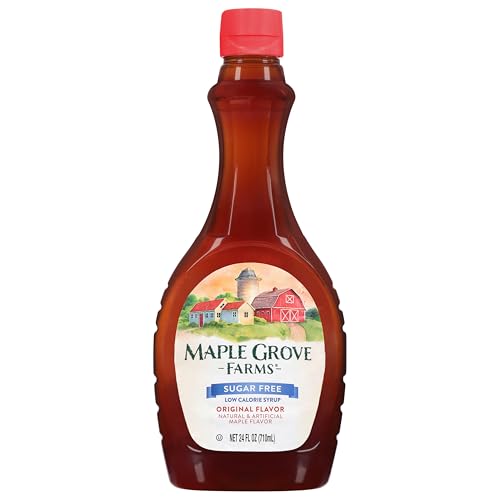
Maple Grove Farms stands out for suggested uses beyond breakfast: its maker recommends the syrup for marinades, dressings and smoothies as well as pancakes, waffles and French toast. The bottle holds 24 fluid ounces, and the flavor is described as inspired by the brand’s pure maple syrup. It is a fit for cooks who want one syrup for both topping and recipe use. The limitation is that the nutrition facts do not include a calorie figure, so shoppers comparing calories should check the nutrition label before choosing.
Bottom line: Pick this if you want a syrup suggested for both breakfast and recipes.
Mrs. Butterworth’s Thick and Rich Sugar Free

Mrs. Butterworth’s is the texture-focused option: its maker calls it thick and rich, with maple flavor for pancakes, waffles, French toast, oatmeal and other foods. The 24-fluid-ounce bottle also suits sweet or savory recipes. It is the natural choice for buyers who prioritize a hearty pour over broad claims about nutrition. The limitation is that no calorie or sugar-gram figure is included in the product facts, so anyone comparing those numbers should verify the package label rather than infer them from the sugar free wording.
Bottom line: Choose this when a thick, rich texture is your main preference.
Log Cabin Sugar Free Syrup

Log Cabin is the clearest choice for a numerical calorie comparison: its maker gives 10 calories per 2 tablespoons and says it has 90% fewer calories than the brand’s original syrup. The product facts also give 0 grams of sugar and 0 grams of added sugar. Its squeeze bottle is designed for easy topping, and the maker says it does not need refrigeration after opening. The tradeoff is that the broader calorie comparison is specifically against Log Cabin original syrup, not a comparison with the other options here.
Bottom line: Pick this if the serving calories and squeeze format matter most.
Cary’s Sugar Free Low Calorie Syrup

Cary’s distinguishes itself with a gluten-free certification claim and a low calorie positioning. The 24-fluid-ounce bottle is the same size as the other options, making the gluten-free claim its main point of difference for shoppers narrowing choices by that attribute. It is intended as a sugar free syrup, but the product facts give no serving calorie count or specific food-use suggestions. That makes it a less informative pick for anyone comparing nutrition numbers or looking for a syrup explicitly suggested for cooking and baking; check the package for those specifics.
Bottom line: Choose this if the gluten-free certification claim is your deciding factor.
How to Compare Sugar Free Pancake Syrup
Start with the nutrition panel, because “sugar free” does not tell you how many calories or which sweeteners a syrup contains. Under FDA rules, a sugar free claim generally means less than 0.5 gram of sugars per reference amount and labeled serving; read the current package to see the serving basis and full nutrient values. “No added sugar” is a separate claim and does not by itself mean a food contains no naturally occurring sugars. If a particular calorie limit matters, compare calories per the same serving amount, not just the front label. For a meaningful comparison here, use the 2-tablespoon serving where available and confirm serving sizes on all packages.
Texture and Bottle Style
Texture and dispensing can change how a syrup works at the table: one option is specifically described as thick and rich, while another comes in a squeeze bottle. A thicker syrup can cling differently to pancakes than a thinner pour, so texture preference is a practical deciding point rather than a nutrition claim. Squeeze bottles allow a controlled stream, but storage and cleaning instructions depend on the package. For a brunch table shared by several people, choose the dispensing style that is easiest to handle and wipe clean. Do not assume that all sugar free syrups use the same sweeteners or have the same viscosity; check the ingredient list if those attributes matter.
Using Syrup Beyond Pancakes
Some pancake syrups are also positioned for other foods, but use suggestions are not interchangeable with recipe performance. One option is suggested for marinades, dressings and smoothies; another is promoted for sweet or savory recipes. When adapting a recipe, begin with a small amount and taste before adding more, since sweetness and thickness vary. Syrup can add liquid as well as sweetness, so in baking it may affect texture; use a recipe that calls for syrup when possible rather than swapping it one-for-one into any recipe. For a topping-only use, the breakfast applications are the clearest guide, while broader use claims make a product more versatile on paper.
What Sugar Free Means on the Label
“Sugar free” is a regulated nutrient claim, not a promise that a food has no calories or tastes exactly like maple syrup. FDA labeling rules allow the claim when sugars are below 0.5 gram per reference amount and labeled serving, subject to the applicable labeling conditions. Sugar alcohols and nonnutritive sweeteners can appear in products marketed this way, but the product name alone does not identify which ingredients are used. Read the ingredient and nutrition panels if you avoid a particular sweetener or need a precise carbohydrate count. The separate “0 grams added sugar” wording describes added sugars, so it should not be used as a substitute for checking total sugars and serving size.
Frequently Asked Questions
Does sugar free pancake syrup have zero calories?
No; a sugar free claim does not mean calorie-free. Compare the calories per serving on the nutrition label, since sweeteners and other ingredients can contribute calories.
How much sugar can a sugar free syrup contain?
For FDA labeling, a sugar free claim generally allows less than 0.5 gram of sugars per reference amount and labeled serving. Check the package panel and serving size for the product’s exact values.
Is sugar free syrup the same as no added sugar syrup?
No. “Sugar free” and “no added sugar” are different nutrient claims, and no added sugar does not necessarily mean zero total sugars. Read both total sugars and added sugars on the nutrition panel.
Can sugar free pancake syrup be used in baking?
Some syrups are suggested for recipes, but their sweetness and thickness can differ from regular syrup. Use a recipe designed for syrup or start with a small substitution and adjust liquid carefully.
Should pancake syrup be refrigerated after opening?
Storage guidance varies by product, so follow the package instructions. One product here is described by its maker as not requiring refrigeration after opening; do not assume that applies to every syrup.