
Telescoping Pole for Starlink: 3 Options Compared

For most buyers, EEZ RV Products 10-ft Mini Pole is the straightforward choice if a 10-foot pole suits a Starlink Mini setup; its four sections retract to 42 inches. Choose Yescom EZ GO 30-ft Mini Mast if you need a taller Mini mast, or 10-ft Gen 3 Ladder-Rail Pole if your dish is Standard Gen 3 rather than Mini.
A telescoping pole raises a dish above an RV or other mounting point, but the right choice depends on dish compatibility, the height needed to clear obstructions, and a secure mount.
We earn a commission if you buy through links on this page. As an Amazon Associate I earn from qualifying purchases. Products are compared on manufacturer specifications, not hands-on testing.
- Best overall: EEZ RV Products 10-ft Mini Pole – The four-section aluminum pole extends beyond 10 feet and retracts to 42 inches for storage.
- Best for extra height: Yescom EZ GO 30-ft Mini Mast – The Mini mast adjusts from 6.4 to 30 feet.
- Best for Standard Gen 3: 10-ft Gen 3 Ladder-Rail Pole – The adapter is compatible with Standard Gen 3 and the pole adjusts from 3.5 to 10 feet.
| Product | Best for | Dish fit | Adjustable height | Mount fit | Shop |
|---|---|---|---|---|---|
| EEZ RV Products 10-ft Mini Pole | Mini RV setup | Starlink Mini | 10+ ft | Ladder mount sold separately | Check Price on Amazon |
| Yescom EZ GO 30-ft Mini Mast | Maximum reach | Starlink Mini | 6.4–30 ft | Rails 0.8–4 in | Check Price on Amazon |
| 10-ft Gen 3 Ladder-Rail Pole | Gen 3 ladder fit | Starlink Standard Gen 3 | 3.5–10 ft | Rails 0.7–1.1 in | Check Price on Amazon |
Telescoping poles for Starlink
Compare dish compatibility, working height, and mounting requirements before choosing a pole.
EEZ RV Products 10-ft Mini Pole

For a Starlink Mini setup, this four-section aluminum pole offers a compact 42-inch collapsed length, unlike the taller mast options. The pole extends to more than 10 feet and has a 2-inch bottom diameter. Its rotating locks let you raise or lower sections without ropes or pulleys, and the finish has a UV inhibitor. The limitation is mounting: the ladder mount is sold separately, so this is a better fit for someone who already has a compatible bracket or plans to choose a separate mounting option.
Bottom line: Choose this if you want a compact Mini pole and can supply the mount.
Yescom EZ GO 30-ft Mini Mast

For buyers who need more reach, this Mini mast adjusts from 6.4 to 30 feet, while the other poles here top out around 10 feet. Its quick flip-cam locks are designed for tool-free height adjustment, and the included rail-fit range is 0.8 to 4 inches. The mast weighs 17 pounds, so account for that when handling and securing it. The height range makes it less suitable when a short, easy-to-store pole is the priority; its compatibility is for Starlink Mini, not Standard Gen 3.
Bottom line: Pick this when a Mini dish needs a much taller mast and the rail fits.
10-ft Gen 3 Ladder-Rail Pole
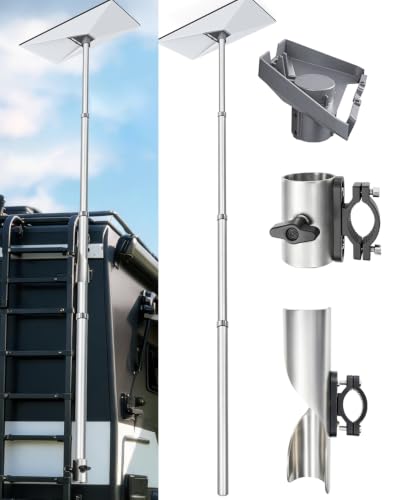
For Standard Gen 3 rather than Mini, this pole pairs a compatible aluminum adapter with an adjustable 3.5-to-10-foot flagpole. Its ladder-rail fit is narrower than the wider range on the taller Mini mast: 0.7 to 1.1 inches. The bracket is 304 stainless steel, while the pole and adapter are aluminum. That specific dish and rail fit are the deciding factors; buyers with a Mini dish or rails outside that range should choose another setup.
Bottom line: Choose this for a Standard Gen 3 dish and a 0.7-to-1.1-inch ladder-rail.
How to choose a telescoping pole for Starlink
Start with dish compatibility, then choose the shortest pole that clears obstructions. The options here split between Starlink Mini and Standard Gen 3; adapter fit is not interchangeable just because both poles telescope. Height also differs substantially: two poles reach about 10 feet, while the taller Mini mast adjusts up to 30 feet. A taller mast can help clear a roofline or nearby trees, but it also needs a secure mounting point and careful handling. Compare your rail diameter with the range before choosing a ladder bracket. If your rail measures outside the pole’s fit range, do not assume tightening the bracket will make it secure.
| Need | Choose |
|---|---|
| Starlink Mini, compact pole | 10-foot pole that collapses to 42 inches |
| Starlink Mini, more height | Adjustable mast up to 30 feet |
| Standard Gen 3, narrow ladder-rail | 10-foot pole for 0.7–1.1-inch rails |
Dish and ladder-rail compatibility
Match the adapter to the exact dish family and the bracket to the rail diameter. The Mini poles here are intended for Mini, while the 10-foot ladder pole is for Standard Gen 3; neither fact establishes compatibility with other Starlink dishes. Measure the outside diameter of a round ladder-rail, rather than estimating from a photo or measuring its circumference. The rail ranges are 0.8–4 inches for the taller Mini mast and 0.7–1.1 inches for the Gen 3 pole. Before ordering, confirm your dish model and rail shape, since a diameter range alone does not guarantee that an unusual rail profile will clamp securely.
Height, obstructions, and stability
A clear view of the sky matters more than adding height for its own sake. Roof edges, tree canopies, and other obstructions can interrupt a satellite connection, so use the Starlink app’s obstruction view at the intended dish position before deciding how high the mast must go. If a 10-foot pole clears the obstructions shown there, a taller mast may add setup complexity without solving a remaining blockage. Taller poles increase leverage on their mounting point, so use a secure, compatible mount and avoid extending a mast beyond what that mount can safely support. Keep people clear of the setup while raising or lowering sections.
Setting up and storing a telescoping pole
Set up the mount on a stable, parked vehicle and check that every locking section is engaged before attaching or positioning the dish. The EEZ pole uses rotating locks, while the Yescom mast uses flip-cam locks; work through sections in order and make sure each is seated before raising the next. Retract sections before transport, and do not use a vehicle-mounted setup while driving unless the product explicitly supports that use. Aluminum poles can be light enough to handle yet still catch wind when extended, so lower or stow the mast when conditions make the setup unstable. Inspect clamps, locks, and fasteners before each use.
Frequently Asked Questions
How tall should a Starlink pole be?
Use the shortest pole that gives the dish a clear sky view; a 10-foot option may be enough if nearby rooflines and trees are below the dish. Check the Starlink app’s obstruction view at the planned position before choosing a taller mast.
Can a Starlink Mini use a Gen 3 pole adapter?
Do not assume so: the pole adapter must match the dish family. The 10-foot Gen 3 pole here is identified for Standard Gen 3, while the other two poles are identified for Mini.
How do I measure an RV ladder-rail for a pole?
Measure the outside diameter of the round rail with a ruler or caliper, then compare it with the bracket’s fit range. The rail ranges here are 0.7–1.1 inches or 0.8–4 inches, depending on the pole.
Should I leave a telescoping Starlink pole raised in wind?
Lower or stow a raised pole when wind makes the vehicle or mount unstable. An extended mast puts leverage on its mount, and the safe wind limit depends on the complete mounting setup.
Can I travel with a ladder-mounted Starlink pole raised?
No; retract and secure a ladder-mounted pole before driving. A raised mast can catch wind or strike overhead obstacles, and the pole options here are not identified as driving mounts.