
Toothpaste With Hydrogen Peroxide: 4 Options Compared

For the highest labeled peroxide concentration in this group, choose Colgate Optic White Pro Series 5%, with 5% hydrogen peroxide; choose another formula if you prefer a lower concentration or baking soda alongside peroxide. Whitening toothpaste uses abrasives, chemical ingredients or both to help remove stains while brushing.
Peroxide concentration is only one factor: compare tube size, fluoride and your tolerance for sensitivity before choosing.
We earn a commission if you buy through links on this page. As an Amazon Associate I earn from qualifying purchases. Products are compared on manufacturer specifications, not hands-on testing.
- Best overall: Colgate Optic White Pro Series 5% – Its 5% hydrogen peroxide concentration is the highest among the products with a percentage.
- Best for fluoride: Crest 3D White Brilliance Pro 4% – The 4% hydrogen peroxide formula also identifies anticavity fluoride protection.
- Best for baking soda: Crest Cavity & Tartar Protection Baking Soda – Its formula combines baking soda and peroxide, with anticavity fluoride.
| Product | Best for | Hydrogen peroxide | Tube size and count | Shop |
|---|---|---|---|---|
| Colgate Optic White Pro Series 5% | Higher concentration | 5% | 3.0 oz, 3 tubes | Check Price on Amazon |
| Crest 3D White Brilliance Pro 4% | Fluoride formula | 4% | 3.8 oz, 2 tubes | Check Price on Amazon |
| Colgate Optic White Advanced 2% | Lower concentration | 2% | 3.2 oz, 3 tubes | Check Price on Amazon |
| Crest Cavity & Tartar Protection Baking Soda | Baking soda formula | — | 5.7 oz, 2 tubes | Check Price on Amazon |
Toothpaste With Hydrogen Peroxide
Compare peroxide concentration, tube size and formula to find a toothpaste that fits your brushing priorities.
Colgate Optic White Pro Series 5%

For shoppers comparing labeled peroxide strengths, Colgate Optic White Pro Series 5% has the highest concentration here: 5% hydrogen peroxide. The pack contains three 3.0-ounce tubes and uses an ActivShine formula in Brilliant Mint flavor. Colgate says its formula targets surface and deep-set stains, but the product’s advertised whitening results are brand claims, not a guarantee for every user.
Bottom line: Choose this if a 5% peroxide concentration is your priority.
Crest 3D White Brilliance Pro 4%

Unlike the 5% option, Crest 3D White Brilliance Pro 4% pairs 4% hydrogen peroxide with an anticavity fluoride formula. The pack has two 3.8-ounce tubes, and Crest describes the toothpaste as using a 3X whitening ingredient system. That combination suits buyers who want peroxide whitening alongside the fluoride benefit. Its peroxide concentration is below the highest option in this group, so it may not suit a shopper whose main selection rule is choosing the largest percentage.
Bottom line: Pick this for a 4% peroxide formula that also identifies anticavity fluoride.
Colgate Optic White Advanced 2%
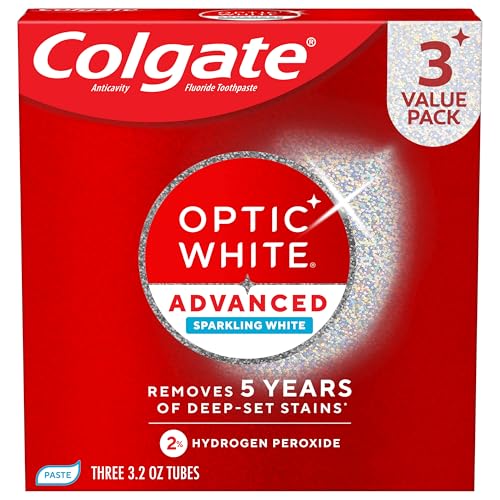
At 2% hydrogen peroxide, Colgate Optic White Advanced 2% has a lower stated concentration than the other percentage-labeled choices. The three 3.2-ounce tubes are the largest individual tubes among those three. Colgate says the formula is enamel safe for daily use and starts whitening after the first brush; those are brand claims, and individual results can differ. This can suit someone looking for a lower labeled peroxide percentage and a multi-tube pack. Buyers focused on a stronger stated concentration should compare it with the 4% and 5% formulas instead.
Bottom line: Choose this if you prefer the lowest peroxide percentage in this group.
Crest Cavity & Tartar Protection Baking Soda

Rather than identifying a peroxide percentage, Crest Cavity & Tartar Protection Baking Soda distinguishes itself by combining baking soda and peroxide with an anticavity fluoride formula. The two tubes are 5.7 ounces each, making this the largest tube size in the group. Crest describes the formula as helping with cavity and tartar protection and producing a deep-clean feeling; those performance statements are brand claims. This option suits buyers who specifically want baking soda and fluoride with peroxide. The missing concentration means it is not the right pick if comparing peroxide strength is essential.
Bottom line: Pick this for the baking soda, peroxide and fluoride combination, not a specific peroxide strength.
How to choose peroxide toothpaste
Start with the peroxide percentage if comparing whitening formulas, then weigh fluoride and tube size. These options with concentrations range from 2% to 5%, while another peroxide formula gives no percentage. A higher percentage is not a promise of a particular shade change: stain type, brushing habits and sensitivity all matter. Whitening toothpastes generally work through polishing abrasives, peroxide chemistry or a combination. For a fluoride priority, select a formula that explicitly identifies fluoride; a whitening claim alone does not establish that feature. If you have a history of tooth sensitivity, start with a lower-concentration option and stop using it if irritation develops.
What peroxide percentages tell you
A toothpaste percentage gives one comparison point, not the complete whitening picture. In this group, 2%, 4% and 5% are the concentrations, while the baking soda formula does not provide a percentage. Peroxide can help address stains, but toothpaste is brushed on briefly and should not be treated as equivalent to a dentist-supervised whitening treatment. Abrasives also help scrub surface stains; their effect depends on the formula and brushing technique. Use the measurable rule of choosing by percentage only when strength is your primary criterion; if fluoride or flavor is more important, choose based on that instead. Brand whitening claims should not be read as a guaranteed result.
Using whitening toothpaste safely
Brush twice daily for about two minutes with a pea-sized amount of toothpaste, and spit rather than swallowing it. Fluoride toothpaste helps protect against cavities; children who may swallow toothpaste need adult supervision and an age-appropriate amount. Whitening products can cause temporary tooth sensitivity or gum irritation, so stop using a formula that causes persistent discomfort and ask a dental professional for guidance. Do not apply toothpaste as a concentrated peroxide treatment or leave it on teeth beyond normal brushing. If you have dental work, exposed roots or ongoing sensitivity, ask a dentist whether a whitening formula is appropriate before making it part of your routine.
Peroxide toothpaste versus whitening strips
Whitening toothpaste is used during ordinary brushing, while whitening strips hold a bleaching product against teeth for a set period. Toothpaste can help with surface stains through brushing and may include peroxide; strips are designed for longer contact and may produce a more noticeable change. Contact time and product concentration vary, so the formats are not interchangeable. A practical decision rule is to choose toothpaste when you want a regular brushing product, and discuss strips or professional treatment with a dentist if you want a more substantial change or have sensitivity. Never use multiple whitening products more often than their directions allow, since overuse can irritate gums or teeth.
Frequently Asked Questions
Can peroxide toothpaste make teeth sensitive?
Yes, whitening toothpaste can trigger temporary tooth sensitivity or gum irritation in some people. If discomfort persists or worsens, stop using the formula and consult a dental professional.
How often should I use whitening toothpaste?
Most toothpaste is intended for twice-daily brushing, typically for two minutes each time. Follow the product directions and stop if irritation develops.
Does a higher peroxide percentage whiten teeth faster?
A higher labeled percentage does not guarantee faster or greater whitening for every person. Stain type, contact time and sensitivity also affect the result.
Can children use peroxide whitening toothpaste?
Children should use a toothpaste suited to their age and should not swallow it. Ask a dentist before using a whitening formula for a child, especially if the child may swallow toothpaste.
Is peroxide toothpaste the same as whitening strips?
No; toothpaste is brushed on briefly, while strips keep a bleaching product against teeth for a longer set period. Contact time and formula strength differ, so use each only as directed.