
Top 5 HD Antenna for Rural Areas: Signal and Fit

Five Star Motorized 360° Outdoor Antenna suits most rural households here because its motorized 360-degree rotation lets you aim toward different broadcast towers, and it claims support for five TVs. Choose another model if you need a simpler fixed antenna or a specific included mounting kit.
Outdoor HD antennas receive free over-the-air broadcasts, but a claimed 200-mile range is not a reliable reception guarantee: terrain, tower direction, antenna height, and obstructions all matter.
We earn a commission if you buy through links on this page. As an Amazon Associate I earn from qualifying purchases. Products are compared on manufacturer specifications, not hands-on testing.
- Best overall: Five Star Motorized 360° Outdoor Antenna – Motorized 360-degree rotation can help aim toward towers in different directions, and it supports up to five TVs.
- Best for included cabling: Five Star Motorized Outdoor Antenna + Kit – Its package includes 40 feet of RG6 coaxial cable, a splitter, and a power supply.
- Best for multiple TVs: Five Star Multi-Directional Outdoor Antenna – The antenna supports up to four TVs when used with a splitter.
| Product | Best for | Design | TV support | Shop |
|---|---|---|---|---|
| Five Star Motorized 360° Outdoor Antenna | Directional aiming | Motorized, 360° rotation | Up to 5 TVs | Check Price on Amazon |
| Five Star Motorized Outdoor Antenna + Kit | Included cabling | Motorized, 360° rotation | — | Check Price on Amazon |
| Five Star Multi-Directional Outdoor Antenna | Four-TV homes | Multi-directional | Up to 4 TVs | Check Price on Amazon |
| Five Star Yagi Outdoor Antenna | Single direction | Yagi, directional | — | Check Price on Amazon |
HD Antennas for Rural Areas
Compare each antenna’s aiming method, TV support, and included setup components before choosing a location.
Five Star Motorized 360° Outdoor Antenna

Motorized rotation is the distinguishing feature of this outdoor antenna, making it a fit when useful towers lie in different directions. Five Star says the antenna has a range of up to 200 miles and supports 4K and 1080p reception; actual reception depends on terrain, tower distance, and obstructions. Its snap-and-fold assembly is described as tool-free, and a built-in bubble level helps level the mount. The specifications gives a five-TV capacity, but it does not identify included cable or a mounting pole, so households planning a multi-TV run should verify the parts needed for that wiring.
Bottom line: Pick this if you need remote directional adjustment and plan to connect several TVs.
Five Star Motorized Outdoor Antenna + Kit
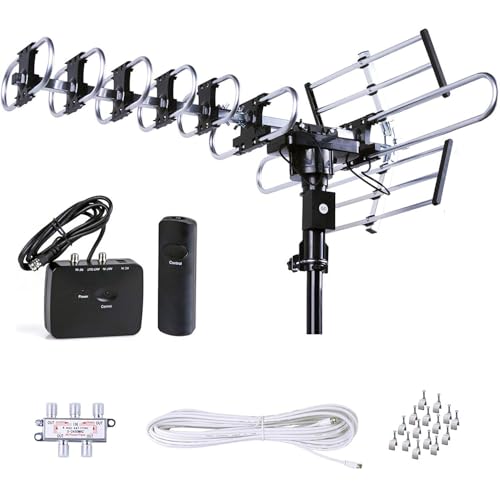
The included installation components distinguish this rotating outdoor antenna: the package lists 40 feet of RG6 coaxial cable, a splitter, a control box, a remote, and a power supply. Five Star gives an adjustable gain range of 15–35 dB and says its low-noise amplifier includes an LTE filter for 4G interference. Its operating frequency is 45–860 MHz. A mounting pole is explicitly excluded, so this option suits a buyer who wants cable and control components in the package but already has, or will source, a suitable pole. The 200-mile reach is not a dependable prediction for a specific rural location.
Bottom line: Choose this when the included 40-foot cable and splitter match your installation plan.
Five Star Multi-Directional Outdoor Antenna

Multi-directional reception and stated support for four TVs set this outdoor model apart from the rotating options. Five Star says it receives VHF and UHF signals and supports 4K, 1080p, and ATSC 3.0-ready reception; a splitter is required for multiple televisions. The product includes an installation kit and J-mount, and the dimensions are 27 inches long, 16.5 inches wide, and 10.5 inches high. That mounting hardware may suit a roof or attic installation, but attic placement can lose signal through roofing materials or foil-backed insulation, so test the intended location before committing to a permanent mount.
Bottom line: Pick this for a multi-directional setup where the included J-mount is useful.
Five Star Yagi Outdoor Antenna
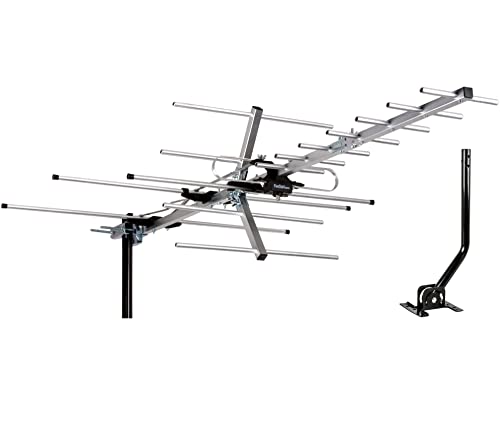
The Yagi design is the key distinction: it is directional rather than motorized, so it is most appropriate when the desired broadcast towers are grouped in one direction. Five Star says this antenna receives VHF and UHF and claims up to 200 miles, with reception dependent on distance and obstructions. The package name includes a J-pole, and the product is described for attic or roof mounting; dimensions are 17 inches long, 8 inches wide, and 6 inches high. A directional antenna needs careful alignment, so this choice is less convenient if stations of interest are spread across several directions.
Bottom line: Choose this when the towers you want are clustered in one direction.
How to choose an HD antenna for rural areas
Choose by tower direction, terrain, and mounting height before comparing advertised range. A directional Yagi can focus toward a cluster of stations, while a rotating antenna lets you change aim; a multi-directional design can avoid manual repositioning when towers are spread out. UHF and VHF broadcasts use different frequency bands, so check which bands local stations use rather than assuming one band is enough. The FCC reception map can help identify station locations, but real reception also depends on hills, trees, buildings, and the antenna’s height. As a practical rule, if desired towers sit in separate directions, favor a rotatable or multi-directional design; if they cluster together, a fixed directional antenna may be simpler.
What a 200-mile antenna range means
A 200-mile range claim should not be treated as a reliable service radius. Television broadcasts generally travel by line of sight, and Earth’s curvature, hills, and dense obstructions can block signals well before that distance. Raising an outdoor antenna above nearby roofs and tree lines often matters more than adding amplifier gain, which boosts received signal and noise together. Start by checking whether a tower has an unobstructed path and whether the antenna can be mounted higher; a clear rooftop path is preferable to a basement or obstructed interior location. A signal amplifier cannot restore a broadcast that terrain has blocked, and strong nearby signals can also overload an amplifier.
Mounting and aiming rural TV antennas
Mount an outdoor antenna securely and aim it toward the stations you actually want to receive. A directional antenna usually needs alignment toward a tower cluster, while a motorized model can be adjusted when stations differ in bearing. Use a compass or tower map to establish an initial direction, then scan for channels after each small adjustment. Keep coaxial cable runs as short as practical because long runs introduce signal loss, especially at higher frequencies; use outdoor-rated coax and weatherproof the exterior connection. Avoid placing an antenna where power lines could contact it if it falls, and follow local electrical and grounding requirements. Attic placement is easier to access but roof materials, metal, and foil insulation can weaken reception.
Connecting multiple TVs to one antenna
Use a splitter to distribute one antenna signal to several televisions, but expect each split to reduce signal level. A two-way splitter typically costs about 3.5 dB per output, and a four-way split about 7 dB, before cable losses; weak rural signals may therefore become unreliable on a long multi-room run. An amplifier placed before the splitter can help compensate for distribution losses when the incoming signal is already usable, but it cannot create missing reception. Count the TVs, cable length, and splitter ports before installation, and keep unused ports terminated with proper 75-ohm caps. Re-scan each television after changing the antenna aim, since saved channel lists may not reflect the new reception.
Frequently Asked Questions
Will a rural TV antenna really reach 200 miles?
A 200-mile claim is not a dependable reception distance because broadcast signals generally rely on line of sight. Hills, Earth curvature, trees, antenna height, and tower power determine whether a station is receivable.
Does an amplifier help a weak rural antenna signal?
An amplifier can offset signal loss from a long cable run or splitter when a usable signal reaches the antenna. It cannot overcome a hill or other obstruction, and a strong nearby signal can overload it.
How high should I mount a rural TV antenna?
Mounting above nearby roofs and tree lines can improve a clear path to the broadcast tower. There is no single height that suits every property; a clear line of sight matters more than an arbitrary mast height.
Can one outdoor antenna serve four televisions?
Yes, if the antenna system and splitter support the connection count, but each split reduces signal level. A four-way splitter typically loses about 7 dB per output before cable losses, so long runs can make weak reception worse.
Should I choose a directional or multi-directional antenna?
Choose a directional antenna when desired towers are grouped in one direction; choose a rotatable or multi-directional model when stations are spread across bearings. Check tower locations first, since aiming convenience does not compensate for terrain blockage.