
Toys for Older Cats: 5 Picks for Gentle Play

For most older cats, Catstages Tower of Tracks is a good starting point because its six spinning balls invite batting without requiring a chase across the room. Cats with limited mobility may prefer a stationary toy, while cats that still enjoy pursuing moving objects may suit a rolling or tunnel-style option.
We earn a commission if you buy through links on this page. As an Amazon Associate I earn from qualifying purchases. Products are compared on manufacturer specifications, not hands-on testing.
- Best overall: Catstages Tower of Tracks – Six spinning balls on three tiers encourage batting and swatting from a stationary base.
- Best for scratching: EHEYCIGA L-Shaped Cat Scratcher – The 26.8-inch L-shaped corrugated board combines vertical scratching with a ball toy.
- Best for hide-and-seek: Qraxond Interactive Tunnel Toy – A concealed plush tail and rotating butterfly offer two kinds of movement.
| Product | Best for | Play style | Dimensions | Power | Shop |
|---|---|---|---|---|---|
| Catstages Tower of Tracks | Batting and swatting | Stationary spinning balls | 10 × 5.3 × 5.25 in | Manual play | Check Price on Amazon |
| Qraxond Interactive Tunnel Toy | Hide-and-seek play | Hidden tail and butterfly | 5.5 × 3.1 × 5.6 in | Rechargeable | Check Price on Amazon |
| EHEYCIGA L-Shaped Cat Scratcher | Scratching and stretching | Scratching with ball toy | 26.8 × 16.6 × 11.2 in | Manual play | Check Price on Amazon |
| BABORUI Interactive Cat Toy Ball | Moving-ball play | Rolling and chasing | Dimensions given as 0.5 in each | Rechargeable | Check Price on Amazon |
| Migipaws MigiMouse | Mouse-like movement | Rolling and spinning | 3.7 × 2.2 × 2.2 in | Rechargeable | Check Price on Amazon |
Toys for Older Cats
Match the toy’s movement and play style to your cat’s comfort, mobility, and interest.
Catstages Tower of Tracks

For cats that prefer batting to chasing, this three-tier tower keeps the action in one place with six spinning balls. The 10 × 5.3-inch base has a non-slip bottom and a safety bar, and the maker says it is intended for older kittens and adult cats. That stationary setup can suit a cat that still enjoys pawing at moving toys but tires quickly when walking. It is less suited to cats who ignore ball tracks or prefer soft, quiet toys; supervise play if your cat chews toy parts.
Bottom line: Choose this for an adult cat who enjoys batting at moving balls without much chasing.
Qraxond Interactive Tunnel Toy

Unlike a ball track, this compact toy combines a plush tail that appears beneath a cover with a rotating butterfly above it. The maker says its dual motors offer three adjustable speeds, so the play can be varied for an adult cat that likes unpredictable movement. Its small footprint may work in a room where a larger toy would be awkward. The moving parts and visual activity may be too stimulating for a cat that prefers calm, predictable play, so start at a slower setting and observe your cat.
Bottom line: Pick this for an adult cat that still enjoys watching and pawing at moving prey-like toys.
EHEYCIGA L-Shaped Cat Scratcher
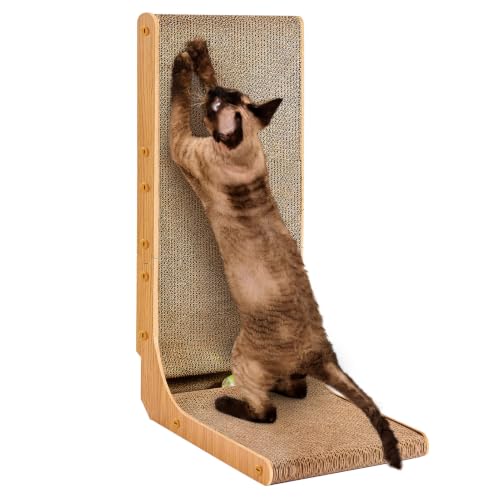
This is the only option here centered on scratching rather than moving prey: its L-shaped corrugated board offers horizontal and vertical surfaces, plus a toy ball. At 26.8 inches tall, it gives a cat room to stretch while scratching, and the maker says the board can be positioned against a wall or sofa. It may suit an older cat that still scratches but is less interested in chasing. The tall shape needs a suitable spot and stable placement; check that the area around it is clear for easy access.
Bottom line: Choose this if scratching and stretching matter more than active chase play.
BABORUI Interactive Cat Toy Ball
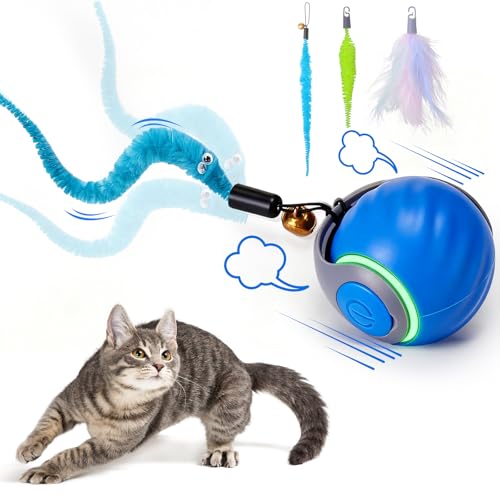
For an older cat that still likes to follow a moving toy, this rechargeable ball rolls across indoor floors and makes a chittering sound. The maker says it has two modes: one runs for five minutes before stopping, while the other enters a dormant mode after five minutes. That pause can break play into short bursts rather than one continuous session. A cat that is startled by sound or has difficulty following a rolling object may prefer a stationary toy; supervise initial play to see how your cat responds.
Bottom line: Pick this for a cat that remains interested in short rolling-ball chases.
Migipaws MigiMouse
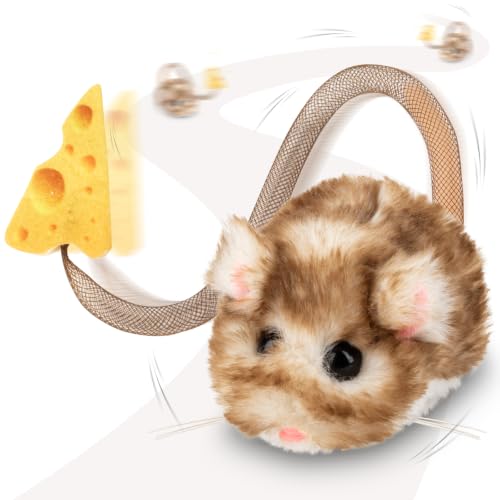
Unlike the track toy’s fixed balls, this small plush mouse rolls, spins, and makes a squeak, offering a more lifelike moving target. Its 3.7-inch length and rechargeable design suit an indoor cat that still enjoys following and pouncing on small toys. The maker suggests letting a timid cat inspect it before activating it. The squeak and sudden motion may be a poor match for cats that startle easily or have little interest in pursuit; remove the toy if your cat begins chewing its parts.
Bottom line: Choose this for an older cat that still enjoys small, moving mouse toys.
How to choose toys for older cats
Start with the movement your cat can comfortably follow: stationary batting toys suit cats that tire during a chase, while rolling toys suit cats that still willingly walk or run after a target. Keep play short, around 5 to 10 minutes at a time, and stop if your cat pants, limps, or disengages. Older cats may have arthritis or changes in vision and hearing, so place toys on a non-slip surface and avoid making a cat jump onto furniture to reach them. Rotate a few toys every several days; novelty can help maintain interest without requiring longer play sessions.
Match play style to mobility
A cat’s usual play behavior is a better guide than age alone: some older cats chase energetically, while others prefer to watch and tap. Use a low-impact rule of thumb: if your cat pauses or seems uncomfortable after a short walk, favor floor-level toys with little required movement. Wand-style toys can be moved slowly along the floor rather than overhead, and stationary ball tracks keep the target close. Avoid toys that require twisting jumps or slippery leaps. Keep pathways to toys clear so a cat with stiff joints does not need to navigate clutter.
Keep play safe and comfortable
Inspect cat toys regularly for loose strings, small detachable pieces, fraying fabric, or cracks; remove damaged toys before play continues. String, ribbon, and elastic can be swallowed and can cause a dangerous intestinal blockage, so put string toys away after supervised sessions. Battery-powered toys should stay dry, and their battery compartments should remain securely closed. Make play easy to approach: place toys on a stable floor, leave room to turn around, and let the cat stop at any time. If movement suddenly changes or play causes pain, consult a veterinarian rather than encouraging more activity.
Ways to keep an older cat engaged
Short, predictable sessions often work better than expecting a long bout of activity; try a few minutes, then let the cat rest. Alternate motion with quiet enrichment, such as a scratcher or a toy the cat can bat from a comfortable position. Move a rolling toy slowly at first, and let a timid cat inspect a new toy while it is switched off. Keep food puzzles simple to start: use a few pieces of the cat’s regular food and an easy opening, then make the task harder only if the cat remains interested. Stop when the cat turns away or shows signs of fatigue.
Frequently Asked Questions
How long should an older cat play at a time?
Try short sessions of about 5 to 10 minutes, then give your cat a chance to rest. End sooner if the cat pants, limps, or loses interest.
Are moving toys suitable for senior cats?
They can be, if the cat can follow them comfortably and the movement stays on a stable floor. Begin slowly and choose stationary batting play if chasing seems tiring.
How often should I rotate my cat’s toys?
Try rotating a small group every several days to make familiar toys feel novel again. Keep any favorite comfort toy available if taking it away causes stress.
Can cats play with string toys unsupervised?
No, string, ribbon, and elastic toys should be put away after supervised play. Swallowed string can cause a dangerous intestinal blockage.
What signs mean my cat should stop playing?
Stop if your cat pants, limps, repeatedly pauses, or turns away from play. A sudden change in movement or activity is a reason to contact a veterinarian.