
Trader Joe’s Low Acid Coffee: Bean Options Compared

Trader Joe’s Low Acid French Roast is the closest match for shoppers seeking the named coffee, and its dark roast whole beans set it apart from the ground alternatives. Choose a different option if you want ground coffee or a medium roast instead.
We earn a commission if you buy through links on this page. As an Amazon Associate I earn from qualifying purchases. Products are compared on manufacturer specifications, not hands-on testing.
- Best overall: Trader Joe’s French Roast, 26 oz – The only Trader Joe’s option here, sold as dark-roast whole beans in a two-pack.
- Best for medium roast: Low Acid Coffee, Medium Roast – Ground medium roast in a 16-ounce bag.
- Best for organic dark roast: Lucy Jo’s Mellow Belly Low Acid Blend – Ground dark-roast coffee with USDA Organic and Fair Trade claims.
| Product | Best for | Form | Roast | Package size | Shop |
|---|---|---|---|---|---|
| Trader Joe’s French Roast, 26 oz | Whole-bean buyers | Whole bean | Dark French roast | 26 oz, 2-pack | Check Price on Amazon |
| Low Acid Coffee, Medium Roast | Medium roast drinkers | Ground | Medium roast | 16 oz | Check Price on Amazon |
| Lucy Jo’s Mellow Belly Low Acid Blend | Organic blend seekers | Ground | Medium dark | 11 oz | Check Price on Amazon |
| VitaCup Perfect Low Acid Organic Dark Roast | Organic dark roast | Ground | Dark roast | 10 oz | Check Price on Amazon |
| Lucy Jo’s Mellow Belly Breakfast Blend | Breakfast blend fans | Ground | Medium roast | 11 oz | Check Price on Amazon |
Trader Joe’s Low Acid Coffee and Alternatives
Compare the Trader Joe’s whole-bean coffee with four ground options by format, roast and package size.
Trader Joe’s French Roast, 26 oz

This is the only Trader Joe’s coffee in the group, and the only whole-bean option. The package name identifies it as a 26-ounce, dark French roast sold as a set of two. Trader Joe’s describes it as low acid; the specifications do not give a measured acidity value. It suits shoppers who want the named coffee and can grind beans before brewing. The main trade-off is format: choose one of the ground alternatives if you need coffee ready for a drip machine or press without grinding first.
Bottom line: Pick this if Trader Joe’s and whole beans are your priorities.
Low Acid Coffee, Medium Roast

This ground medium roast offers a different roast and ready-to-brew format from the Trader Joe’s whole-bean French roast. The specifications give a 16-ounce package and a pH claim of 5.3; the maker positions it as lower-acid coffee. That number is a product claim, not a universal measure of how coffee will taste or feel to every drinker. It may suit someone seeking a medium roast in ground form.
Bottom line: Choose it for a ground medium roast and the pH figure.
Lucy Jo’s Mellow Belly Low Acid Blend
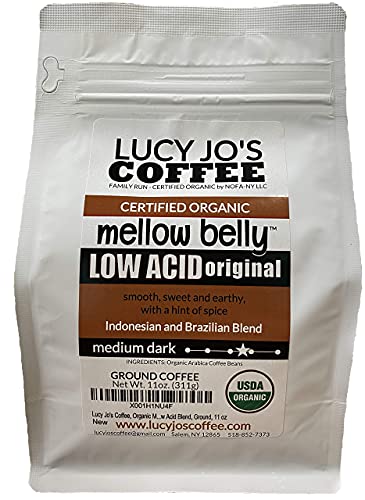
Lucy Jo’s Mellow Belly is a medium-dark ground blend, rather than a whole-bean single roast like the Trader Joe’s option. Its maker identifies it as certified organic, using Arabica beans from Indonesia and Brazil, with sweet, earthy notes and a hint of spice. The 11-ounce bag suits buyers who want a smaller ground blend with those stated origins and flavor notes. The limitation is size: it contains less coffee than the 16-ounce ground alternative, so it may not suit someone prioritizing a larger bag.
Bottom line: Pick it for a certified-organic medium-dark blend in ground form.
VitaCup Perfect Low Acid Organic Dark Roast

VitaCup pairs a dark roast with ground coffee, USDA Organic and Fair Trade claims, while Trader Joe’s pairs dark French roast with whole beans. This is a 10-ounce single-origin Arabica coffee from Guatemala; the maker also claims it is third-party lab tested and mycotoxin-free. Those are maker claims, not a substitute for a measured acidity value in the specifications. It fits buyers who want a ground Guatemalan coffee with organic and Fair Trade credentials. Its 10-ounce package is the smallest among these options.
Bottom line: Choose it for ground Guatemalan coffee with organic and Fair Trade claims.
Lucy Jo’s Mellow Belly Breakfast Blend

Lucy Jo’s Breakfast blend is the medium roast counterpart to the brand’s medium-dark Mellow Belly blend, making roast preference its clearest distinction here. The maker identifies it as certified organic, low acid, and made with Arabica beans from Indonesia and South America; the flavor notes are sweet, earthy and nutty. The bag holds 11 ounces of ground coffee, suitable for someone who wants a breakfast-style blend ready to brew. It is not Trader Joe’s coffee, and its roast is lighter than the French roast named in the search.
Bottom line: Pick it for a ground, medium roast breakfast blend.
How to choose low acid coffee
Choose by format and roast first, then treat acidity language as a product claim rather than a guarantee about taste or comfort. Whole beans need a grinder; ground coffee is ready for brewing but its grind must suit the method. Roast level changes flavor, but dark roast alone does not prove a particular acidity level. A pH number also does not tell you the full flavor profile or how you personally respond. If the measured pH is the deciding factor, compare the same measurement method and conditions; the products here provide only one pH figure. For a practical split, choose whole beans if you already grind at home, and ground coffee if convenience matters more.
Whole beans versus ground coffee
Whole beans keep their interior less exposed to air until grinding, while ground coffee has more surface area exposed and can lose aroma faster after opening. Buy ground coffee when the grind suits your brewer; drip machines generally need medium grounds, while French presses use coarse grounds. Espresso requires a fine grind. A mismatch can make coffee extract too quickly or slowly and taste weak or harsh. For whole beans, grind shortly before brewing when possible and adjust grind size to the brewer. This distinction matters more here than package color: the Trader Joe’s choice is whole bean, while the alternatives in this comparison are ground.
This table maps brewing needs to a useful starting choice.
| Need | Starting choice |
|---|---|
| Grind at home | Whole beans |
| Ready for drip brewing | Ground, medium grind |
| French press brewing | Ground, coarse grind |
How to brew a balanced cup
A common starting ratio is 1 gram of coffee to 16–18 grams of water by weight; adjust stronger or weaker after tasting. Use a scale for repeatability, since scoops vary with bean size and grind. Water just off the boil—about 195–205°F—is a typical range for hot brewing. Finer grounds and longer contact time generally extract faster, while coarse grounds or shorter contact can yield a weaker cup. Change one variable at a time, such as grind size or dose, so you can tell what changed the result. Coffee brewing involves hot water, so keep kettles and drippers stable and away from children.
Storing coffee after opening
Store coffee in a tightly closed container in a cool, dry place away from direct sunlight, heat and moisture. Air, light, heat and moisture can dull aroma; refrigeration can also expose coffee to condensation and nearby food odors when containers are opened. Buy a bag size you can use while the coffee still smells fresh rather than transferring it repeatedly between containers. Keep beans whole until brewing if you have a grinder. Do not store coffee near a stove or sink, where heat and steam are common. For longer storage, freeze an airtight portion and let it return to room temperature while still sealed before opening.
Frequently Asked Questions
Does dark roast coffee always have less acid?
No, roast color alone does not establish a coffee’s acidity. Roast level affects flavor, and a specific acidity comparison needs comparable measurements rather than roast names.
What is a good coffee-to-water ratio for brewing?
Start with 1 gram of coffee per 16–18 grams of water. Use the same scale and ratio while adjusting grind or dose to tune strength.
Which grind works for a French press?
Use a coarse grind as a starting point for French press coffee. Very fine grounds pass through many press filters more readily and can leave a gritty cup.
How should I store opened coffee beans?
Keep beans in a tightly sealed container in a cool, dry place away from light and heat. Grind just before brewing when practical to limit aroma loss.