
Truck Back Seat Storage: 3 Organizers Compared

For most truck owners, Pitozer Seat Back Organizer is the practical starting point because its 24.4-by-16.5-inch panel combines zippered pockets, open compartments and a tissue pocket. Choose 6-Pack Tactical MOLLE Organizer instead for removable MOLLE pouches, or Tidify Laptop and Tablet Seat Organizer if a padded laptop compartment matters more than a tactical layout.
Seat-back organizers hang from the front seats to keep loose gear accessible in the rear cabin; confirm strap ranges and seat compatibility before ordering.
We earn a commission if you buy through links on this page. As an Amazon Associate I earn from qualifying purchases. Products are compared on manufacturer specifications, not hands-on testing.
- Best overall: Pitozer Seat Back Organizer – Combines three zippered pockets, three open compartments and adjustable top and bottom straps.
- Best for modular gear: 6-Pack Tactical MOLLE Organizer – Includes five detachable MOLLE pouches that can be arranged for separate items.
- Best for laptop storage: Tidify Laptop and Tablet Seat Organizer – Has a dedicated padded compartment for a laptop and stabilizing side straps.
| Product | Best for | Organizer layout | Fit or attachment | Dimensions | Shop |
|---|---|---|---|---|---|
| Pitozer Seat Back Organizer | Everyday gear | 3 zip pockets; 3 open compartments | Top 16–28 in; bottom 22–34 in straps | 24.4 × 16.5 in | Check Price on Amazon |
| 6-Pack Tactical MOLLE Organizer | Modular storage | 5 detachable MOLLE pouches per organizer | Universal vehicle fit; attaches to seat back | 10 × 8 × 5 in | Check Price on Amazon |
| Tidify Laptop and Tablet Seat Organizer | Laptop carrying | Padded laptop compartment; 2 bottle holders | Adjustable bottom side straps | 15 × 17 × 2 in | Check Price on Amazon |
Truck Back Seat Storage Organizers
Compare these seat-back organizers by their storage layout, attachment approach and stated dimensions.
Pitozer Seat Back Organizer
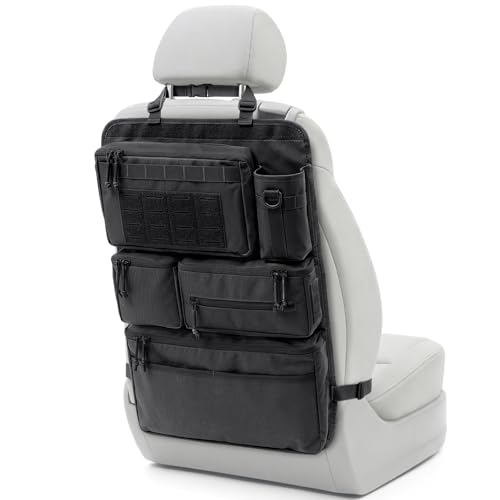
For a mix of small essentials and grab-and-go items, this organizer combines three zippered pockets, three open compartments and a dedicated tissue pocket. The panel measures 24.4 by 16.5 inches, and adjustable top and bottom buckles secure it without tools. It suits truck owners carrying items such as gloves, cables, bottles or toys who want separate pocket types in one seat-back panel. Its universal-fit claim does not guarantee compatibility with every seat, so measure the seat and check the strap ranges before choosing it.
Bottom line: Choose this if you want a single panel with both open and zippered storage.
6-Pack Tactical MOLLE Organizer

Modularity is the distinguishing feature here: each organizer has five detachable MOLLE pouches for separating gear such as tools or a first-aid kit. The package includes six organizers, making it suitable when you want matching storage across several vehicles or seats. It attaches to the seat back and is described as compatible with trucks, SUVs, Jeeps and cars. The dimensions are 10 by 8 by 5 inches, but the package does not clarify which dimension corresponds to the mounted panel; check the actual fit if seat coverage is important.
Bottom line: Pick this for multiple seats or a pouch-by-pouch modular setup.
Tidify Laptop and Tablet Seat Organizer

For work gear, this organizer emphasizes a secure padded laptop compartment and deep storage for large binders rather than MOLLE pouches. It also has two bottle holders, mesh storage, zip and open pockets, and a phone-sized drawstring pocket. Adjustable side straps at the bottom help secure the hanging bag to a seat, making it a better match for commuters carrying office materials. Its 15-by-17-inch dimensions and 2-inch listed depth are smaller than a bulky cargo bin, so it is not the choice for large loose equipment.
Bottom line: Choose this when laptop protection and organized work storage are priorities.
How to choose truck back seat storage
Start with the shape of the items you carry: bottles and frequently reached gear work well in open pockets, while documents and small tools are easier to contain in zippered pockets. A padded sleeve is more suitable for a laptop than an open compartment. Seat-back organizers typically attach with straps around the headrest and lower seat; adjust them snugly so the panel does not swing into passengers. Before ordering, measure the usable seat-back width and height, then compare those measurements with the panel and strap ranges. For frequent passenger access, keep the organizer’s lower edge clear of foot and knee space.
Seat fit and strap measurements
Measure the seat where the organizer will hang, including the distance from the headrest support to the lower attachment point. Strap adjustment ranges matter as much as panel dimensions: a panel can fit the seat surface but fail to secure if its straps cannot reach around the seat. Check whether headrest posts, seat pockets or integrated seat belts obstruct the attachment path. For a truck with a split rear bench or unusually shaped front seats, assess each seat separately rather than assuming both sides match. Leave room for the seat to move and for passengers to enter without snagging buckles or straps.
Seat-back organizer styles compared
Choose a layout based on what needs to stay accessible and what needs containment. Tactical MOLLE designs use attachment loops and removable pouches; pocket panels consolidate mixed small gear; office-style organizers prioritize padded storage and document compartments. The table links common carrying needs to a useful design feature.
| Need | Useful feature |
|---|---|
| Small loose tools | Zippered pockets or removable pouches |
| Water bottles | Open bottle compartments or holders |
| Laptop and papers | Padded compartment and deep pocket |
| Gear used by several people | Detachable, separately arranged pouches |
Safe installation and everyday use
Secure every strap before driving and keep the organizer from covering seat-belt buckles, airbags or controls. Seat-mounted side airbags can deploy from the outer seat bolster, so do not route straps across an airbag seam or place a bulky organizer where it could interfere; consult the vehicle manual for the airbag locations. Keep heavy tools low and restrained rather than in an open pocket where hard braking could send them forward. Avoid overfilling bottle pockets or hanging dense loads from a headrest strap, and recheck buckles after adjusting the seat.
Frequently Asked Questions
How do I measure a seat for a back seat organizer?
Measure the usable seat-back width and the attachment distance from the headrest area to the lower seat. Compare both measurements with the panel size and strap adjustment range, and account for seat pockets and belt hardware.
Can a seat-back organizer block side airbags?
It can interfere if straps or a loaded panel cover an airbag seam on the outer seat bolster. Check the vehicle manual for airbag locations and keep straps clear of those deployment areas.
Where should heavy tools go in a truck cabin?
Keep heavy tools low and restrained in a secured compartment rather than in an open seat-back pocket. A loose tool can become a projectile during hard braking or a collision.
How can I stop an organizer from swinging?
Use both upper and lower attachment points and tighten the straps until the panel sits close to the seat. Remove excess load from open pockets, which can pull a hanging organizer away from the seat.
What is the difference between MOLLE and pocket organizers?
MOLLE organizers use a webbing grid to attach or reposition compatible pouches, while fixed-pocket designs keep storage compartments sewn in place. Choose removable pouches when you need to rearrange or carry sections separately.