
Two-Hole Punches for Top-Punched Paper: 4 Picks

For most top-punched paper, Officemate 50-Sheet 2-Hole Punch is the practical pick because its 50-sheet capacity and padded handle suit repeated office work. Choose a 30-sheet model for occasional filing or a 100-sheet model for thicker stacks; confirm the hole spacing matches your folder or binder before ordering.
We earn a commission if you buy through links on this page. As an Amazon Associate I earn from qualifying purchases. Products are compared on manufacturer specifications, not hands-on testing.
- Best overall: Officemate 50-Sheet 2-Hole Punch – Its 50-sheet capacity and padded handle balance stack size with repeated-use comfort.
- Best for large stacks: CARL XHC-2100N 100-Sheet Punch – It punches up to 100 sheets of standard 20 lb. paper at once.
- Best for compact desks: Officemate 30-Sheet Metal Punch – Its 30-sheet capacity and 6.22-inch length suit everyday filing in a smaller footprint.
| Product | Best for | Sheet capacity | Length | Shop |
|---|---|---|---|---|
| Officemate 50-Sheet 2-Hole Punch | Repeated office use | 50 sheets | 4.5 in | Check Price on Amazon |
| CARL XHC-2100N 100-Sheet Punch | Large paper stacks | 100 sheets | 10 in | Check Price on Amazon |
| Officemate 30-Sheet Metal Punch | Everyday filing | 30 sheets | 6.22 in | Check Price on Amazon |
| 30-Sheet Punch with 3.15-Inch Spacing | Known spacing fit | 30 sheets | 5.83 in | Check Price on Amazon |
Two-Hole Punches for Top-Punched Paper
Match punch capacity and spacing to the paper stack and filing system you use most often.
Officemate 50-Sheet 2-Hole Punch
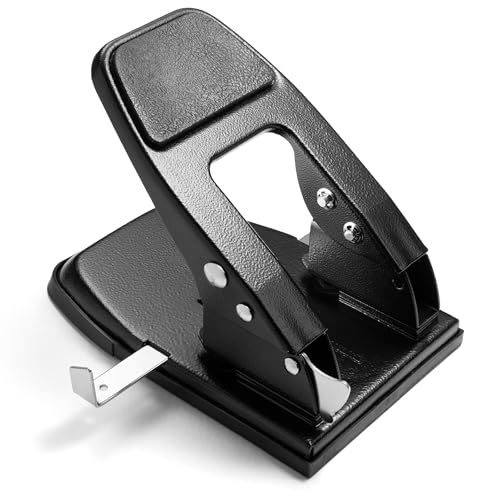
For repeated punching, the padded handle and 50-sheet capacity distinguish this model from the smaller manual punches. The adjustable guide helps align letter-size documents, while the metal base and punch heads are designed for frequent use. A chip tray catches punched paper waste for cleanup. This is a sensible choice when 30 sheets is too limiting but a 100-sheet heavy-duty unit would be more punch than the job needs. The capacity is for sheets as specified by the maker; thick or unusually heavy paper can change how much material is practical to punch at once.
Bottom line: Pick this for regular filing when a padded handle and 50-sheet capacity fit your workload.
CARL XHC-2100N 100-Sheet Punch

Large batches set this model apart: its maker gives it a 100-sheet capacity for standard 20 lb. bond paper. The metal construction, non-skid base, dual self-centering guides and large waste tray suit a fixed desk setup with frequent, substantial stacks. Its punch heads make 1/4-inch holes for standard two-ring journals and ledgers. At 10 inches long and 4 pounds, it takes more desk space than a compact manual punch, so occasional users may find its capacity unnecessary. The limited lifetime warranty excludes punch heads and disks.
Bottom line: Choose this when you routinely punch large stacks of standard-weight paper.
Officemate 30-Sheet Metal Punch

Compact dimensions distinguish this manual punch from the larger-capacity choices: it measures 6.22 inches long and handles up to 30 sheets of standard 20 lb. paper. Its adjustable paper guide aids alignment, and the metal construction and removable chip tray fit routine home, classroom or office filing. This capacity works for reports and forms handled in modest batches, but it is less suited to frequent stacks over 30 sheets than the higher-capacity options. Check your folder or binder’s required spacing before choosing any punch, since hole placement must match the filing system.
Bottom line: Pick this for routine filing and modest stacks where a shorter punch fits your desk.
30-Sheet Punch with 3.15-Inch Spacing

The 3.15-inch hole spacing is the defining distinction here, so this model is best considered when that measurement matches the folder or binder you use. It punches up to 30 sheets of standard 20 lb. paper and makes 9/32-inch holes. A guide, non-slip base and removable waste tray support ordinary desk filing, while its 5.83-inch length keeps the unit relatively compact. The spacing may not match every two-hole filing system, so measure the distance between the centers of your folder or binder holes before choosing this punch.
Bottom line: Choose this only when 3.15-inch spacing and 9/32-inch holes match your filing system.
How to choose a two-hole punch
Choose a two-hole punch by matching its capacity to your usual stack and its hole spacing to your filing system. The capacities here range from 30 sheets of standard 20 lb. paper to 100 sheets, but capacity claims depend on paper weight and condition; avoid forcing a thick stack through a smaller unit. For occasional forms, 30 sheets can be ample; for frequent large batches, a 100-sheet model is more appropriate. Check hole spacing before buying: two holes can be positioned differently across punch models, and a mismatch leaves pages unable to sit correctly on the folder prongs. Also consider footprint: a 10-inch-long punch needs more desk room than a unit under 6.5 inches.
A simple rule is to choose the smallest capacity that comfortably exceeds your largest routine stack, rather than routinely punching at the limit.
Hole spacing and fit for top-punched paper
Measure hole spacing from the center of one hole to the center of the other, then compare that measurement with the folder or binder. A punch making 9/32-inch holes with 3.15-inch spacing may not fit hardware designed for a different arrangement. Hole diameter and spacing are separate measurements: a larger hole does not correct a spacing mismatch. Punch a single test sheet and place it on the prongs before processing a stack, especially when changing to a new punch. Paper guides help keep sheets aligned at the edge, but they do not establish compatibility with every filing product. If your documents are letter size, align the guide to the sheet edge and keep the paper flat for consistent placement.
For any unverified filing setup, confirm the required spacing and hole diameter before ordering.
Manual two-hole punch capacities compared
Manual punch capacities suit different batch sizes; use this chart to match the rated stack to your typical job.
| Capacity | Typical fit | Trade-off |
|---|---|---|
| 30 sheets | Occasional forms and reports | Smaller batches |
| 50 sheets | Regular office filing | More desk space than compact models |
| 100 sheets | Large batch work | Larger, heavier desk unit |
Rated capacity is not a reason to force paper through a punch. Paper thicker than standard copy stock, curled sheets or uneven stacks can make punching harder and reduce alignment. Separate oversized jobs into smaller, even batches, keep fingers clear of the punch heads, and empty the chip tray before waste interferes with movement. A stable, flat work surface also helps prevent the punch from shifting while the handle is pressed.
Using and maintaining a paper punch
Keep sheets square against the guide and punch on a stable surface to reduce skewed holes. Most office copy paper is 20 lb. bond, and capacity figures for these punches are tied to that standard weight; cardstock and coated stock can behave differently, so try a small stack first. Empty the chip tray regularly to prevent accumulated scraps from obstructing the mechanism. If a punch becomes difficult to press or leaves ragged holes, reduce the stack and clear the waste tray before continuing. Keep hands away from the punch heads and do not reach underneath while pressing the handle. Store the unit with the handle down only if its design allows it to lock safely.
For clean results, test alignment on one sheet before punching a full set.
Frequently Asked Questions
How far apart should two punched holes be?
Hole spacing depends on the folder or binder, so measure center to center rather than assuming every two-hole punch matches. One punch in this group specifies 3.15-inch spacing; compare the required measurement before buying.
Can a 30-sheet punch handle thicker paper?
The 30-sheet capacity is for standard 20 lb. paper, not every paper type. For heavier stock, use a smaller test stack and stop if the handle requires excessive force.
What size holes do two-hole punches make?
Hole diameter varies by punch; one model here makes 9/32-inch holes, while another specifies 1/4-inch holes. Match diameter as well as spacing when fitting documents to prongs.
How do I keep punched pages aligned?
Square the sheet edges against the punch’s adjustable guide and test a single page before punching a full stack. Keep the punch stable on a flat surface so it does not shift under pressure.
Is a 100-sheet punch right for occasional filing?
A 100-sheet model is intended for large stacks of standard-weight paper, so occasional small batches generally do not need that capacity. A shorter, 30-sheet punch takes less desk space for modest jobs.