
Urine Splash Guards for Seniors: 3 Models Compared

The P-flector Toilet Seat Urine Guard, 2-Pack suits most households seeking a urine splash guard for seniors because its flexible under-seat attachment is designed for curved, elongated, and rounded toilets. Choose another style if you need a guard that sits at the front of the seat or prefer a center strap.
These guards direct urine toward the bowl or cover gaps where it may escape; fit and placement matter because toilet seats vary in shape and clearance.
We earn a commission if you buy through links on this page. As an Amazon Associate I earn from qualifying purchases. Products are compared on manufacturer specifications, not hands-on testing.
- Best overall: P-flector Toilet Seat Urine Guard, 2-Pack – The flexible under-seat design is made for curved, elongated, and rounded toilets.
- Best for raised seats: GYPNS Flexible Front Splash Guard – The maker says it can be used with toilet seat risers and raised seats.
- Best for center strap: Toilet Pee Splash Guard with O-Ring – The built-in O-ring handle and center strap distinguish this design.
| Product | Best for | Attachment style | Toilet fit | Size | Shop |
|---|---|---|---|---|---|
| P-flector Toilet Seat Urine Guard, 2-Pack | Multi-shape fit | Under-seat attachment | Curved, elongated, rounded | 6 × 2.5 × 0.13 in. | Check Price on Amazon |
| GYPNS Flexible Front Splash Guard | Raised-seat use | Placed at seat front | Toilet seat; raised-seat use | — | Check Price on Amazon |
| Toilet Pee Splash Guard with O-Ring | Center-strap design | Center strap with O-ring | Seat-to-bowl gap | 11.4 × 6.3 in. | Check Price on Amazon |
Urine Splash Guards for Seniors Compared
Compare how each guard attaches and which toilet-seat shapes or setups it is intended to fit.
P-flector Toilet Seat Urine Guard, 2-Pack
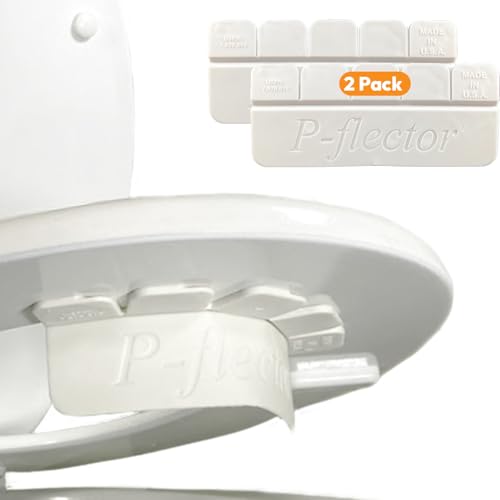
The P-flector Toilet Seat Urine Guard, 2-Pack is the only two-piece set here, and its flexible guard attaches underneath the toilet seat. The maker says it blocks the seat-to-bowl gap and fits curved-bottom, elongated, and rounded toilets. Each guard measures 6 inches long, 2.5 inches wide, and 0.13 inch high; the pieces are reusable and easy to clean. That broad shape range may suit households with a nonstandard seat profile. The limitation is that attachment time varies, so it may not be the simplest choice for someone who wants a front-positioned guard that just rests on the seat.
Bottom line: Choose this set if you want an under-seat guard designed for several common seat shapes.
GYPNS Flexible Front Splash Guard

The GYPNS Flexible Front Splash Guard is positioned at the front of the toilet rather than attached underneath the seat. Its maker says it can also be used with toilet seat risers or raised toilet seats, making that setup its clearest distinction for senior care. The installation is simply placing the guard at the front to direct urine toward the bowl. The specifications identify it as white but provide no dimensions, so buyers with a narrow seat opening or limited space should confirm fit before ordering. Unlike the under-seat option, this style depends on correct placement each time.
Bottom line: Pick this style when a raised toilet seat is part of the setup.
Toilet Pee Splash Guard with O-Ring

The Toilet Pee Splash Guard with O-Ring stands apart with a single center strap that extends into a built-in O-ring handle. The maker says the guard seals the gap between the seat and bowl, and describes the central strap as an alternative to side straps. Its dimensions are 11.4 by 6.3 inches. The design may suit buyers who value a handle integrated into the guard, but the specifications do not identify specific seat shapes or attachment instructions. Check the seat opening and available clearance before choosing it if compatibility is uncertain.
Bottom line: Choose this one if a center strap and integrated O-ring are priorities.
How to Choose a Urine Splash Guard
Choose by attachment method first, then confirm that the guard matches your seat and leaves enough room for comfortable seating. Under-seat designs stay connected to the seat, while front-positioned guards must be placed at the front; strap designs use a different contact point. Measure the seat opening and compare it with the guard’s dimensions when available. A mismatch can leave a gap or make the guard awkward to position. For a senior using a raised toilet seat, check that the guard and riser do not compete for the same front edge or reduce usable clearance. A splash guard is not a substitute for a properly secured toilet seat or a stable transfer setup.
Check Toilet Seat Shape and Clearance
Seat shape is a decisive fit check: rounded and elongated bowls have different front profiles, and open-front or specialty seats can leave a different gap than a standard closed seat. A guard designed for one profile may not sit securely on another. Compare the fit description with the actual seat, including any seat riser or integrated bidet features. Keep the guard from pressing against the user’s legs or obstructing a safe sit-to-stand movement. If the seat has less than 1 inch of usable front clearance, measure before ordering rather than assuming a front-mounted guard will fit; the products here do not all provide dimensions.
The table summarizes the distinctions that guide a first fit check.
| Setup need | Design to consider | Fit check |
|---|---|---|
| Several seat profiles | Flexible under-seat guard | Confirm attachment space below seat |
| Raised toilet seat | Front-positioned guard | Check it does not interfere with riser |
| Integrated handle preference | Center-strap guard | Compare strap position with seat opening |
Cleaning and Everyday Use
Rinse a reusable urine guard after use and clean it with mild soap and water, then let it dry before storing or reattaching it. Regular cleaning prevents residue from building up in corners, straps, or around an attachment point. Avoid abrasive pads and harsh cleaners unless the manufacturer permits them, since they can damage plastic or adhesive. For an under-seat model, check periodically that the attachment remains secure and that the guard has not shifted. Remove a loose or cracked guard rather than relying on it to redirect urine. Keep the bathroom floor dry and clear around the toilet, especially where a user needs stable footing or a mobility aid.
Common Fit and Placement Mistakes
The most common mistake is choosing by the word “universal” instead of matching the guard to the actual seat shape and installation method. A guard that rests at the front can shift if it is not positioned correctly; an under-seat design may require access beneath the seat, and a strap design needs unobstructed space between the legs. Measure the seat opening and front edge before choosing if the user has limited positioning options. Do not let the guard prevent the seat from lowering fully or make transfers less stable. Test placement while the toilet is unoccupied, then make sure the user can sit and stand without contacting sharp or pinching edges.
Frequently Asked Questions
Can a urine splash guard work with a raised toilet seat?
Some front-positioned guards are intended for raised toilet seats; the maker of GYPNS Flexible Front Splash Guard says it can be used with risers. Check the added height and front clearance so the guard does not interfere with the seat or transfer.
How do I know which toilet seat shape I have?
A rounded seat has a shorter, more curved front, while an elongated seat extends farther forward. Measure from the seat-mount bolts to the front edge and compare that measurement with the guard’s fit before choosing.
How often should I clean a reusable urine guard?
Rinse and clean a reusable guard after use, especially around straps and attachment points where residue can collect. Mild soap and water are suitable for routine cleaning unless the manufacturer specifies a different care method.
Can a splash guard make standing transfers safer?
A splash guard is not a transfer aid and should not bear weight. Keep the toilet seat and any grab bars secure, and make sure the guard does not obstruct the user’s handholds or footing.
What should I measure before ordering a guard?
Measure the seat opening, front edge, and available clearance around any riser or integrated toilet features. Compare those measurements with the guard’s dimensions; if its dimensions are unavailable, confirm fit before ordering.