
VEVOR Exhaust Fans: 3 Models Compared by Use

For general garage or shed ventilation, VEVOR 10-Inch Shutter Exhaust Fan stands out for its wall-mounted shutter design, variable-speed control and 900 CFM airflow. Choose VEVOR Adjustable Roof Exhaust Fan for roof-mounted attic ventilation or VEVOR Commercial Canopy Exhaust Fan for a commercial kitchen canopy application; mounting and intended use are the main differences.
Exhaust fans move indoor air outdoors, and the right choice depends on both the room’s ventilation target and a suitable installation location.
We earn a commission if you buy through links on this page. As an Amazon Associate I earn from qualifying purchases. Products are compared on manufacturer specifications, not hands-on testing.
- Best overall: VEVOR 10-Inch Shutter Exhaust Fan – Its wall-mounted shutter and variable-speed controller pair with 900 CFM airflow for adjustable garage or shed ventilation.
- Best for attic roofs: VEVOR Adjustable Roof Exhaust Fan – The roof-mounted design offers selectable 900 or 1,500 CFM airflow.
- Best for kitchen canopies: VEVOR Commercial Canopy Exhaust Fan – The direct-drive canopy fan provides 612 CFM for commercial kitchen or food-truck hood use.
| Product | Best for | Mounting style | Airflow | Motor power | Shop |
|---|---|---|---|---|---|
| VEVOR 10-Inch Shutter Exhaust Fan | Garage ventilation | Wall shutter | 900 CFM | 45 W | Check Price on Amazon |
| VEVOR Adjustable Roof Exhaust Fan | Attic ventilation | Roof mount | 900 / 1,500 CFM | 220 W | Check Price on Amazon |
| VEVOR Commercial Canopy Exhaust Fan | Kitchen canopy | Canopy / roof | 612 CFM | 180 W | Check Price on Amazon |
VEVOR Exhaust Fans Compared
Compare these fans by where they mount, their airflow capacity and their motor power.
VEVOR 10-Inch Shutter Exhaust Fan

For adjustable wall ventilation, VEVOR 10-Inch Shutter Exhaust Fan is the only model here with an included variable-speed controller and automatic shutter. Its 10-inch steel fan is intended for garages, greenhouses and sheds, and the maker says its 45 W AC motor runs at 1,650 RPM and delivers up to 900 CFM. That combination suits spaces where you want to adjust airflow rather than rely on a fixed setting. The limitation is its wall-mounted format: buyers who need a roof installation or a commercial canopy fan should choose a different style.
Bottom line: Pick this for a wall opening where adjustable airflow is useful.
VEVOR Adjustable Roof Exhaust Fan

For roof-mounted attic ventilation, VEVOR Adjustable Roof Exhaust Fan is the only model here with two selectable airflow levels, 900 and 1,500 CFM. It has a 21-inch base, aluminum-alloy housing cap and a 220 W motor; the maker gives motor speeds of 1,572 and 2,200 RPM. The two settings can suit different heat-removal needs, while the roof format separates it from the wall and canopy models. Its larger roof-base format makes it a poor match for a wall opening or a hood installation; check roof opening and flashing compatibility before ordering.
Bottom line: Choose this for attic ventilation when the roof setup supports its base.
VEVOR Commercial Canopy Exhaust Fan
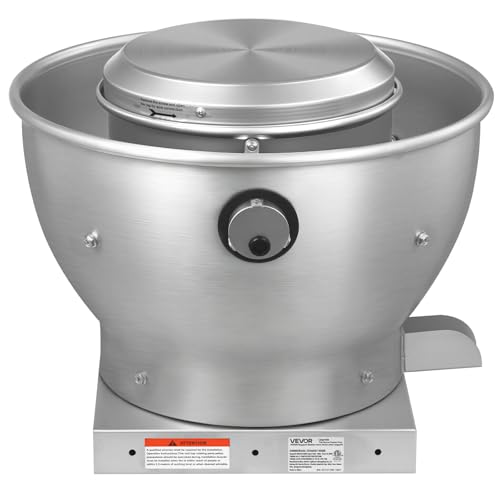
For kitchen canopy or food-truck hood use, VEVOR Commercial Canopy Exhaust Fan is the purpose-specific choice, with a direct-drive design and 612 CFM airflow. Its 180 W pure-copper motor and aluminum-alloy construction distinguish it from the adjustable attic and wall fans. The maker says its sound level is no more than 75 dB and identifies the construction as IP54 weatherproof. This model suits buyers matching a fan to a canopy application, not someone choosing solely for maximum airflow: its 612 CFM is lower than the two selectable settings on VEVOR Adjustable Roof Exhaust Fan and the 900 CFM rating on VEVOR 10-Inch Shutter Exhaust Fan.
Bottom line: Choose this when the installation is a compatible kitchen canopy or food-truck hood.
How to size an exhaust fan for a room
Room volume and target air changes per hour provide a practical starting point for sizing an exhaust fan. Multiply length × width × ceiling height in feet, then multiply that volume by the desired air changes per hour and divide by 60 to estimate CFM. For example, a 1,000-cubic-foot space at 6 air changes per hour needs about 100 CFM before accounting for duct losses. Longer ducts, elbows, restrictive screens and louvers reduce delivered airflow, so a fan’s rated CFM is not necessarily the airflow at the room. Use the target ventilation rate for the actual space and installation rather than choosing on motor wattage alone.
Choose a mounting style that fits the opening
Mounting location is the first compatibility check: roof fans require a suitable roof opening and weather-sealed flashing, while wall shutter fans need an opening through an exterior wall. Canopy fans are intended to work with the hood arrangement they serve, not as a general substitute for an attic or room fan. Measure the clear opening, available depth and path to the outdoors before selecting a model. A change in direction or a long duct run can add resistance and reduce airflow. For a commercial cooking setup, confirm that the hood, duct, fan and installation meet applicable local fire and mechanical-code requirements; do not treat an ordinary exhaust fan as a grease-duct system.
Compare roof, wall and canopy exhaust fans
Roof, wall and canopy fans solve different installation problems, so match the fan type to the route air needs to travel. Roof designs exhaust through the roof, shutter models through a wall, and canopy fans serve hood applications. Use the table to narrow the installation style first, then compare airflow with the room’s ventilation target. A larger CFM number alone does not make a fan suitable if the opening or duct path is incompatible.
| Installation need | Fan style | Example airflow |
|---|---|---|
| Roof opening | Roof exhaust fan | 900 or 1,500 CFM |
| Exterior wall opening | Shutter exhaust fan | 900 CFM |
| Kitchen hood application | Canopy exhaust fan | 612 CFM |
Installation and electrical safety checks
Exhaust fans need a safe outdoor discharge path, secure mounting and an electrical supply that matches the motor and local code. Roof penetrations need suitable flashing to keep water out, and wall-mounted equipment must not discharge into an enclosed cavity or attic. Before installation, identify the circuit, wire requirements and any required disconnect; a qualified electrician can verify them when needed. A fan should not be operated with an exposed or damaged electrical connection, and moving parts should remain guarded. In cooking areas, grease and heat create additional fire risks, so use a fan and duct arrangement approved for the intended hood rather than adapting a general-purpose unit.
Frequently Asked Questions
How much airflow does a room exhaust fan need?
A common starting point is room volume multiplied by the target air changes per hour, divided by 60. For a 1,000-cubic-foot room at 6 air changes per hour, that is 100 CFM before duct and fitting losses.
Does a longer exhaust duct reduce fan airflow?
Yes, duct length and resistance reduce delivered airflow compared with a fan’s rated capacity. Elbows, restrictive grilles and undersized ducts add resistance, so keep the route direct and size the duct to the fan and installation.
Can an attic fan replace a kitchen hood fan?
No, an attic exhaust fan is not a replacement for a kitchen hood exhaust system. Cooking exhaust can carry grease, and the hood, duct and fan must suit the application and applicable local fire and mechanical codes.
Where should an exhaust fan discharge air?
An exhaust fan should discharge outdoors, not into an attic, wall cavity or other enclosed space. For a roof installation, the roof penetration also needs appropriate weather sealing to limit water intrusion.
What should I measure before choosing a wall exhaust fan?
Measure the clear wall opening and available mounting depth, then confirm there is a suitable path to outdoors. Room volume and duct resistance also matter because they affect whether the selected airflow can meet the ventilation target.