
Vibrant Super Quiet Resonator: Models Compared by Fit

For most buyers, Vibrant 1142 3-inch Ultra Quiet is the closest match because it pairs Vibrant’s Ultra Quiet design with a 3-inch size and T304 stainless steel construction. Choose another model if your exhaust tubing is 2.5 or 2.25 inches, or verify diameter and body clearance before ordering.
We earn a commission if you buy through links on this page. As an Amazon Associate I earn from qualifying purchases. Products are compared on manufacturer specifications, not hands-on testing.
- Best overall: Vibrant 1142 3-inch Ultra Quiet – The 3-inch Vibrant unit combines a T304 stainless body with a straight-through perforated core.
- Best for 2.5-inch tubing: Vibrant 1141 2.5-inch Ultra Quiet – Its name identifies a 2.5-inch Vibrant resonator.
- Best for 2.25-inch tubing: Vibrant 1140 2.25-inch Ultra Quiet – Its inlet and outlet are both 2.25 inches, with a 13.75-inch overall length.
| Product | Best for | Inlet/outlet diameter | Body length | Shop |
|---|---|---|---|---|
| Vibrant 1142 3-inch Ultra Quiet | 3-inch systems | 3 in | 14 in | Check Price on Amazon |
| Vibrant 1141 2.5-inch Ultra Quiet | 2.5-inch systems | 2.5 in | — | Check Price on Amazon |
| Vibrant 1140 2.25-inch Ultra Quiet | 2.25-inch systems | 2.25 in | 9.75 in body | Check Price on Amazon |
Vibrant Super Quiet Resonators Compared
Match the tubing diameter first, then compare body dimensions and construction for installation clearance.
Vibrant 1142 3-inch Ultra Quiet

For a 3-inch exhaust system, this Vibrant model is the clearest match among these options; it has a 3-inch size and a larger sound-absorption chamber than typical bottle-style resonators. Vibrant says the design dampens exhaust noise while facilitating undisrupted flow. The resonator uses a T304 stainless body and a straight-through perforated core. Its length is 14 inches, so check the available space and tubing diameter before choosing it. The dimensional fields do not identify inlet and outlet measurements separately, which matters if your piping uses a different connection size.
Bottom line: Choose this if your system uses 3-inch tubing and you want a Vibrant straight-through resonator.
Vibrant 1141 2.5-inch Ultra Quiet
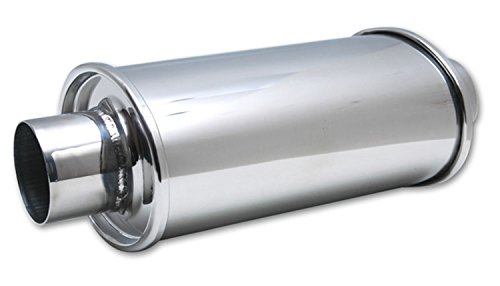
For 2.5-inch tubing, this Vibrant option gives a named size that separates it from the 3-inch and 2.25-inch choices. It has a T304 stainless steel body and a straight-through perforated core; Vibrant says it is designed to dampen exhaust noise while facilitating exhaust flow. A resonator’s inlet diameter must match the pipe or use a compatible adapter, so confirm the connection size when the size label alone is not enough.
Bottom line: Pick this for a 2.5-inch setup seeking the Vibrant Ultra Quiet design.
Vibrant 1140 2.25-inch Ultra Quiet

For a smaller 2.25-inch system, this Vibrant resonator is the only option here with explicit inlet and outlet diameters, both 2.25 inches. Its body measures 6.5 by 4.75 inches and 9.75 inches long, with an overall length of 13.75 inches. T304 stainless steel and a straight-through perforated core are specified; Vibrant says the design is intended to dampen noise and preserve exhaust flow. The shorter body than the 3-inch choice may help where room is limited, but the overall length still includes the connection ends and needs to fit the available run.
Bottom line: Choose this when 2.25-inch inlet and outlet sizing and its measured body length suit your system.
How to Choose a Vibrant Super Quiet Resonator
Start with pipe diameter, then compare length and clearance; a resonator that does not match the exhaust tubing needs a properly sized adapter or a different part. Straight-through resonators use a perforated core surrounded by sound-absorbing material, allowing exhaust to pass through while the surrounding chamber absorbs some sound energy. They are not a substitute for a muffler when the goal is substantial overall volume reduction. Measure the straight section available along the pipe, including room for welds or clamps, and check body width and height against nearby floor pans, suspension parts and heat-sensitive components. In these choices, the connection sizes range from 2.25 to 3 inches, while the 2.25-inch model gives the clearest body measurements.
Resonator Size and Exhaust Fit
Choose the same nominal diameter as the exhaust pipe when possible; a 2.5-inch resonator is not a direct match for 3-inch tubing without a transition. Measure the pipe’s outside diameter with calipers, since exhaust pipe sizes commonly refer to nominal outside diameter and clamps or expanded ends can complicate a tape measurement. Body dimensions matter separately from inlet size: allow space for the resonator shell plus the connection length, and check ground clearance on a lowered vehicle. A practical rule is to reject any candidate whose body length plus connection ends exceeds the straight section available. For a tightly packed system, confirm whether a length describes the shell or overall assembly before cutting pipe.
Resonator Types and Sound Control
A straight-through resonator has a perforated central tube and an absorption chamber; chamber size, packing and shell dimensions influence which sound frequencies it attenuates. A larger absorption chamber can affect sound suppression compared with a compact bottle-style body, but no resonator guarantees elimination of all exhaust drone. Drone often occurs in a narrow engine-speed range, so the vehicle, engine, exhaust layout and resonator placement all affect the result. A resonator is generally installed in the exhaust path ahead of the rear muffler, but available pipe length and the vehicle layout determine practical placement. Do not remove or alter emissions-control equipment to fit an aftermarket resonator; resonators and catalytic converters serve different purposes.
| Need | What to prioritize |
|---|---|
| Match existing pipe | Same inlet and outlet diameter |
| Limited straight run | Body and overall length that fit measured space |
| Sound absorption focus | Perforated core and absorption chamber design |
Installation and Heat-Safety Checks
Exhaust components become hot enough to burn skin and ignite nearby materials, so let the system cool completely before measuring or working beneath a vehicle. Support a raised vehicle with rated jack stands on a firm, level surface; never rely on a hydraulic jack alone. Keep the resonator and exhaust pipe clear of brake lines, fuel lines, wiring, plastic panels and the floor pan, and retain any factory heat shields. Use an exhaust shop when cutting, welding or aligning the pipe is beyond your equipment or experience. Before installation, mock up the part to check ground clearance and suspension movement, then inspect for leaks after the system cools.
Frequently Asked Questions
Will a resonator eliminate exhaust drone completely?
No resonator can guarantee that result; drone depends on the engine, exhaust layout, sound frequency and resonator placement. A straight-through perforated core with an absorption chamber is designed to reduce selected sound energy while keeping a direct exhaust path.
How do I measure exhaust pipe diameter?
Measure the pipe’s outside diameter with calipers at a straight, accessible section, away from an expanded joint. Match the resonator’s inlet and outlet to that measurement or account for a correctly sized transition.
Does a resonator replace a muffler?
Usually not: resonators target particular sound frequencies, while mufflers provide broader exhaust-noise reduction. Many systems use both, and removing a muffler can make the vehicle substantially louder.
How much room should I leave around a resonator?
The shell must clear the floor pan, suspension, wiring, fuel and brake lines, and any heat-sensitive parts through suspension movement. Measure the body and connection length against the available straight pipe, and retain factory heat shields.
Can I install an exhaust resonator myself?
A bolt-on or clamp connection can be manageable for an experienced DIYer, but cutting and welding require proper tools and alignment. Let the exhaust cool fully, support the vehicle on jack stands, and never work under a car held only by a jack.