
Viking 4 Amp Battery Charger: Compatible Options Compared

For a 4-amp charger compatible with Viking, Viking-Compatible 4A Charger/Maintainer is the direct match, with microprocessor control and automatic maintenance mode. Choose another model if you need broader battery-chemistry support, selectable 6V/12V charging, or higher output.
Battery chargers convert AC power into controlled DC current; the correct voltage and chemistry setting matter more than extra charging stages.
We earn a commission if you buy through links on this page. As an Amazon Associate I earn from qualifying purchases. Products are compared on manufacturer specifications, not hands-on testing.
- Best overall: Viking-Compatible 4A Charger/Maintainer – The only model explicitly compatible with Viking, with a 4-amp output.
- Best for 6V/12V lead-acid: Adakiit 4A Smart Charger – Offers both voltage options and supports several lead-acid battery types.
- Best for LiFePO4: Sailvono 4A 6V/12V Charger – Supports 12V LiFePO4 as well as multiple lead-acid chemistries.
| Product | Best for | Output | Voltage | Battery support | Shop |
|---|---|---|---|---|---|
| Viking-Compatible 4A Charger/Maintainer | Viking compatibility | 4A | — | Battery type and voltage — | Check Price on Amazon |
| Adakiit 4A Smart Charger | 6V/12V lead-acid | 4A | 6V / 12V | Pb/SLA/VRLA/GEL/AGM | Check Price on Amazon |
| Sailvono 4A 6V/12V Charger | LiFePO4 support | 4A | 6V / 12V | Lead-acid; 12V LiFePO4 | Check Price on Amazon |
| Battery Tender 4A 6V/12V Charger | Battery Tender users | 4A | 6V / 12V | Lead-acid, AGM, gel, lithium | Check Price on Amazon |
| 15A 12V Smart Charger | Higher output | Up to 15A | 12V | LiFePO4; lead-acid types | Check Price on Amazon |
Viking 4 Amp Battery Chargers Compared
Compare each charger’s output, supported voltage and battery chemistry before choosing a match for your vehicle or battery.
Viking-Compatible 4A Charger/Maintainer
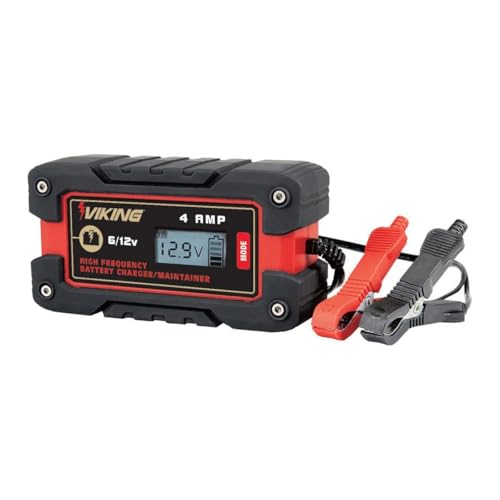
Viking-Compatible 4A Charger/Maintainer is the direct Viking-compatible option in this group, with a 4-amp output and automatic maintenance mode. Its microprocessor adjusts current to battery type and condition, while the LCD shows charging mode, capacity, voltage and faults. A winter mode is included, and the 7-foot, 14-gauge cables provide useful reach from the outlet. The unit measures 6.25 by 3.25 by 2.25 inches and weighs 1.25 pounds. The fields do not establish supported battery chemistries or voltage, so confirm those match your battery before purchase.
Bottom line: Choose this when explicit Viking compatibility and a 4-amp output are the priorities.
Adakiit 4A Smart Charger

Unlike the Viking-compatible model, Adakiit 4A Smart Charger is specified for both 6V and 12V lead-acid batteries, including AGM, gel, SLA, VRLA and Pb types. Its capacity range is 4–120Ah, and the LCD reports voltage, current, mode and battery percentage. Eight charging stages include diagnosis, bulk, absorption, recondition and float; the maker says it stops automatically when full. It can serve as a trickle maintainer and includes 50A fused ring connectors. It is not identified as Viking-compatible, so choose it for a matching 6V/12V lead-acid battery rather than when that compatibility is essential.
Bottom line: Pick this for a supported 6V or 12V lead-acid battery and the 4–120Ah range.
Sailvono 4A 6V/12V Charger

Sailvono 4A 6V/12V Charger stands apart by including support for 12V LiFePO4 batteries alongside several lead-acid types, and it offers both 6V and 12V charging. Its maker describes a 10-stage program, LCD status display, maintenance, trickle charging and supply mode. The maker says its climate adaptation adjusts charging for hot and cold conditions. The compact unit measures about 4.72 by 1.97 by 9.45 inches and weighs about 1.43 pounds. Its claimed repair function is not a reason to assume every deeply discharged or damaged battery can be recovered; choose it only if the battery’s chemistry and voltage are supported.
Bottom line: Choose this when you need 4A charging with 12V LiFePO4 support.
Battery Tender 4A 6V/12V Charger

Battery Tender 4A 6V/12V Charger is another 4-amp alternative with switchable 6V or 12V operation and support for lead-acid, AGM, gel and lithium batteries. It automatically shifts from charging to float mode, and the included cable combination has 11 feet of total reach: a 6-foot AC cord plus a 5-foot DC charging cord. The package also includes ring terminals and alligator clips.
Bottom line: Pick this for switchable 6V/12V charging and the included terminal and clip cable.
15A 12V Smart Charger

15A 12V Smart Charger differs from the 4-amp options with a maximum 15-amp output, intended for 12V batteries from 4–200Ah. The maker says it supports LiFePO4 and several lead-acid types, including AGM, gel, SLA, EFB and flooded batteries. It combines charger, maintainer, desulfator and trickle functions, with a cooling fan and temperature compensation. The maker claims it can charge a 100Ah battery in 6–7 hours; actual charge time depends on battery condition and charging stage. It is not a Viking-compatible 4-amp model, so it suits buyers prioritizing higher output and a supported 12V battery.
Bottom line: Choose this only when a 12V, higher-output charger is a better fit than a 4A model.
How to Choose a Viking 4 Amp Battery Charger
Match battery voltage and chemistry first, then check output and the job you need the charger to do. A 12V charger is not a substitute for a 6V charger; a chemistry-specific program also matters, especially for lithium batteries. Among these options, only Viking-Compatible 4A Charger/Maintainer is explicitly called Viking-compatible. Adakiit 4A Smart Charger supports 6V/12V lead-acid batteries in a 4–120Ah range, while Sailvono 4A 6V/12V Charger adds 12V LiFePO4 support. 15A 12V Smart Charger is a 12V, up-to-15A option rather than a direct 4A match. For a 12V battery rated above 120Ah, Adakiit 4A Smart Charger falls outside its capacity range. Check the battery label for voltage and chemistry before connecting any charger.
What 4 Amps Means for Charging Time
A 4A charger can supply at most about 4 amp-hours of charge per hour before charging losses and the slower final charging stage; a 40Ah battery therefore needs at least 10 hours from empty in ideal arithmetic, and typically longer in practice. Battery condition and starting charge change the real time. Use a charger’s amp-hour capacity range when the maker provides one: Adakiit 4A Smart Charger states 4–120Ah, while 15A 12V Smart Charger states 4–200Ah but has a different 15A maximum output. A charger is for replenishing a battery, not necessarily supporting vehicle electronics during service. Never connect a charger until its output voltage matches the battery.
Battery Charger Features and Battery Types
Lead-acid batteries include flooded, AGM and gel designs, and charging profiles are not interchangeable across every chemistry. Lithium batteries likewise require a charger mode made for the specific lithium chemistry and voltage. The multi-stage labels—bulk, absorption and float—describe common charging phases: bulk replenishes quickly, absorption tapers current near full, and float maintains charge. A desulfation or repair mode should not be treated as a guaranteed way to restore a failed battery. For long-term parked storage, use a maintainer mode designed for the battery type and inspect connections periodically.
Safe Connection and Maintenance Basics
Connect positive to positive and negative to the designated negative point, following the battery and charger manuals; reversing polarity can damage equipment or cause sparks. Charge lead-acid batteries in a ventilated area because charging can release hydrogen, an explosive gas. Keep flames, smoking materials and sparks away, and do not charge a visibly damaged, leaking or frozen battery. Disconnect AC power before removing clamps, then store cables without exposed metal ends touching. For a battery that repeatedly goes flat, check the vehicle’s charging system and parasitic draw rather than relying on a maintainer to solve the underlying fault. Stop if a battery becomes unusually hot, swells or vents during charging.
Frequently Asked Questions
How long does a 4 amp charger take to charge a battery?
A 4A charger needs at least about 10 hours to deliver 40Ah in ideal arithmetic, and real charging usually takes longer. Starting charge, battery condition and the slower final charging stage affect total time.
Can I use a 12V charger on a 6V battery?
No; the charger voltage must match the battery voltage. Use a selectable 6V/12V mode only after confirming the correct setting before connecting it.
Can a battery maintainer stay connected all winter?
A maintainer designed for the battery’s chemistry can be used for storage, but inspect the battery and cable connections periodically. Lead-acid charging requires ventilation because hydrogen gas can accumulate.
Do AGM batteries need a special charger mode?
Use an AGM-compatible charging profile, since AGM is a lead-acid design with charging needs that can differ from flooded batteries. Check the battery label and select a charger mode that expressly supports AGM.
What does float mode do on a battery charger?
Float mode maintains a charged battery with a lower sustaining charge rather than continuing the faster bulk charge. Automatic transition to float is useful for storage, provided the charger supports that battery type.