
Best Self-Propelled Walk-Behind String Trimmers Compared

The BILT HARD self-propelled walk-behind string trimmer suits most buyers who want less pushing, with its 1.9 mph drive and 22-inch cutting diameter. Choose a push model if you prefer a simpler walking pace or need a specific feature such as an offset head for trimming along fences.
We earn a commission if you buy through links on this page. As an Amazon Associate I earn from qualifying purchases. Products are compared on manufacturer specifications, not hands-on testing.
- Best overall: BILT HARD Self-Propelled 22-Inch Trimmer – Self-propelled drive moves at 1.9 mph, paired with a 22-inch cutting diameter.
- Best for large wheels: BILT HARD 22-Inch Push Trimmer – Its 14-inch flat-free wheels are larger than the 10-inch wheels on the self-propelled model.
- Best for fence lines: YARDMAX YL2250 22-Inch Trimmer – The offset head is designed to trim straight along fences and landscaping.
| Product | Best for | Drive | Wheel diameter | Shop |
|---|---|---|---|---|
| BILT HARD Self-Propelled 22-Inch Trimmer | Less pushing | Self-propelled, 1.9 mph | 10 in. | Check Price on Amazon |
| BILT HARD 22-Inch Push Trimmer | Larger wheels | Push | 14 in. | Check Price on Amazon |
| YARDMAX YL2250 22-Inch Trimmer | Fence-line trimming | Push | 14 in. | Check Price on Amazon |
Walk-Behind String Trimmers
Compare drive style, cutting width and wheel size to match a trimmer to your terrain and mowing priorities.
BILT HARD Self-Propelled 22-Inch Trimmer

The self-propelled drive is the key distinction: it moves at 1.9 mph, so the operator guides the trimmer rather than supplying all of its forward motion. The machine has a 170cc, 4-cycle engine, a 22-inch cutting diameter, eight height positions and 10-inch flat-free wheels. Those features suit larger or uneven areas where less pushing is a priority. Its wheel diameter is smaller than the 14-inch wheels on the push alternatives, so buyers who value larger wheels over powered movement may prefer a different fit.
Bottom line: Choose this if reducing pushing effort matters more than having larger wheels.
BILT HARD 22-Inch Push Trimmer

The 14-inch flat-free wheels set this push model apart from the other choices, which have smaller wheels or no wheel size given. It pairs those wheels with a 170cc, 4-cycle engine, a 22-inch cutting diameter, a one-piece steel deck and foldable handle. The push design suits buyers who want a walk-behind machine without the self-propelled drive. On slopes or long routes, the operator must provide the forward motion; choose the self-propelled option if minimizing that effort is the main goal.
Bottom line: Pick this for 14-inch flat-free wheels and a push-style machine.
YARDMAX YL2250 22-Inch Trimmer
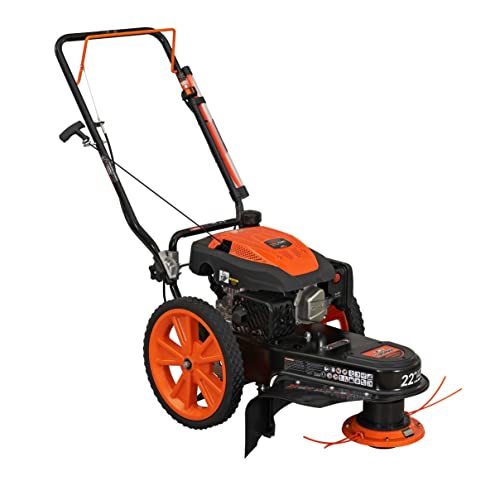
The offset head is the defining feature for trimming straight along fence lines, barns and landscaping without repeatedly moving in and out. This 22-inch walk-behind model has a 170cc gas engine, five tool-free cutting-height settings from 1.5 to 3.5 inches, 14-inch ball-bearing wheels and onboard line storage. It suits buyers who prioritize edging access and height adjustment. Unlike the BILT HARD self-propelled model, the features do not include powered drive, so it is not the choice for someone seeking assistance moving forward.
Bottom line: Choose this when an offset head and five cutting heights fit the job.
How to Choose a Walk-Behind String Trimmer
Choose first between powered drive and push operation, then weigh cutting width against maneuverability. A 22-inch cutting path covers more width per pass than a 12-inch handheld trimmer, but a walk-behind machine needs room to turn and store. Self-propelled drive can reduce pushing effort; a push model keeps the operator in control of its walking pace. For an area with fences, barns or landscaping, an offset head can help reach along edges without moving in and out as often. Check gate openings and storage space before choosing: the machines span roughly 21.6 to 22.5 inches in width, and handles or attachments may affect usable clearance.
Walk-Behind Trimmer Drive and Wheel Fit
Drive type and wheel size affect how much work the operator does on a long or uneven route. The self-propelled option here is rated at 1.9 mph, while the push models require the operator to move them. The push BILT HARD and YARDMAX machines have 14-inch wheels; the self-propelled BILT HARD has 10-inch flat-free wheels. As a practical rule, if you expect long passes or slopes and want less pushing, favor self-propelled drive; for shorter, controlled passes, a push model may be sufficient. Wheel diameter alone does not guarantee traction or slope capability, so match the machine to your terrain and safe footing.
Cutting Height, Line and Brush Conditions
Cutting height helps determine whether a trimmer clips short grass or leaves more growth standing. The YARDMAX offers five settings from 1.5 to 3.5 inches, while the self-propelled BILT HARD has eight positions. Avoid removing more than about one-third of grass height in a single pass; tall growth may call for a higher first cut followed by a lower pass. Nylon line is intended for grass and weeds, not woody stems or saplings; dense woody growth calls for a tool designed for that material. Keep line diameter and replacement length compatible with the machine, since line that is too long or thick can overload the cutting head.
Safe Operation and Basic Care
Wear eye protection, hearing protection, sturdy footwear and long pants because spinning line can throw stones and debris. Keep bystanders well clear of the cutting area, and never clear or service the cutting head while the engine is running; allow moving parts to stop first. Gas engines also produce carbon monoxide, so start and operate them outdoors, never in a garage or enclosed shed. For 4-cycle engines, check the oil before use and follow the engine manual for oil changes, air-filter care and fuel handling; maintenance intervals depend on the engine. Clear grass buildup only with the engine off and cool, and inspect the line and guards before each session.
Frequently Asked Questions
Are walk-behind string trimmers good for tall weeds?
Walk-behind string trimmers can cut tall grass and weeds when fitted with compatible nylon line. For very tall growth, take an initial higher pass and lower the cutting height on a later pass rather than removing more than about one-third of grass height at once.
Can a walk-behind trimmer cut small saplings?
Nylon line is intended for grass and weeds, not woody stems or saplings. Use a tool designed for woody growth, and keep people clear of the cutting area because debris can be thrown.
How wide is a typical walk-behind string trimmer path?
A 22-inch cutting diameter is common among the three walk-behind options compared here. A wider path covers more ground per pass, but narrow gates and tight turns may favor a smaller machine.
What protective gear should I wear when trimming?
Wear eye and hearing protection, long pants and sturdy footwear whenever operating a string trimmer. Keep bystanders well away from the work area, since spinning line can propel stones and other debris.
Can I run a gas trimmer inside a garage?
No; operate a gas-powered trimmer outdoors because its engine produces carbon monoxide. Allow the engine and moving parts to stop before clearing grass or servicing the cutting head.