
Vortex Crossfire II: 4 Scopes Compared by Fit

For a crossbow, the 2-7×32 Crossfire II Crossbow Scope Kit is the direct fit, with an XBR-2 reticle built for a 40-yard zero and holdovers from 20 to 100 yards. Choose a different model if you need a riflescope for a firearm, such as a 3-9x hunting setup or a 3-12x option for low-light hunting.
We earn a commission if you buy through links on this page. As an Amazon Associate I earn from qualifying purchases. Products are compared on manufacturer specifications, not hands-on testing.
- Best overall: Vortex Crossfire II Crossbow 2-7×32 – The crossbow-specific XBR-2 reticle supports a 40-yard zero and holdovers from 20 to 100 yards.
- Best for general hunting: Vortex Crossfire II 3-9×40 V-Plex – The 3-9×40 model pairs a V-Plex all-purpose hunting reticle with a 1-inch tube.
- Best for holdover: Vortex Crossfire II 3-9×50 Dead-Hold BDC – The Dead-Hold BDC reticle is intended for varying ranges where estimating holdover is a concern.
- Best for low light: Vortex Crossfire II Hog Hunter 3-12×56 – The 56mm objective and V-Brite reticle target low-light hunting conditions.
| Product | Best for | Magnification | Objective | Reticle | Shop |
|---|---|---|---|---|---|
| Vortex Crossfire II Crossbow 2-7×32 | Crossbow setups | 2-7x | 32 mm | XBR-2 | Check Price on Amazon |
| Vortex Crossfire II 3-9×40 V-Plex | General hunting | 3-9x | 40 mm | V-Plex | Check Price on Amazon |
| Vortex Crossfire II 3-9×50 Dead-Hold BDC | Variable-range hunting | 3-9x | 50 mm | Dead-Hold BDC | Check Price on Amazon |
| Vortex Crossfire II Hog Hunter 3-12×56 | Low-light hunting | 3-12x | 56 mm | V-Brite | Check Price on Amazon |
Vortex Crossfire II scopes
Start with the optic type and reticle, then match magnification and objective size to your setup.
Vortex Crossfire II Crossbow 2-7×32
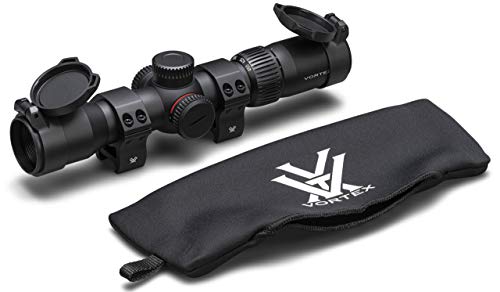
The 2-7×32 crossbow model is the only option here designed around a crossbow reticle. Its XBR-2 is intended for a 40-yard zero and fast holdovers from 20 to 100 yards, while dual red/green illumination offers two color choices. The kit includes 30mm rings, flip caps and a neoprene cover, so it suits a buyer who wants those accessories with the scope. The magnification ring also carries an FPS marking for compatibility with different setups. Confirm the marked FPS range works with your bow before choosing this model.
Bottom line: Choose this if your setup is a crossbow and its FPS range matches the scope markings.
Vortex Crossfire II 3-9×40 V-Plex

The V-Plex reticle distinguishes this 3-9×40 riflescope as the general-purpose hunting choice rather than a crossbow optic. Its 1-inch tube and second focal plane layout suit a conventional riflescope setup, while the fast-focus eyepiece and forgiving eye box support quick sight acquisition. Vortex says its fully multi-coated lenses are anti-reflective and its O-ring-sealed, nitrogen-purged construction is waterproof and fogproof. The V-Plex does not provide the crossbow-specific holdover marks of the XBR-2, so choose another model if those references are central to your setup.
Bottom line: Pick this for general hunting with a riflescope and a V-Plex reticle.
Vortex Crossfire II 3-9×50 Dead-Hold BDC

The Dead-Hold BDC reticle sets this 3-9×50 riflescope apart for hunters who want holdover references at varying ranges. It shares the line’s fast-focus eyepiece, forgiving eye box and one-piece aircraft-grade aluminum tube, but has a larger objective than the 40mm V-Plex alternative. Vortex says the O-ring-sealed, nitrogen-purged scope is waterproof and fogproof. The reticle is not the XBR-2 crossbow pattern, and its holdover marks do not replace confirming your rifle’s zero and trajectory; this option is for a compatible firearm setup.
Bottom line: Choose this for a rifle setup where BDC holdover references are useful.
Vortex Crossfire II Hog Hunter 3-12×56

The Hog Hunter stretches magnification to 12x and uses a 56mm objective with an illuminated V-Brite reticle, making it the low-light-oriented riflescope among these choices. Its adjustable objective provides image focus and parallax removal, and capped reset turrets use MOA clicks. Vortex says the lenses are fully multi-coated and anti-reflective; the fast-focus eyepiece and forgiving eye box remain useful for acquiring a sight picture. This is a larger-objective rifle scope, not a crossbow scope, so its reticle and configuration are the wrong match for crossbow holdovers.
Bottom line: Pick this for a rifle used in dim conditions where the larger objective and adjustable objective fit your needs.
How to choose a Crossfire II scope
Choose by optic type and reticle first; magnification alone does not make a riflescope suitable for a crossbow. The Crossbow model uses the XBR-2 pattern for a 40-yard zero and holdovers from 20 to 100 yards, while the V-Plex is an all-purpose hunting reticle and Dead-Hold BDC is intended for varying-range holdover. A useful decision rule is to select the crossbow model only when its FPS marking covers your bow’s setup; otherwise, the holdover references may not align with the intended configuration. For rifle use, decide whether a general-purpose reticle or BDC references fit your shooting needs. Then compare objective size, magnification range and mounting dimensions.
Objective size and light gathering
A larger objective lens can make a scope exit pupil larger at a given magnification, but it does not guarantee a brighter image in every condition. Exit pupil is objective diameter divided by magnification: a 40mm objective at 8x yields 5mm, while a 50mm objective at 10x also yields 5mm. Eye position and ambient light affect the perceived view, and high magnification reduces exit pupil. A 56mm scope can offer a larger exit pupil at the same power than a 40mm scope, but adds physical bulk; check that your firearm’s mounting height and clearance accommodate the objective bell. Lens coatings reduce reflections but cannot create light when the scene is dark.
Crossbow scopes and riflescopes compared
Crossbow optics and rifle scopes use different reticle assumptions, so match the model to the launching system rather than treating them as interchangeable. The XBR-2 here is designed for crossbow holdovers and includes FPS markings on its magnification ring; the other options are riflescopes with V-Plex, Dead-Hold BDC or V-Brite reticles. The table summarizes the practical distinction: choose the crossbow-specific option for its calibrated references, and choose among rifle optics by intended reticle and magnification. All four product types differ in purpose, so a matching reticle is more important than sharing a brand name.
| Use | Reticle choice | What to match |
|---|---|---|
| Crossbow | XBR-2 | Bow FPS marking and 40-yard zero |
| General rifle hunting | V-Plex | Magnification and mounting fit |
| Varying-range rifle hunting | Dead-Hold BDC | Rifle zero and trajectory |
| Dim-condition rifle use | V-Brite | Objective clearance and parallax setup |
Mounting and zeroing an optic safely
Use rings that match the scope tube diameter and firearm rail, and ensure the objective bell clears the barrel and action through the full adjustment range. A scope that contacts the firearm or has poor eye relief can interfere with a stable position; verify clearance before tightening mounts. After installation, zero at a known distance on a safe range, then confirm any holdover marks against the actual setup rather than assuming a reticle label guarantees a trajectory. Crossbow users should match the FPS marking and verify the intended zero and holds with their own bolts. Keep the muzzle pointed in a safe direction and follow the firearm or crossbow manufacturer’s handling rules.
Frequently Asked Questions
What does a second focal plane scope do?
A second focal plane reticle appears the same size as magnification changes, so its subtensions are generally valid only at a designated power. Check the model’s instructions for the power at which any reticle references are intended to be used.
How do I match a crossbow scope to FPS?
Match the bow’s rated bolt speed to the FPS markings on the scope’s magnification ring. The crossbow model’s XBR-2 is intended for a 40-yard zero, with holdovers spanning 20 to 100 yards; confirm those marks against your bow and bolts.
Does a larger objective always look brighter?
No; brightness also depends on magnification, coatings, eye position and available light. Compare exit pupil by dividing objective diameter by power—for example, 50mm at 10x gives 5mm.
What does an adjustable objective change?
An adjustable objective lets the shooter focus the image and remove parallax at the chosen distance. Parallax can cause apparent reticle movement over the target when eye position shifts, so adjust it at the distance you are using.
Why does a BDC reticle need confirmation?
BDC marks rely on the firearm’s zero, ammunition and trajectory, so their point of impact can differ from the intended hold. Confirm each reference at a safe range before relying on it in the field.