
Waistband Amplifiers With Lithium Batteries Compared

For a waistband amplifier with a lithium battery, HZXINWANG Portable Amplifier is the clearest match because it has a built-in 2,200mAh lithium battery and an adjustable strap for waist wear. Choose Pyle PWMA50B Portable PA instead if you want a headset, waist-band strap and a 50-watt speaker; the other options are portable voice amplifiers but do not establish both waist wear and lithium power.
We earn a commission if you buy through links on this page. As an Amazon Associate I earn from qualifying purchases. Products are compared on manufacturer specifications, not hands-on testing.
- Best overall: HZXINWANG Portable Amplifier – Combines a 2,200mAh lithium battery, adjustable waist strap and belt clip.
- Best for higher output: Pyle PWMA50B Portable PA – Pairs a 50-watt speaker with a waist-band strap and a 1,600mAh lithium battery.
| Product | Best for | Battery capacity | Speaker output | Wearing option | Shop |
|---|---|---|---|---|---|
| HZXINWANG Portable Amplifier | Waist wear | 2,200mAh | — | Adjustable strap, belt clip | Check Price on Amazon |
| Pyle PWMA50B Portable PA | Higher output | 1,600mAh | 50 watts | Waist-band strap | Check Price on Amazon |
| Portable Voice Amplifier, 2,200mAh | Audio playback | 2,200mAh | 8 watts | — | Check Price on Amazon |
| Norwii Teacher Voice Amplifier | Feedback control | 4,000mAh | 10 watts | — | Check Price on Amazon |
| ZOWEETEK Original Voice Amplifier | Long music playback | 1,800mAh | 10 watts | — | Check Price on Amazon |
Waistband Amplifiers With Lithium Batteries
Compare battery capacity, output and wearing options to find the right portable voice amplifier for your routine.
HZXINWANG Portable Amplifier

Waist wear is the distinguishing feature of this model: the HZXINWANG amplifier has an adjustable strap and a rear clip for a belt or trouser waistband. Its built-in 2,200mAh rechargeable lithium battery is claimed to provide up to 20 hours of continuous use, with a 3-hour recharge time. At 210 grams, it is intended for portable voice amplification during activities such as teaching, guiding or outdoor yoga. The 1,000-square-meter sound range is a coverage claim, not a guarantee for every room; room shape, background noise and speaker placement affect audibility.
Bottom line: Pick this if a wearable strap and long claimed run time matter more than a published wattage figure.
Pyle PWMA50B Portable PA

The Pyle PWMA50B separates itself with a 50-watt speaker and a waist-band strap. Its built-in 7.4V, 1,600mAh lithium battery is claimed to run for more than 8 hours during karaoke or music playback, and the headset uses a flexible gooseneck to position the microphone near the mouth. An auxiliary 3.5mm jack accepts external audio devices. The specifications do not give a separate voice-amplification run time, so buyers who need a guaranteed work shift should confirm that duration before ordering.
Bottom line: Choose this when higher stated wattage, a headset and an auxiliary input are priorities.
Portable Voice Amplifier, 2,200mAh

Audio playback options distinguish this compact classroom-oriented amplifier: it supports TF-card and USB flash-drive playback, alongside its headset microphone. The maker claims up to 8 watts of output and coverage for 25 to 100 people, while the product name gives a 2,200mAh rechargeable battery. Its small form is suited to presentations, teaching and tours where playing stored audio is useful.
Bottom line: Pick this for TF-card or USB playback if waist attachment and confirmed lithium chemistry are not essential.
Norwii Teacher Voice Amplifier
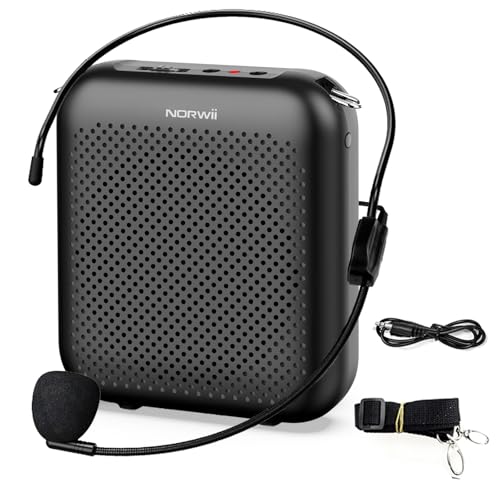
Feedback control sets the Norwii apart: its maker says frequency-shifting technology helps suppress ear-piercing feedback, and it uses a wired headset microphone with a 3-inch speaker. The product name identifies a 4,000mAh battery, and the maker gives a 10-watt output rating. This portable indoor model is aimed at teachers and instructors who want to project their voice without holding a microphone. The specifications do not establish lithium chemistry or a waistband strap, so it does not meet the full wearable-lithium requirement.
Bottom line: Choose this for its feedback-control feature if the missing waist-wear match is acceptable.
ZOWEETEK Original Voice Amplifier

Separate voice and music run-time claims make the ZOWEETEK useful for mixed speaking and playback: the maker says its built-in 1,800mAh lithium battery supports up to 12 hours of amplification and up to 10 hours of music. It has a maximum 10-watt output, and the maker claims coverage of about 10,000 square feet. TF-card support is also included. The specifications do not establish a waistband strap or belt clip, so this is a partial match for buyers who need a wearable amplifier rather than simply a portable one.
Bottom line: Pick this for its separate claimed voice and music run times, not for confirmed waistband wear.
How to choose a waistband voice amplifier
Choose by attachment, microphone setup and the task before comparing output claims. A belt clip holds the speaker in one spot, while a strap can make it wearable without a compatible belt; check that the attachment will stay secure as you move. Headset microphones keep the microphone close to the speaker’s mouth and leave both hands free. For intelligible speech, position the mic close to the mouth without touching it, and keep it away from clothing that may rub. Output wattage alone does not predict room coverage: room size, layout, background noise and speaker direction all matter. If you need a specific work-shift duration, prioritize a clearly stated voice-amplification run time rather than a music-playback claim.
Battery capacity and run time
Battery capacity in milliamp-hours (mAh) is useful for comparing batteries at the same voltage, but capacity alone does not determine how long an amplifier runs. Speaker volume, audio playback and battery condition can change real-world run time, and music and voice use may have different claims. Compare each model’s use case and recharge time, not just the largest mAh number. Lithium-ion batteries are commonly charged with a charger matched to the device; using an incompatible charger can damage the battery. Avoid charging a device that is hot, swollen or visibly damaged, and stop using it if the battery shows those signs.
Wear and position the amplifier for clear speech
Keep the speaker opening unobstructed and place a clipped unit where clothing or a bag will not cover it. A headset mic works best close to the mouth, but a few inches of distance can reduce breath noise and plosive sounds; adjust it rather than turning up the speaker first. Feedback happens when amplified sound re-enters the microphone, so increase the distance between mic and speaker or turn the microphone away from the speaker if a squeal starts. For a moving class or tour, test speech at the farthest listening point and adjust placement before raising volume. A louder setting can drain the battery more quickly.
Waistband amplifier features compared
Choose the model by the feature you need most: confirmed waist attachment, a speaker output or a particular playback option. A speaker’s watt rating does not translate directly into an exact room-size limit because layout and ambient noise change what listeners can hear. Battery run-time figures also refer to different kinds of use, so they are not directly interchangeable. Use this comparison to narrow the type of fit you need, then check the manufacturer’s runtime claim against your speaking schedule.
| Need | Useful feature | What to compare |
|---|---|---|
| Wear while moving | Strap or belt clip | How the unit attaches |
| Speak hands-free | Headset microphone | Microphone position and cable |
| Play stored audio | TF-card or USB support | Supported input type |
| Cover a full shift | Voice-use run-time claim | Use mode and recharge time |
Frequently Asked Questions
Does a higher mAh rating always mean longer use?
No; mAh is only a useful direct comparison when battery voltage and operating conditions are similar. Speaker volume and music playback can also affect run time, so compare the claimed use mode as well as capacity.
Where should I position a headset microphone?
Place the microphone close to the corner of your mouth, usually a few inches away, and keep it from brushing against clothing. If breath sounds are distracting, move it slightly farther away rather than increasing speaker volume.
How can I reduce feedback from a voice amplifier?
Increase the distance between the microphone and speaker, and point the microphone away from the speaker. Feedback is more likely when amplified sound re-enters the mic, especially at high volume.
Can a voice amplifier play music as well as speech?
Some models support stored audio through inputs such as TF cards or USB drives, while others include an auxiliary audio jack. Music playback may have a different battery run-time claim from voice amplification.
What should I check before wearing an amplifier on a belt?
Confirm the unit has a clip or strap that fits the clothing you plan to wear and will not be covered during use. A clear speaker opening and a microphone positioned close to the mouth help keep speech audible without unnecessarily raising volume.