
Water Softener for Mobile Home: 3 Models Compared

For many mobile homes, Aquasure Harmony 50,000-Grain is the strongest starting point because it offers 50,000 grains of capacity in a 48-inch-tall unit. Choose a different model if a smaller footprint or a lower capacity better matches your utility space and water use.
A whole-house water softener treats incoming water before it reaches the home’s fixtures; capacity should be matched to measured hardness and household demand, not bathroom count alone.
We earn a commission if you buy through links on this page. As an Amazon Associate I earn from qualifying purchases. Products are compared on manufacturer specifications, not hands-on testing.
- Best overall: Aquasure Harmony 50,000-Grain – It combines the highest capacity here, 50,000 grains, with a 48-inch height.
- Best for tight footprints: Aquasure Harmony 40,000-Grain – Its 9-by-9-inch footprint is the smallest among these whole-house units.
- Best for larger capacity: Aquasure Harmony 48,000-Grain – Its 48,000-grain rating exceeds the 40,000-grain model’s capacity.
| Product | Best for | Capacity | Height | Footprint | Shop |
|---|---|---|---|---|---|
| Aquasure Harmony 50,000-Grain | Higher capacity | 50,000 grains | 48 in | 11 × 11 in | Check Price on Amazon |
| Aquasure Harmony 48,000-Grain | Metered control | 48,000 grains | 62 in | 10 × 10 in | Check Price on Amazon |
| Aquasure Harmony 40,000-Grain | Small footprint | 40,000 grains | 55 in | 9 × 9 in | Check Price on Amazon |
Water Softeners for Mobile Homes
Compare capacity and dimensions, then size a whole-house unit to your water hardness and household demand.
Aquasure Harmony 50,000-Grain
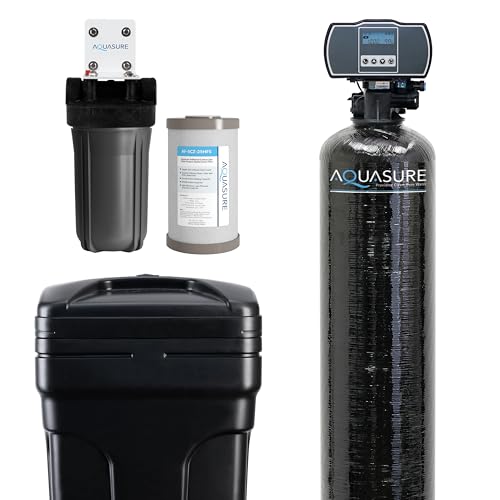
At 50,000 grains, this model has the largest rated capacity among the whole-house options here, while its 48-inch height is shorter than the other two. It is a whole-house unit with an automatic digital metered control head and a pre-filter. The manufacturer says its triple-purpose sediment/GAC/zinc pre-filter removes 99% of listed contaminants. Its 11-by-11-inch footprint is larger than the 40,000-grain model’s, so measure the planned installation space, including room for plumbing and service access. Its 3–4-bathroom sizing claim does not replace calculating capacity from actual hardness and use.
Bottom line: Pick this if the 48-inch height works and your measured demand justifies its larger capacity.
Aquasure Harmony 48,000-Grain

The 48,000-grain capacity sits between the other two whole-house models, and this unit has a 10-by-10-inch footprint. Its 62-inch height is the tallest of the group, which can matter in a mobile home’s utility closet or under a low ceiling. The manufacturer describes the control head as high-efficiency and digital metered, and says the system is designed for 3–4 bathrooms. A triple-purpose sediment/carbon/zinc pre-filter is included. Before choosing it, check overhead clearance and access to the connection and service points; its height may rule it out where a shorter cabinet would fit.
Bottom line: Choose this when its intermediate capacity and 10-inch footprint suit the installation space.
Aquasure Harmony 40,000-Grain

The 9-by-9-inch footprint is the smallest among these whole-house models, making this the space-conscious option on the floor. It has a 40,000-grain rating and stands 55 inches tall, between the heights of the other two units. The manufacturer says it includes an automatic digital metered control head and a triple-purpose sediment/GAC/zinc pre-filter that removes 99% of listed contaminants; its bathroom range is 3–4. The smaller footprint does not make it the right capacity for every household. Compare its rating with hardness and daily use, and confirm there is room above and around it for installation and service.
Bottom line: Pick this when floor width is constrained and the 40,000-grain rating fits your calculated demand.
How to size a mobile home water softener
Size a water softener by multiplying hardness in grains per gallon by daily water use, then by the number of days between regenerations. A planning estimate of 75 gallons per person per day is a useful starting point; actual use changes with laundry, bathing and other habits. For example, 3 people using 75 gallons each with 10 gpg hardness create about 2,250 grains of daily demand, or 15,750 grains over 7 days. Choose capacity with enough reserve so regeneration does not wait until resin is exhausted. Bathroom count is only a rough sizing clue. Get a hardness test for the home’s water source, then compare the result and household use with the unit capacity.
Fit a whole-house softener into a mobile home
Measure the installation area before selecting a cabinet: height, floor footprint, plumbing clearance and room to reach the control head all matter. A unit under a countertop or in a narrow closet can fail the fit check even if its base fits. A softener needs a connection to the home’s incoming water, a drain path for regeneration discharge and access to electrical power if its control head requires it. The product dimensions are not the full service envelope. Leave workable space for salt replenishment and maintenance, and verify that the planned drain and electrical setup meet the home’s requirements. If the space is shorter than 48 inches, none of these three listed whole-house units fits by height.
Compare capacity and footprint
Use the capacity and dimensions together: a smaller floor footprint does not indicate lower height or better fit in every utility area. The table compares only the whole-house models by the figures supplied.
| Model capacity | Height | Footprint |
|---|---|---|
| 40,000 grains | 55 in | 9 × 9 in |
| 48,000 grains | 62 in | 10 × 10 in |
| 50,000 grains | 48 in | 11 × 11 in |
Capacity describes the rated amount of hardness the resin can capture between regenerations, not a guaranteed number of days of use. Higher hardness or greater household water use consumes that capacity faster. With less than 48 inches of vertical clearance, seek a shorter unit rather than relying on a bathroom range.
What to check before installation
Test hardness before choosing a capacity, and check whether the water also contains iron because iron can affect softener operation and may call for pretreatment. Sodium-based ion exchange swaps hardness minerals for sodium; households with sodium restrictions should discuss alternatives with a qualified water professional. Regeneration uses salt and sends brine to a drain, so confirm that local plumbing arrangements allow the discharge. Keep the bypass valve accessible so water can be routed around the softener during service. Do not treat a softener as a general-purpose drinking-water purifier: a softener addresses hardness, while separate treatment may be needed for other water concerns.
Frequently Asked Questions
How many grains should a mobile home softener have?
Capacity depends on hardness and daily use, not home type alone. At 10 gpg and 225 gallons per day, a household uses about 2,250 grains of softening capacity daily before reserve needs are considered.
How often does a water softener regenerate?
A metered softener regenerates when its remaining capacity reaches a set threshold, so the interval changes with water hardness and use. At 10 gpg and 225 gallons per day, demand is about 2,250 grains per day.
Does a water softener remove all contaminants?
No, a conventional ion-exchange softener targets hardness minerals such as calcium and magnesium. It is not a substitute for treatment selected for bacteria, nitrates or other specific contaminants.
Can a water softener fit in a mobile home closet?
It can if the closet accommodates the unit’s height and footprint plus plumbing, drain and service access. Measure the clear opening and overhead space; the shortest unit here is 48 inches tall.
Does soft water contain more sodium?
Sodium-based ion exchange adds sodium as it removes hardness minerals, and the amount depends in part on source-water hardness. People limiting sodium should ask a clinician or water-treatment professional about suitable options.