
Waterproof Heat Shrink Connectors: 5 Kits Compared

For most wiring jobs, haisstronica 330-Piece Butt Connectors is the most versatile pick because its 330 heat-shrink butt connectors span 26–10 AWG in four color-coded sizes. Choose Kuject 120-Piece Solder-Seal Kit instead if you specifically want solder-seal splices that use a heat gun without crimping; the other kits suit buyers who need assorted terminal styles or a smaller quantity.
We earn a commission if you buy through links on this page. As an Amazon Associate I earn from qualifying purchases. Products are compared on manufacturer specifications, not hands-on testing.
- Best overall: haisstronica 330-Piece Butt Connectors – A 330-piece butt-connector kit covers four color-coded wire ranges from 26–10 AWG.
- Best for solder-seal splices: Kuject 120-Piece Solder-Seal Kit – Its solder-seal butt connectors join wires with a heat gun rather than crimping.
- Best for mixed terminal styles: Kuject 320-Piece Mixed-Terminal Kit – The 320-piece kit includes ring, fork, spade and butt connectors.
| Product | Best for | Quantity | Wire range | Connector styles | Shop |
|---|---|---|---|---|---|
| haisstronica 330-Piece Butt Connectors | Broad gauge coverage | 330 pieces | 26–10 AWG | Butt connectors | Check Price on Amazon |
| Kuject 120-Piece Solder-Seal Kit | No-crimp splicing | 120 pieces | 26–10 AWG | Solder-seal butt connectors | Check Price on Amazon |
| Kuject 320-Piece Mixed-Terminal Kit | Mixed terminal needs | 320 pieces | — | Ring, fork, spade, butt | Check Price on Amazon |
| AIRIC 100-Piece Butt Connector Kit | Basic gauge grouping | 100 pieces | 22–10 AWG | Butt connectors | Check Price on Amazon |
| Oiojuct 600-Piece Mixed Connector Kit | Large assortments | 600 pieces | — | Butt, ring, fork, spade | Check Price on Amazon |
Waterproof Heat Shrink Connectors Compared
Match wire gauge and terminal style first, then choose a kit with the quantity and connector mix your wiring job requires.
haisstronica 330-Piece Butt Connectors

haisstronica 330-Piece Butt Connectors stands out for its four wire-size groups, including 48 pieces for 26–24 AWG and 32 for 12–10 AWG. The kit uses copper-core butt connectors with adhesive-lined heat-shrink tubing, and the maker says the tubing helps seal the connection. It suits buyers who want a broad gauge range in one crimp-connector kit. The limitation is that it contains butt connectors rather than ring, fork or spade terminals, so it is a less suitable choice when a job calls for those terminal shapes.
Bottom line: Choose this kit for a broad range of wire gauges in butt-splice form.
Kuject 120-Piece Solder-Seal Kit

Kuject 120-Piece Solder-Seal Kit differs from the crimp-terminal kits because its butt connectors use a built-in solder ring and two hot-melt adhesive rings. The maker says a heat gun completes the joint without a separate crimping or soldering step, which can help in narrow work areas. The assortment covers 26–10 AWG and contains 120 pieces. This kit suits someone seeking solder-seal splices rather than conventional crimp terminals; it is not the pick for a job that needs ring, fork or spade ends.
Bottom line: Pick this kit when solder-seal, heat-gun connections are the priority.
Kuject 320-Piece Mixed-Terminal Kit
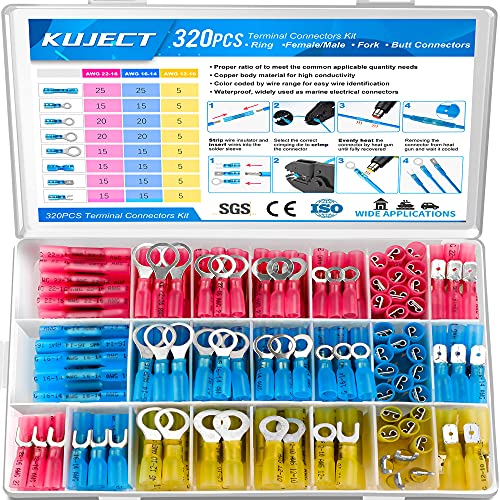
Kuject 320-Piece Mixed-Terminal Kit is the mixed-terminal choice: its 320-piece assortment combines ring, fork, spade and butt connectors. The maker says the translucent adhesive-lined tubing allows visual inspection and seals around the barrel when heated. That variety suits vehicle or boat wiring projects that need more than inline splices. The specifications do not give a wire-gauge range, so confirm that its terminals fit the wire sizes in your project before choosing it; buyers needing a gauge span should consider a different kit.
Bottom line: Choose this assortment when several terminal shapes matter more than a gauge span.
AIRIC 100-Piece Butt Connector Kit

AIRIC 100-Piece Butt Connector Kit keeps the assortment focused on waterproof butt splices, with 50 red connectors for 22–16 AWG, 40 blue for 16–14 AWG and 10 yellow for 12–10 AWG. The specifications identify a seamless copper core and uses including marine, automotive and electronics wiring. Its 100-piece count makes it a straightforward fit for a smaller supply of crimp splices. The tradeoff is that its gauge coverage starts at 22 AWG, rather than extending to the finer 26–24 AWG range found in some kits.
Bottom line: Pick this kit for a smaller butt-splice assortment spanning 22–10 AWG.
Oiojuct 600-Piece Mixed Connector Kit

Oiojuct 600-Piece Mixed Connector Kit offers the largest quantity at 600 pieces and mixes butt connectors with ring, fork and spade terminals. The maker describes the terminals as heat-shrink crimp connectors for marine and automotive electrical work. That mix suits a buyer who needs a larger assortment of several connector forms in one kit.
Bottom line: Choose this larger assortment when you need several crimp-terminal styles.
How to Choose Waterproof Heat Shrink Connectors
Start by matching the connector’s wire-gauge range to the wire, then choose the terminal shape required by the device. Butt connectors splice two wire ends inline; ring terminals fasten under a screw or stud, while fork terminals can slip beneath a loosened screw and spade terminals mate with a tab. Color coding commonly groups red for 22–16 AWG, blue for 16–14 AWG and yellow for 12–10 AWG, but follow the kit’s range when available. Use a proper crimp tool for crimp-style terminals; a solder-seal connector instead needs controlled heat to melt its solder and adhesive. For exposed marine wiring, select a sealed connector and protect the finished joint from strain and abrasion.
How to Match Wire Gauge and Connector Fit
Choose a connector whose specified AWG range includes the conductor size; AWG numbers run in reverse, so 10 AWG wire is thicker than 22 AWG wire. Strip only enough insulation to seat the bare conductor fully inside the barrel, and avoid nicking strands. A correctly sized crimp should hold the conductor without cutting it or leaving it loose. Heat-shrink tubing should cover insulation beyond the metal barrel at both ends, and adhesive should flow evenly around the seal as it shrinks. If the wire size sits outside the connector’s printed range, do not compensate by folding strands or forcing an oversized barrel; use a correctly sized terminal instead.
Crimp Connectors Versus Solder-Seal Splices
Crimp connectors use a tool to compress a metal barrel onto the conductor, while solder-seal connectors use heat to melt a solder ring around the joined wires. Both styles may have adhesive-lined tubing that shrinks around the wire, but the joining method and required tools differ. Crimp styles are available in several terminal shapes, making them useful when a wire must attach to a stud or tab instead of splice inline. Solder-seal styles keep the joint inline and require enough heat for the solder and adhesive to flow without scorching insulation. Do not treat either style as a substitute for checking wire gauge, current suitability and the installation environment.
How to Heat and Inspect a Sealed Connection
Use a heat gun rather than an open flame, which can scorch insulation or unevenly melt the tubing. Apply heat gradually around the connector and stop when the tubing has contracted and adhesive begins to appear at its ends; solder-seal types also need the solder ring to melt around the conductors. Let the joint cool before bending or loading it. Inspect for full wire insertion, a secure crimp or flowed solder, and an even seal without exposed conductor. Heat-shrink insulation does not by itself establish a current rating or make a connection safe in every wet or high-vibration setting; use terminals rated for the circuit and support the cable against pulling.
Frequently Asked Questions
What do the colors on heat shrink connectors mean?
Connector colors commonly correspond to wire-gauge groups: red often covers 22–16 AWG, blue 16–14 AWG and yellow 12–10 AWG. Check the range printed for the specific connector because color conventions can vary.
Can heat shrink connectors be used on boat wiring?
Adhesive-lined heat-shrink connectors are used for marine wiring, but the connector must match the wire gauge and the installation environment. Keep the joint mechanically supported, since sealing tubing does not protect a loose wire from vibration or pulling.
Do solder-seal connectors need a crimping tool?
Solder-seal connectors are designed to form the splice with heat rather than a separate crimp, and they require a heat gun to melt the solder ring and adhesive. Crimp-style heat-shrink terminals do need an appropriate crimping tool before the tubing is heated.
How can I tell whether a heat-shrink splice is sealed?
Look for tubing shrunk evenly over the barrel and insulation, with adhesive visible at the ends; solder-seal joints also need the solder ring to flow around the conductors. Let the connection cool before handling, and replace it if bare conductor remains exposed.