
Weber Side Draft Carburetors: 40mm and 45mm Compared

Choose a 45 DCOE when your engine and manifold are set up for its 45mm body; the options use a 36mm venturi, while the 40 DCOE has a 30mm venturi. Pick the 40 DCOE if that smaller configuration matches your setup, and choose among the 45 DCOE versions by jetting and included hardware.
A DCOE is a twin-choke side-draft carburetor, so engine fit, manifold compatibility and tuning matter more than body size alone.
We earn a commission if you buy through links on this page. As an Amazon Associate I earn from qualifying purchases. Products are compared on manufacturer specifications, not hands-on testing.
- Best overall: 45 DCOE 19600.060 – A 45 DCOE with a 36mm venturi, 145 main jet, F16 emulsion tube and 55 idle jet.
- Best for 40 DCOE setups: 40 DCOE 19550.174 – The 40mm body has a 30mm venturi and a distinct listed jet combination.
- Best for included hardware: 45 DCOE with Linkage and Gaskets – The package includes a T fuel inlet, two throttle arms and two gaskets.
| Product | Best for | Bore | Venturi | Main jet | Shop |
|---|---|---|---|---|---|
| 45 DCOE 19600.060 | 45 DCOE jetting | 45 mm | 36 mm | 145 | Check Price on Amazon |
| 45 DCOE with Gaskets and T Inlet | Jetting specification | 45 mm | 36 mm | 145 | Check Price on Amazon |
| 45 DCOE with Linkage and Gaskets | Included fittings | 45 mm | — | — | Check Price on Amazon |
| 40 DCOE 19550.174 | 40 DCOE setups | 40 mm | 30 mm | 115 | Check Price on Amazon |
Weber Side Draft Carburetors
Compare body size, choke diameter and included hardware against your engine’s manifold and tuning needs.
45 DCOE 19600.060
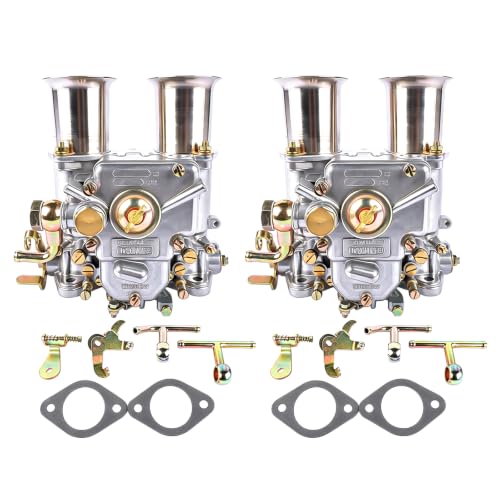
This 45 DCOE is defined by its 36mm venturi and F16 emulsion tube, with a 145 main jet, 55 idle jet and 45 pump jet. The fit range names Datsun Z cars and 510, MGB and Midget, Triumph TR6, and several other makes; treat those as starting points for checking your own manifold and linkage rather than a universal fit guarantee. It suits a setup calling for these jet sizes. Its specification does not give an auxiliary venturi or air-correction jet, so buyers who need those exact values should verify them before ordering.
Bottom line: Choose this when your setup calls for a 45 DCOE with a 36mm venturi and the jet combination.
45 DCOE with Gaskets and T Inlet

This version gives a more complete tuning specification than the other 45 DCOE options: 36mm venturi, 8mm auxiliary venturi, 145 main jet, 155 air-correction jet, F16 emulsion tube, 55 idle jet, 45 pump jet and 2 needle valve. It names Datsun Z cars and 510, MG models, Triumph TR6, and other vehicles as fitment examples, but vehicle names alone do not confirm manifold, linkage or engine compatibility. It suits buyers comparing a known jet package against an existing setup. The maker mentions gaskets and a T inlet, but does not establish their count.
Bottom line: Choose this when matching a 45 DCOE setup and you need the auxiliary venturi and air-correction jet values.
45 DCOE with Linkage and Gaskets

This 45 DCOE stands out for its included installation hardware: one T fuel inlet, two throttle arms and two gaskets. Its fitment examples cover Datsun Z models and 510, MG models, Triumph TR6, Jaguar, Porsche and others, but those broad examples do not settle whether the carburetor matches a particular manifold or throttle arrangement. It suits a buyer who needs the fittings alongside a 45mm carburetor.
Bottom line: Choose this when the included T inlet, throttle arms and gaskets matter more than published jet values.
40 DCOE 19550.174

This 40 DCOE is the smaller-bore option here, with a 30mm venturi, 115 main jet, 200 main air jet, 45 idle jet, 40 pump jet and 1.75 needle valve. Its fit range is 1975–1992 water-cooled VW 1.5–1.8-liter models with an 8-valve non-crossflow head; the product also mentions modified applications on other makes. That makes it relevant when a 40 DCOE and this calibration match the intended setup. The narrower stated fitment means buyers with other engines should confirm the required mounting and linkage configuration before ordering.
Bottom line: Choose this for a compatible VW application or a setup specifically calling for its 40 DCOE calibration.
How to choose a Weber side draft carburetor
Match the DCOE body and venturi to the engine, manifold and target airflow rather than choosing by bore alone. These options span 40mm and 45mm bodies, and their venturis range from 30mm to 36mm. A larger body does not by itself establish that an engine will run better; the choke, jets and engine combination have to work together. Use your current carburetor’s stamped sizes and jet markings as a baseline, then compare them to the option’s published combination. If your manifold’s port or mounting pattern does not match, the carburetor will not become a direct fit just because a vehicle make appears in its fitment examples.
For a setup already using a 36mm choke and 145 main jet, the 45 DCOE options are closer starting points than the 40 DCOE’s 30mm choke and 115 main jet.
DCOE venturi and jet sizing
Venturi diameter is a key sizing choice because it influences the air speed through each barrel and the engine’s response across its operating range. The 30mm and 36mm chokes are meaningfully different; do not assume that changing only the carburetor body preserves the existing tune. Main jets meter fuel at higher airflow, idle jets serve low-throttle operation, and air-correction jets shape mixture as airflow rises. Emulsion tubes also affect how fuel is mixed with air. Jet numbers are not a complete recipe because engine displacement, camshaft, exhaust and altitude can alter calibration needs.
Use this table to compare the baseline parts before confirming a match with your existing tune.
| Setup | Venturi | Main jet | Other parts |
|---|---|---|---|
| 40 DCOE | 30 mm | 115 | 200 main air, 45 idle |
| 45 DCOE options | 36 mm | 145 | 55 idle, 45 pump, F16 tube |
Check fitment before installing a side draft carburetor
Confirm the manifold pattern, throttle linkage travel, fuel inlet orientation and air-cleaner clearance before committing to a carburetor. A vehicle name in a broad fitment range does not account for engine swaps, manifold changes or linkage differences. For a replacement, compare the existing part number and measured throat and venturi sizes; for a conversion, establish that the manifold and linkage support the DCOE layout. Also verify that the fuel inlet and supplied fittings suit the fuel line routing without putting strain on the hose.
Carburetors contain fuel, so keep ignition sources away during installation and leak checks. Work with the engine off and cool, and address any fuel leak before starting; gasoline vapors can ignite readily.
Tuning and synchronization after installation
DCOE twin-choke barrels need balanced airflow, and multiple carburetors on one engine need synchronization so each cylinder group receives a comparable mixture. Start from a suitable baseline jet set, then make tuning changes only after checking for air leaks, correct fuel delivery and free throttle return. A carburetor that is mechanically misaligned or leaking at its mounting face cannot be corrected reliably by swapping jets. Tune idle behavior separately from higher-load operation because idle jets and main circuits serve different ranges.
Change one calibration variable at a time and record the result; changing the main jet, air correction and emulsion tube together makes cause and effect difficult to isolate. Use a qualified carburetor technician when the setup requires jetting beyond your experience.
Frequently Asked Questions
What does DCOE mean on a Weber carburetor?
DCOE identifies a Weber-style side-draft carburetor with two barrels and a horizontal layout. The 40 and 45 designations in these options refer to nominal body-size classes, not the venturi diameter; the venturis are 30mm and 36mm.
Can a 45 DCOE replace a 40 DCOE directly?
Not necessarily: the body size, manifold opening, throttle linkage and calibration all need to match. The options here pair the 40 DCOE with a 30mm venturi and the 45 DCOE with a 36mm venturi, so compare the actual setup before swapping.
What does a DCOE venturi do?
The venturi, also called the choke tube, narrows the airflow passage and helps draw fuel into the air stream. The choices here are 30mm and 36mm; a larger choke changes airflow characteristics and may require recalibration.
Do DCOE carburetors need synchronization?
Yes, when multiple carburetors or barrels feed separate cylinder groups, balance airflow so they operate consistently. Check for air leaks and ensure the linkage returns freely before adjusting synchronization, since mechanical faults can undermine the adjustment.
How should I check for a carburetor fuel leak safely?
Inspect fuel connections with the engine off and cool, away from sparks, flames and other ignition sources. Do not start the engine if gasoline is wetting a fitting or pooling, because fuel vapor can ignite.