
Westaho Salt Chlorine Generator Models Compared by Fit

For an inground pool up to 40,000 gallons, Westaho Inground Pool System, 40,000 Gallons is the Westaho salt chlorine generator to consider because its capacity is the largest among these pool models. Choose a different model for an above-ground pool up to 15,000 gallons or a hot tub or swim spa up to 2,200 gallons; these systems are designed for those applications.
A salt chlorine generator uses an electrolytic cell to produce chlorine from dissolved salt, rather than relying on adding chlorine separately.
We earn a commission if you buy through links on this page. As an Amazon Associate I earn from qualifying purchases. Products are compared on manufacturer specifications, not hands-on testing.
- Best overall: Westaho Inground Pool System, 40,000 Gallons – Its 40,000-gallon capacity suits larger inground pools.
- Best for above-ground pools: Westaho Above-Ground Pool System, 15,000 Gallons – Designed for above-ground pools up to 15,000 gallons.
- Best for app monitoring: Westaho Wi-Fi Spa System, 2,200 Gallons – Wi-Fi and app features provide remote salt and system monitoring for spas up to 2,200 gallons.
- Best for simple spa controls: Westaho Spa System, 2,200 Gallons – LED indicators show device status and salinity for spas up to 2,200 gallons.
| Product | Best for | Application and capacity | Cell runtime | Monitoring | Shop |
|---|---|---|---|---|---|
| Westaho Inground Pool System, 40,000 Gallons | Large inground pools | Inground pool, 40,000 gallons | Up to 10,000 hours | Control-panel readings | Check Price on Amazon |
| Westaho Above-Ground Pool System, 15,000 Gallons | Above-ground pools | Above-ground pool, 15,000 gallons | Up to 2,800 hours | Control-panel readings | Check Price on Amazon |
| Westaho Wi-Fi Spa System, 2,200 Gallons | Remote spa monitoring | Hot tub or swim spa, 2,200 gallons | 3,000+ hours | Dual-band Wi-Fi app | Check Price on Amazon |
| Westaho Spa System, 2,200 Gallons | Simple spa controls | Hot tub or swim spa, 2,200 gallons | 3,000+ hours | LED indicators | Check Price on Amazon |
Westaho salt chlorine generators
Match the generator’s intended pool or spa type and maximum capacity to your water volume before choosing features.
Westaho Inground Pool System, 40,000 Gallons

For the largest pool capacity among these options, Westaho Inground Pool System, 40,000 Gallons is designed for inground pools up to 40,000 gallons. Its control panel displays salt level, water temperature, cell lifespan, voltage and current, while the built-in protection shuts the system off below 52°F. The USA-made titanium cell has a lifespan of up to 10,000 hours. This model suits owners who want panel-based system readings and have an inground pool within its capacity; it is not the match for an above-ground pool or a spa.
Bottom line: Choose this for an inground pool with a water volume no greater than 40,000 gallons.
Westaho Above-Ground Pool System, 15,000 Gallons

Unlike the inground system, Westaho Above-Ground Pool System, 15,000 Gallons is made for above-ground pools, including compatible Intex pools, up to 15,000 gallons. Its control panel shows salt level, water temperature, cell usage time, voltage and current; low-temperature protection shuts the system down below 52°F. The USA-made cell has a runtime of up to 2,800 hours. The lower capacity is the key limitation: choose another application-specific option if your pool exceeds 15,000 gallons, or if you need a spa system.
Bottom line: Pick this for an above-ground pool of 15,000 gallons or less.
Westaho Wi-Fi Spa System, 2,200 Gallons

Remote app monitoring sets Westaho Wi-Fi Spa System, 2,200 Gallons apart from the spa model with LED indicators. It supports 2.4 GHz and 5 GHz Wi-Fi, shows salt level and water temperature, and sends low-salt alerts through the controller and app. Its USA-made titanium cell is rated for more than 3,000 hours, and the temperature display range is 50°F to 104°F. This kit is designed for hot tubs and swim spas up to 2,200 gallons, so it is not a substitute for a pool generator.
Bottom line: Choose this if remote monitoring matters for a spa up to 2,200 gallons.
Westaho Spa System, 2,200 Gallons
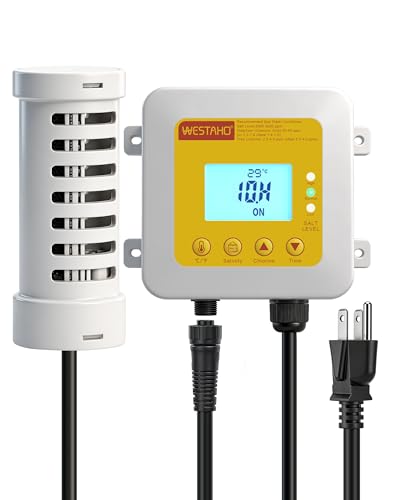
For spa owners who prefer on-unit indicators to app controls, Westaho Spa System, 2,200 Gallons uses LED lights to show device status and salinity. The system is designed for hot tubs and swim spas up to 2,200 gallons, with a USA-made titanium cell rated for more than 3,000 hours and operation designed for hot water. Its feature set differs from the Wi-Fi spa option by focusing on the built-in controller; choose another model if you want remote app access or need equipment for a swimming pool.
Bottom line: Pick this for a spa within capacity when LED status checks are sufficient.
How to choose a Westaho salt chlorine generator
Start with the water volume and whether the equipment is for a pool or spa. A generator rated for 15,000 gallons is not the right choice for a 16,000-gallon pool, and spa systems are built for a different application. Salt systems produce chlorine through electrolysis: dissolved salt passes through an energized cell, which generates chlorine that sanitizes the water before cycling back into salt. Cell runtime is measured in operating hours, not calendar years; actual lifespan depends on how long the cell runs and maintenance. Use the volume and application as the first filters, then decide whether remote monitoring or a control-panel display better suits your routine.
Pool and spa capacity fit
Choose a system whose maximum capacity meets or exceeds the pool or spa’s actual water volume. The pool choices here top out at 40,000 gallons for an inground pool and 15,000 gallons for an above-ground pool; the spa systems are sized up to 2,200 gallons. For an oddly shaped pool, estimate volume by dividing it into simple sections and adding their volumes rather than relying on surface area alone. If your calculated volume is close to a system’s cap, confirm the required capacity with the manufacturer before ordering. Also confirm the cell and plumbing connections suit the existing equipment; matching gallon capacity alone does not establish plumbing compatibility.
Salt chlorine generator care and operation
Salt generators need the correct salt concentration and a clean cell to produce chlorine effectively. Many residential pools operate around 2,700 to 3,400 parts per million of salt, but the appropriate target depends on the generator, so use its specified range rather than assuming a universal level. Test free chlorine and pH regularly; salt systems still require water balancing, and salt itself does not replace routine testing. Scale can form on an electrolytic cell, especially in hard water or when pH is high, so inspect and clean it only as the maker directs. Keep the cell energized only when water is circulating, and do not treat a saltwater pool as chlorine-free.
Monitoring and cell runtime differences
Monitoring features determine how you check system status, not whether the water still needs testing. Panel readings can make salt, temperature and cell-use information visible at the equipment, while app-connected monitoring can make selected readings accessible remotely. Cell-hour ratings also differ: compare operating-hour figures rather than converting them into a guaranteed number of years, since daily run time changes the calendar lifespan. Low-temperature shutoff is relevant where water can cool near the threshold; it does not remove the need to follow the system’s operating limits. A generator’s status display is not a substitute for an independent water test for chlorine and pH.
Frequently Asked Questions
How much salt does a salt chlorine generator need?
Many residential pools use roughly 2,700 to 3,400 parts per million of salt, but generator targets vary. Follow the system’s target range and test with a salt test strip or meter before adding salt.
Does a saltwater pool still contain chlorine?
Yes. A salt chlorine generator makes chlorine from dissolved salt using electrolysis; the pool is not chlorine-free. Test free chlorine and pH routinely, because the generator does not replace water testing.
How often should I clean a salt cell?
Inspect the cell periodically for scale, and clean it only when buildup is present and the manufacturer’s instructions call for cleaning. Hard water and high pH can promote scale, while unnecessary acid cleaning can shorten cell life.
Can I use a pool generator for a hot tub?
Do not assume a pool generator suits a hot tub: pool and spa systems have different intended applications and capacities. Match the device to spa volume and its temperature and equipment requirements.
What does a salt cell’s hour rating mean?
A cell rated for 3,000 hours is rated by operating time, not a fixed number of calendar years. For example, running 8 hours per day would use about 2,920 hours in a year, before accounting for actual runtime and maintenance.