
Willow & Everett Electric Kettle: 3 Models Compared

The Willow & Everett electric kettle range includes 0.8-liter gooseneck models, so choose by temperature control and the features you want at the counter. The model with five presets and a 60-minute keep-warm mode suits buyers who want more control; choose a simpler option if you mainly need a controlled pour.
We earn a commission if you buy through links on this page. As an Amazon Associate I earn from qualifying purchases. Products are compared on manufacturer specifications, not hands-on testing.
- Best overall: Willow Eco Series Gooseneck Kettle – Five temperature presets and a keep-warm mode that maintains the selected temperature for up to 60 minutes.
- Best for custom temperatures: Willow & Everett Gooseneck Kettle, Temperature Control – Its name specifies custom temperature presets and a keep-warm option.
- Best for simple boiling: Willow & Everett 1000W Gooseneck Kettle – A 1000-watt element and automatic shutoff are specified, without temperature presets.
| Product | Best for | Temperature controls | Power | Shop |
|---|---|---|---|---|
| Willow Eco Series Gooseneck Kettle | Preset brewing | 5 presets | 1200 W | Check Price on Amazon |
| Willow & Everett Gooseneck Kettle, Temperature Control | Custom temperature | Custom presets | — | Check Price on Amazon |
| Willow & Everett 1000W Gooseneck Kettle | Simple boiling | Boil only | 1000 W | Check Price on Amazon |
Willow & Everett electric kettles
Compare the three gooseneck models by capacity, temperature controls, and listed power.
Willow Eco Series Gooseneck Kettle

Five one-touch temperature presets and a keep-warm mode set this model apart for people who make different drinks through the day. The 0.8-liter kettle has a gooseneck spout for a steady, controlled pour, and its keep-warm function maintains the selected temperature for up to 60 minutes. The maker describes the presets as suited to coffee, tea, or hot water, but does not give their individual temperatures here. That matters if you need a precise brewing temperature for a particular tea; check the preset values before choosing it.
Bottom line: Choose this if you want multiple preset temperatures and a timed keep-warm function.
Willow & Everett Gooseneck Kettle, Temperature Control
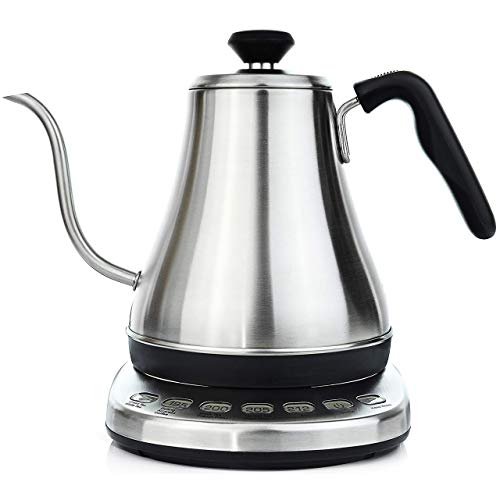
Custom temperature presets and a keep-warm option distinguish this model from the simpler boil-and-pour choice. Its 0.8-liter capacity and gooseneck shape suit small batches of tea or pour-over coffee, while the stainless steel body and neck pair with a BPA-free plastic handle and base. If your recipe depends on an exact water temperature or holding time, confirm those controls before choosing.
Bottom line: Pick this when customizable temperature control matters more than a specified preset count.
Willow & Everett 1000W Gooseneck Kettle

A 1000-watt heating element and automatic shutoff make this the straightforward boiling option among these gooseneck kettles. Its 0.8-liter stainless steel vessel has a BPA-free plastic handle, and the long spout is intended to provide a slow, controlled flow for pour-over coffee or tea. The maker also describes an airtight lid. Unlike the temperature control models, this one is presented as a boil-focused kettle, so it is less suitable for recipes requiring a chosen water temperature.
Bottom line: Choose this for controlled pouring and automatic shutoff without temperature presets.
How to choose a Willow & Everett electric kettle
Start with whether you need a specific water temperature or simply boiling water. The 0.8-liter capacity is about 27 fluid ounces, suitable for a few cups rather than a large group. For tea, water temperature changes the brew: green tea is commonly steeped around 160–180°F, while black tea typically uses near-boiling water, about 200–212°F. Pour-over coffee recipes often call for roughly 195–205°F. Choose a kettle with usable temperature settings when you regularly brew across those ranges; a boil-only model is simpler if you just need hot water. A keep-warm feature helps when making successive cups, but check its hold duration against your routine.
Gooseneck kettles and pour control
A gooseneck spout gives a slower, more directed pour than a broad kettle spout, useful when wetting coffee grounds evenly. It does not guarantee a particular flow rate, so technique still matters: pour steadily and avoid filling the brewer faster than the grounds can drain. Small-capacity kettles also mean more frequent refills when serving several people. For a pour-over setup, compare the kettle’s capacity with the water amount in your recipe; 0.8 liters is about 27 fluid ounces, before allowing for any water left in the vessel. Hot water can scald, so keep the kettle on a stable, heat-resistant surface and pour with the spout pointed away from hands and faces.
Temperature settings and keep-warm functions
Temperature settings matter most when a recipe calls for water below a full boil. Green tea often uses 160–180°F water, and pour-over coffee commonly uses 195–205°F; exact preferences vary by tea, roast, and recipe. A preset count alone does not tell you which temperatures are available, so check that the settings match the drinks you prepare. Keep-warm functions are also not interchangeable: one model here specifies up to 60 minutes, while another only identifies the feature. If you need water held at a specific temperature for repeated cups, prioritize a hold time and temperature control rather than assuming every mode behaves the same.
Electric kettle safety and everyday care
Automatic shutoff can turn off a kettle after boiling, but it does not make the vessel safe to touch: hot water and metal surfaces can still cause burns. Set the base on a dry, level counter and keep the cord away from the counter edge. Mineral deposits from hard water can collect inside kettles; periodic descaling with a manufacturer-approved method helps remove scale and maintain heating performance. Avoid immersing an electric kettle or its powered base in water. A gooseneck spout can be narrow, so pour carefully and do not overfill; leave room for the water to move without splashing during heating.
Frequently Asked Questions
How much water does a 0.8-liter kettle hold?
A 0.8-liter kettle holds about 27 fluid ounces, or roughly 3.4 eight-ounce cups. Actual servings depend on how much water each drink requires.
What temperature should I use for green tea?
Green tea is commonly brewed with water around 160–180°F rather than a full boil. Delicate varieties may suit the lower end of that range.
What temperature is best for pour-over coffee?
Pour-over recipes commonly use water around 195–205°F. Grind size, roast, and brewing method can affect the result, so use the recipe’s target when available.
Does a gooseneck kettle pour more slowly?
A gooseneck spout supports a more directed, controlled pour than a wide spout. Pour speed still depends on how you tilt and handle the kettle.
How often should I descale an electric kettle?
Descale when mineral buildup becomes visible or heating performance changes; hard-water areas may need more frequent care than soft-water areas. Use a method approved for the kettle and keep water away from its powered base.