
Yuwell Blood Pressure Monitors Compared by Fit

Yuwell Automatic Upper-Arm Monitor suits most people seeking a Yuwell blood pressure monitor because its upper-arm cuff adjusts from 8.7 to 17.7 inches and stores 199 readings. Choose a different model if you want Bluetooth app syncing, wrist placement or voice guidance.
A home blood pressure monitor measures pressure with an inflatable cuff; proper cuff fit and measurement position matter as much as the model.
We earn a commission if you buy through links on this page. As an Amazon Associate I earn from qualifying purchases. Products are compared on manufacturer specifications, not hands-on testing.
- Best overall: Yuwell Automatic Upper-Arm Monitor – Its adjustable 8.7–17.7-inch upper-arm cuff and 199-reading memory suit a broad range of home tracking needs.
- Best for app tracking: Yuwell Bluetooth Upper-Arm Monitor – Bluetooth syncs readings to a free iOS and Android app, with 60 readings stored on the monitor.
- Best for wrist use: Yuwell Rechargeable Wrist Monitor – The rechargeable wrist monitor stores 74 readings and has a one-touch design.
| Product | Best for | Cuff style | Stored readings | App connectivity | Shop |
|---|---|---|---|---|---|
| Yuwell Automatic Upper-Arm Monitor | Broad arm fit | Upper arm, 8.7–17.7 in | 199 | No | Check Price on Amazon |
| Yuwell Bluetooth Upper-Arm Monitor | Phone-based tracking | Upper arm, extra-large | 60 | Yes, iOS and Android | Check Price on Amazon |
| Yuwell Large Upper-Arm Monitor | Voice guidance | Upper arm, large | 99 | No | Check Price on Amazon |
| Yuwell Rechargeable Wrist Monitor | Wrist placement | Wrist | 74 | No | Check Price on Amazon |
Yuwell Blood Pressure Monitors
Compare cuff placement, reading storage and phone connectivity to find the right fit for your routine.
Yuwell Automatic Upper-Arm Monitor

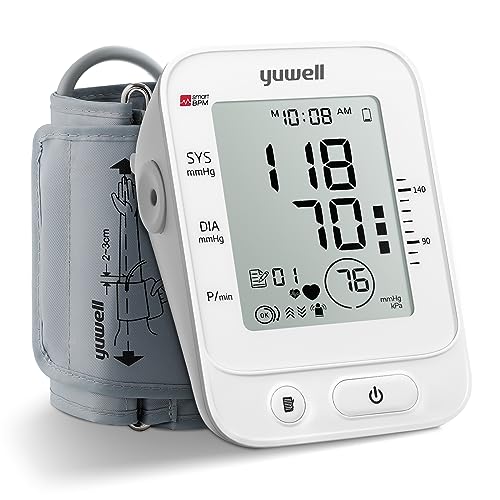
For broad arm fit and a larger reading history, this upper-arm model combines an adjustable 8.7–17.7-inch cuff with storage for 199 readings. It also includes cuff-position detection, an irregular-heartbeat alert and WHO blood pressure classification. The large display is intended to make readings easier to see at home. Choose it if you want built-in tracking without relying on a phone. Its cuff range may not suit arms outside the span, so measure around the upper-arm before choosing it.
Bottom line: Pick this model if its cuff range fits your arm and you want the largest stored reading history.
Yuwell Bluetooth Upper-Arm Monitor

For phone-based tracking, this upper-arm model sends readings by Bluetooth to the Yuwell Healthcare+ app for iOS and Android; the monitor itself stores 60 readings. It also has a three-color backlit display, voice guidance and a rechargeable battery. The maker says it meets ESH and AAMI standards and uses its DFFA algorithm. Choose it if charting readings on a phone matters more than keeping the full history on the device. The cuff’s exact arm-size range is not established here, so confirm it fits before ordering.
Bottom line: Choose this model if app syncing and visualized history matter more than device-only storage.
Yuwell Large Upper-Arm Monitor
For voice-guided readings without a phone app, this large upper-arm model broadcasts during measurement and stores 99 readings. It has one-button operation, a large display, and comes with a power adapter and batteries. The maker says its algorithm is based on clinical data and meets the ESH standard. It is less suited to people who want Bluetooth charts or a clearly quantified cuff range.
Bottom line: Pick this model if spoken guidance and included power options are your priorities.
Yuwell Rechargeable Wrist Monitor

Unlike the upper-arm options, this model measures at the wrist and is rechargeable, with storage for 74 readings. It adds voice notification, a large LCD, smart inflation and alerts for irregular heartbeat and hypertension. The maker says it meets the AAMI standard and has FDA registration. Wrist monitors require careful positioning at heart level during each reading, making technique especially important. Choose it when wrist placement or portability is a priority; people who prefer upper-arm measurement should select an upper-arm model instead.
Bottom line: Choose this one if you need wrist placement and can keep the cuff at heart level while measuring.
How to choose a home blood pressure monitor
Choose by cuff fit, placement and how you plan to keep readings, rather than by display features alone. The American Heart Association recommends an automatic, upper-arm cuff monitor for home use; wrist and finger devices are generally less reliable unless a clinician advises otherwise. A cuff that is too small can produce readings that are too high, while one that is too large can produce readings that are too low. Measure your bare upper-arm and compare it with the cuff range before buying. If you want trends on a phone, prioritize Bluetooth syncing; if you prefer to review readings on the device, compare memory capacity. A larger memory helps when readings are taken regularly, but it does not replace a written record for appointments.
How to take a consistent blood pressure reading
For a more consistent home reading, rest quietly for 5 minutes first, sit with your back supported and feet flat, and keep your arm supported at heart level. Avoid smoking, exercise and caffeine for at least 30 minutes beforehand, and take the reading on a bare arm. Take two readings at least 1 minute apart and record both; a single result can vary from one measurement to the next. Do not talk or use a phone during the measurement. For wrist cuffs, keep the wrist at heart level throughout inflation, since a position above or below the heart can distort the result. Follow your clinician’s plan for when and how often to measure, especially if a reading seems unusual.
Upper-arm and wrist monitors compared
Upper-arm monitors are the usual home choice, while wrist monitors can be useful when an upper-arm cuff is unsuitable or a clinician recommends wrist measurement. The key tradeoff is less about convenience than getting a dependable reading with the cuff positioned correctly. Use this comparison to match placement to your needs:
| Type | Typical advantage | Key fit or use rule |
|---|---|---|
| Upper-arm | Recommended for routine home monitoring | Measure arm circumference; cuff must cover its range |
| Wrist | Alternative when upper-arm cuff use is difficult | Hold wrist at heart level during measurement |
Neither type can compensate for an incorrectly sized cuff or poor posture. If your clinician asks you to compare home readings with office measurements, bring the monitor and its cuff so they can check your technique.
How to interpret home readings safely
Blood pressure categories depend on both the top (systolic) and bottom (diastolic) numbers, and diagnosis should not be based on one isolated measurement. In the U.S. guideline categories, stage 1 hypertension begins at 130–139 mm Hg systolic or 80–89 mm Hg diastolic; either number can determine the higher category. A monitor’s built-in classification or alert is a prompt to review readings, not a diagnosis. Keep a dated log and share repeated readings with a healthcare professional rather than changing medication based on a single result. If a reading is over 180/120 mm Hg, wait at least 1 minute and measure again; seek urgent medical help if it remains that high, especially with chest pain, shortness of breath, weakness or vision changes.
Frequently Asked Questions
How tight should a blood pressure cuff feel?
A cuff should be snug but not painfully tight, with its lower edge positioned just above the elbow crease for an upper-arm reading. Use the cuff only within its arm-circumference range; an undersized cuff can read falsely high.
Should I take two blood pressure readings?
Yes, take two readings at least 1 minute apart after sitting quietly for 5 minutes. Record both numbers because readings can differ from one measurement to the next.
Can I measure blood pressure over clothing?
No, place an upper-arm cuff on bare skin rather than over a sleeve. Clothing under the cuff can interfere with the measurement and make the result less dependable.
When should I avoid taking a home reading?
Wait at least 30 minutes after exercise, smoking or caffeine, then sit quietly for 5 minutes before measuring. These conditions can temporarily affect a reading.
What should I do with a reading over 180/120?
Wait at least 1 minute and measure again if a reading is over 180/120 mm Hg. If it remains that high, seek urgent medical advice; symptoms such as chest pain, shortness of breath or weakness require emergency care.