
Zig Clean Color Real Brush: 3 Sets Compared

For the widest palette, choose Kuretake Zig Clean Color Real Brush 120-Color Set: its 120 colors offer more options for illustration and layered gradients than the 30- and 6-color sets. Choose Kuretake Zig Clean Color Real Brush 30-Color Set C for a smaller set with new colors, or Kuretake Zig Clean Color Real Brush 6-Color Smoky Set if you specifically want six smoky colors.
Zig Clean Color Real Brush pens use water-based dye ink in brush-style tips, so they can make both fine and broad strokes and blend with water.
We earn a commission if you buy through links on this page. As an Amazon Associate I earn from qualifying purchases. Products are compared on manufacturer specifications, not hands-on testing.
- Best overall: Kuretake Zig Clean Color Real Brush 120-Color Set – The 120-color set provides the broadest palette for varied artwork.
- Best for new colors: Kuretake Zig Clean Color Real Brush 30-Color Set C – This 30-color set includes colors introduced in 2023.
- Best for muted palettes: Kuretake Zig Clean Color Real Brush 6-Color Smoky Set – The six-color set is specifically labeled Smoky Colors.
| Product | Best for | Set size | Brush tip | Shop |
|---|---|---|---|---|
| Kuretake Zig Clean Color Real Brush 120-Color Set | Broad color range | 120 colors | Brush tip | Check Price on Amazon |
| Kuretake Zig Clean Color Real Brush 30-Color Set C | New color selection | 30 colors | Flexible brush tip | Check Price on Amazon |
| Kuretake Zig Clean Color Real Brush 6-Color Smoky Set | Smoky color palette | 6 colors | Brush tip | Check Price on Amazon |
Zig Clean Color Real Brush Sets
Compare the sets by palette size and choose the one that fits the range of colors you need.
Kuretake Zig Clean Color Real Brush 120-Color Set
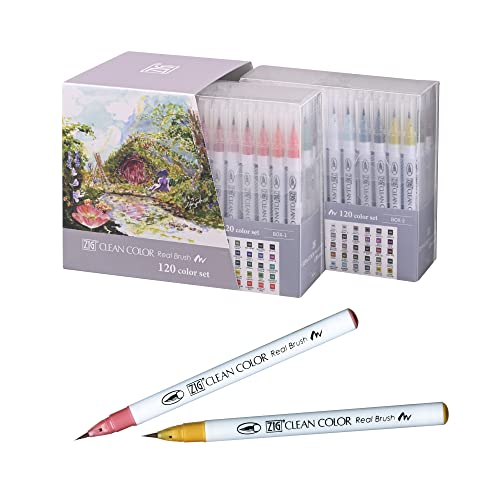
Kuretake Zig Clean Color Real Brush 120-Color Set has the largest palette here, with 120 colors for projects that move between illustration, lettering, and detailed color work. The water-based dye ink can be blurred with water or mixed with other Real Brush colors or a blender, and the colors can be layered for gradients. That range suits artists who want many shades on hand without combining a small palette to build every variation. The tradeoff is that a large color set may be more than a lettering project with a narrow palette needs; choose a smaller set when fewer colors will do.
Bottom line: Pick this set when broad color choice matters more than keeping the palette compact.
Kuretake Zig Clean Color Real Brush 30-Color Set C

Kuretake Zig Clean Color Real Brush 30-Color Set C offers 30 colors, including colors added to the range in 2023, making it a middle-sized palette between the broad 120-color set and the six-color smoky set. The flexible tip supports fine lines when held upright and broader strokes at an angle, while water can soften marks or help create tonal variation. This format suits brush lettering and drawing when a moderate selection is enough. Its limitation is palette breadth: artists who need a wider choice of ready-to-use colors should consider the 120-color set instead.
Bottom line: Choose this set for a moderate palette that includes the newer colors.
Kuretake Zig Clean Color Real Brush 6-Color Smoky Set

Kuretake Zig Clean Color Real Brush 6-Color Smoky Set is the focused option, with six colors in a smoky palette rather than a broad assortment. Like the other sets, its brush-style pens use water-based dye ink that can be blurred with water or mixed with other Real Brush colors. A limited palette can suit journaling, card making, or lettering where a restrained color scheme is the goal. The constraint is straightforward: six colors give fewer ready-made choices than either larger set, so this is a poor fit when a project calls for many distinct hues without mixing.
Bottom line: Pick it for projects where a six-color smoky palette is enough.
How to Choose a Zig Clean Color Real Brush Set
Choose by the number and kind of colors you expect to use: 120 colors suit varied projects, 30 colors offer a middle-sized selection, and six smoky colors suit a deliberately limited palette. Water-based dye ink can be blended with water, but adding water also spreads and softens a mark, so test the effect on a scrap of the paper you plan to use. Paper absorbency changes how much color feathers; smooth, heavier watercolor paper usually handles wet blending better than thin copy paper. If your main work is fine lettering, start with light pressure and the tip upright; use an angled hold for broader strokes.
A practical rule is to choose the six-color set only when a restricted palette is intentional; select a larger set if the project needs more than six distinct colors without mixing.
How Water-Based Brush Pens Blend
Water-based dye ink can be softened with a damp brush or water brush, and adjacent wet colors can blend into gradients. Dye ink is transparent, so layers can shift the appearance of colors beneath them; build from lighter marks toward darker accents when preserving a light area matters. Water amount, paper absorbency, and timing all affect the result: adding water while ink is wet typically creates softer transitions than re-wetting a dry mark. Test mixtures first, because colors can flow beyond a small lettering stroke on very absorbent paper.
For a controlled gradient, place the darker color first and add a second color before the first dries. Let the paper dry between separate layers when you want cleaner edges rather than a blended transition.
Brush Tip Strokes and Lettering Control
Brush pens create different line widths through pressure and angle: a light touch and upright hold make finer marks, while a slanted tip and firmer pressure cover more area. For consistent lettering, keep the pen angle steady and practice thin upstrokes and thicker downstrokes on scrap paper before starting a finished piece. A flexible brush tip responds to pressure, so pressing hard can make a wider stroke but also increases ink delivery. Avoid pressing until the tip splays; controlled pressure keeps transitions between strokes more predictable.
Watercolor paper commonly ranges from about 140 to 300 pounds, with heavier sheets generally resisting buckling better during wet work. For short lettering sessions, smoother mixed-media paper can be easier to write on, but test it first for bleeding and feathering.
Paper and Care for Brush Markers
Paper choice affects both blending and line sharpness: thin paper can buckle when wet, while highly absorbent paper may spread dye ink quickly. Watercolor paper around 140 pounds is a common starting point for light washes; heavier paper can better tolerate repeated wet applications. Keep brush tips clean and capped between strokes, and use clean water when blending so stray pigment does not muddy a lighter color. Store pens horizontally when practical to help ink remain accessible across the tip.
Do not assume dye ink is lightfast or waterproof after drying; water-based dye marks can reactivate or shift with moisture, and sunlight can fade some dyes. Protect finished work behind glazing or scan it if long-term color stability matters.
Frequently Asked Questions
Can Zig Clean Color Real Brush pens blend with water?
Yes, their water-based dye ink can be blurred with water or a water brush. Use a small amount first, since absorbent paper can spread the color quickly.
How do you make a gradient with brush markers?
Apply the darker color first, then add a second color before Kuretake Zig Clean Color Real Brush 120-Color Set dries. A damp brush can soften the boundary, while less water preserves a sharper transition.
What paper works well for water-based brush pens?
Watercolor paper around 140 pounds is a useful starting point for light washes because it tolerates moisture better than thin copy paper. More water or repeated wet layers may call for heavier paper.
How do you get thin and thick strokes from a brush pen?
Hold the pen more upright and use a light touch for a fine line; angle the tip and add controlled pressure for a wider stroke. Practice on scrap paper to learn how quickly the tip broadens.
Are water-based dye brush pen marks waterproof?
Do not assume they are waterproof once dry; water-based dye marks may shift or reactivate with moisture. Keep finished artwork away from water if preserving the marks matters.