
1 Step Looper Pliers: Beadsmith Models Compared

The Beadsmith Original One-Step Looper is the named 1 step looper plier, and its 1.5 mm loop size suits work that needs a consistent small loop with 24–18 gauge wire. Choose a multi-size tool instead if your projects call for loops larger than 1.5 mm.
One-step loopers shape a loop as you squeeze; the first two choices also trim the wire in the same motion. None of these tools is intended for stainless steel wire.
We earn a commission if you buy through links on this page. As an Amazon Associate I earn from qualifying purchases. Products are compared on manufacturer specifications, not hands-on testing.
- Best overall: Beadsmith Original 1.5 mm Looper – Makes 1.5 mm loops and trims compatible 24–18 gauge wire in one squeeze.
- Best for three loop sizes: Beadsmith Original Three-Size Combo – Includes 1.5, 2.25 and 3 mm loop sizes in a combo pack.
- Best for either hand: Three-Size One-Step Looper Pliers – Offers three loop sizes and is designed for left- or right-handed use.
| Product | Best for | Loop sizes | Loop and trim | Shop |
|---|---|---|---|---|
| Beadsmith Original 1.5 mm Looper | Small consistent loops | 1.5 mm | Yes, one step | Check Price on Amazon |
| Beadsmith Original Three-Size Combo | Multiple loop diameters | 1.5, 2.25, 3 mm | Yes, one step | Check Price on Amazon |
| Three-Size One-Step Looper Pliers | Ambidextrous use | 1.5, 2.25, 3 mm | Loop; trim not stated | Check Price on Amazon |
1 Step Looper Pliers Compared
Compare loop diameter, wire compatibility and whether the tool trims as it forms the loop.
Beadsmith Original 1.5 mm Looper

The Beadsmith Original makes one loop size, 1.5 mm, while cutting the wire in the same squeeze. It is designed for 24–18 gauge dead-soft or half-hard wire, including copper, brass and craft wire. A hole in the upper jaw supports longer wire, which can help when making repeated components. The tool measures 6.75 inches long and weighs 0.19 pounds. Its limitation is the fixed loop diameter: choose another option if a project needs 2.25 mm or 3 mm loops. The maker says it is not for stainless steel wire.
Bottom line: Choose this for repeated 1.5 mm loops with compatible wire.
Beadsmith Original Three-Size Combo

The Beadsmith combo provides three separate loop sizes—1.5, 2.25 and 3 mm—rather than one fixed diameter, and it loops and trims in one squeeze. The tools are designed for 24–18 gauge dead-soft or half-hard wire, including copper, brass and craft wire. This set fits makers switching between small and larger loop dimensions without changing wire gauge. Its tradeoff is that a three-size set is more than needed if every component uses only 1.5 mm loops. The maker says the tools are not for stainless steel wire.
Bottom line: Pick this when a project uses more than one of its three loop diameters.
Three-Size One-Step Looper Pliers
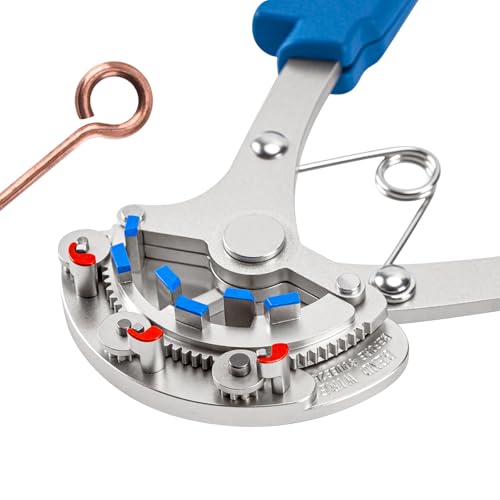
This single plier offers 1.5, 2.25 and 3 mm loops and is designed for both left- and right-handed use, unlike a pack of three separate tools. It is made of steel with rubber handles, and the 3.8-inch handle spacing is intended to make squeezing easier for smaller hands. Its wire range is 24–18 gauge craft wire. The main limitation is that its features describe looping in one-step but do not establish that it trims wire during the squeeze; choose a Beadsmith option if simultaneous trimming is essential.
Bottom line: Choose this if one ambidextrous tool and three loop sizes suit your workflow.
How to choose 1 step looper pliers
Choose by loop diameter first, then confirm the wire gauge and metal. A 1.5 mm loop works for small wire components; select a tool offering 2.25 mm or 3 mm when the design needs a larger opening. Wire gauge is a thickness system: 24 gauge is about 0.020 inch (0.51 mm), while 18 gauge is about 0.040 inch (1.02 mm). Lower gauge numbers mean thicker wire. If your design needs only 1.5 mm loops, a fixed-size tool avoids paying for unused sizes; if it uses two or more diameters, a multi-size option is more flexible. Do not assume every one-step tool trims: check that feature when cut-and-loop in one squeeze is a requirement.
Wire gauge and material fit
These pliers are intended for 24–18 gauge wire, roughly 0.51–1.02 mm in diameter, but gauge alone does not guarantee compatibility. Dead-soft wire bends more readily than half-hard wire, so harder wire may take more hand pressure and may not form as easily. Copper, brass and craft wire are named compatible materials for the Beadsmith options here; stainless steel is explicitly excluded by their maker. Never force wire that resists the tool, since excess pressure can damage the jaws or cause the wire to slip. For any wire outside the 24–18 gauge range, confirm compatibility before ordering rather than assuming the tool will form or cut it cleanly.
Single-size and multi-size loopers compared
A fixed-size tool suits work built around one loop diameter; a multi-size choice suits designs that vary between smaller and larger loops. The key distinction is range, not the shared 24–18 gauge wire compatibility. Compare the sizes and trim function before choosing.
| Need | Choose | Reason |
|---|---|---|
| Only 1.5 mm loops | Single-size looper | One dedicated loop diameter |
| 1.5, 2.25 and 3 mm loops | Multi-size looper | Three diameter options |
| Loop and cut in one squeeze | Tool with explicit trim function | Trimming is not established for every choice |
For a design requiring loops above 1.5 mm, choose one of the multi-size options; a fixed 1.5 mm head cannot meet that dimension.
Using and maintaining a one-step looper
Feed the wire through the jaw hole and beneath the peg, hold it in position, then squeeze the handles; the Beadsmith tools describe this motion as forming and trimming at once. Keep the wire aligned and use short practice pieces first, because a shifted wire can make an uneven loop or miss the intended trim point. Wear eye protection when cutting wire: short offcuts can spring away from the jaws. Clear wire fragments from the cutting area after use and store the tool dry to limit corrosion on metal parts. Avoid stainless steel with the Beadsmith options, and do not force a wire size or material outside the range.
Frequently Asked Questions
What wire gauge works with one-step looper pliers?
These choices are designed for 24–18 gauge wire, approximately 0.51–1.02 mm thick. Confirm both gauge and metal compatibility, since the Beadsmith options exclude stainless steel.
Do one-step looper pliers cut the wire too?
The Beadsmith single-size and combo options say they loop and trim in one squeeze. The third tool is described as a one-step looper, but its features do not establish that it trims.
What is the difference between 1.5 mm and 3 mm loops?
The loop diameter differs by 1.5 mm, giving the 3 mm option twice the diameter of a 1.5 mm loop. Choose the size required by the component or connection; these diameters are not interchangeable.
Can these loopers handle stainless steel wire?
The Beadsmith tools explicitly say they are not for stainless steel wire. They are designed for 24–18 gauge wire such as copper, brass and craft wire.
How do I use one-step looper pliers safely?
Keep the wire seated beneath the peg while squeezing, and wear eye protection when cutting because wire offcuts can spring away. Start with a short piece of compatible wire and avoid forcing a wire that resists the tool.