
Best Cold Laser for Dogs: 4 Devices Compared

GOVW Veterinary Laser Therapy Device is the best cold laser for dogs for most buyers because it combines 660 nm, 810 nm and 980 nm emitters in a device explicitly described for veterinary use. Choose a different model if you want a lighter handheld device or a larger battery capacity instead.
Cold laser therapy devices use red and near-infrared light emitters; they are not a substitute for veterinary diagnosis or treatment. Ask a veterinarian before using one on an injury or painful condition.
We earn a commission if you buy through links on this page. As an Amazon Associate I earn from qualifying purchases. Products are compared on manufacturer specifications, not hands-on testing.
- Best overall: GOVW Veterinary Laser Therapy Device – Three wavelengths and an explicit veterinary-use focus for animals.
- Best for portability: Mibest Dual-Wavelength Pet Light – Weighs approximately 7.6 oz and is described as handheld.
- Best for adjustable sessions: Cold Laser Therapy Device for Dogs and Cats, 7000 mAh – Offers three power levels, pulse or continuous modes, and a 0–60 minute timer.
| Product | Best for | Wavelengths | Battery | Controls | Shop |
|---|---|---|---|---|---|
| GOVW Veterinary Laser Therapy Device | Three-wavelength care | 660, 810, 980 nm | — | — | Check Price on Amazon |
| Cold Laser Therapy Device for Dogs and Cats, 7000 mAh | Flexible sessions | 650, 808, 980 nm | 7000 mAh | 3 levels; pulse/continuous; 0–60 min | Check Price on Amazon |
| Three-Wavelength Therapy Device, 7000 mAh | Power-level choice | 650, 808, 980 nm | 7000 mAh | 3 levels; pulse; 60 min | Check Price on Amazon |
| Mibest Dual-Wavelength Pet Light | Lightweight handling | 650, 808 nm | 3400 mAh | — | Check Price on Amazon |
Cold laser devices for dogs
Compare the wavelength combinations and controls first, then choose a format that suits your intended routine.
GOVW Veterinary Laser Therapy Device

For buyers prioritizing a veterinary-focused model, this device is explicitly described for dogs and other animals and combines 660 nm, 810 nm and 980 nm emitters. The maker says the wavelengths are intended for surface, deeper soft-tissue and deep-tissue applications, respectively. Its dimensions are 8.54 × 2.36 × 2.13 inches, which gives a sense of its handheld footprint. The specifications do not provide its battery capacity or session controls, so it may be a weaker fit for buyers who need a known runtime or timer setting.
Bottom line: Choose this if an animal-focused, three-wavelength design is your priority.
Cold Laser Therapy Device for Dogs and Cats, 7000 mAh

Buyers who want control over session setup get three power levels, pulsed or continuous operation, and a timer adjustable from 0 to 60 minutes. The device combines 18 × 650 nm, 6 × 808 nm and 3 × 980 nm emitters and has a 7000 mAh rechargeable battery. It is described for dogs and cats as well as other animals and people.
Bottom line: Pick this when a timer and multiple operating modes matter most.
Three-Wavelength Therapy Device, 7000 mAh
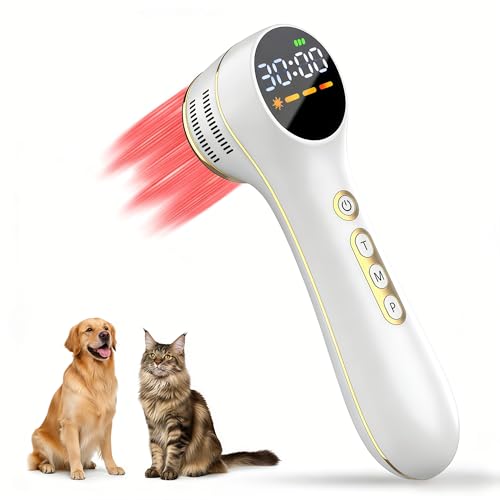
This handheld option stands out for combining three power levels with pulse mode and a 60-minute timer. It uses 4 × 980 nm, 5 × 808 nm and 16 × 650 nm emitters and has a 7000 mAh battery. The product name frames it for both people and pets, including dogs.
Bottom line: Choose this for three power levels and a 7000 mAh battery.
Mibest Dual-Wavelength Pet Light
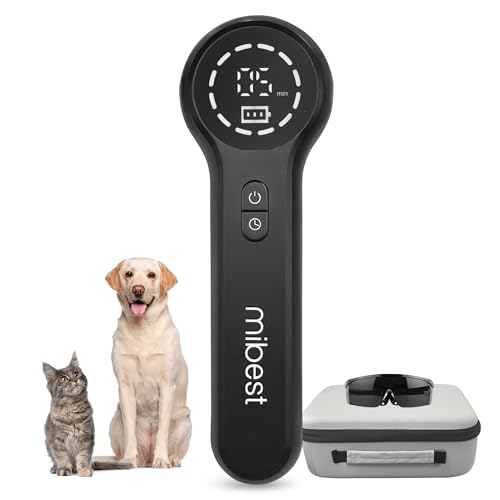
At approximately 7.6 oz, this is the clearest pick for buyers who prioritize a lighter handheld device. It combines 12 × 650 nm red emitters with 4 × 808 nm near-infrared emitters and has a rechargeable 3400 mAh battery. The design is described for dogs, cats and other animals, with suggested areas including the back, hips, legs, joints and muscles. It has two wavelengths rather than the three found in several alternatives, so buyers specifically seeking a 980 nm emitter should choose another model.
Bottom line: Choose this if low carrying weight matters more than a third wavelength.
How to choose a cold laser for dogs
Start by matching the device’s wavelengths and controls to the routine you intend to discuss with your veterinarian. These options include red wavelengths from 650 to 660 nm and near-infrared wavelengths from 808 to 980 nm; a larger number of wavelengths does not by itself establish that a device is appropriate for a particular condition. Compare practical controls too: a timer range, pulse choice and battery capacity can affect how easily a routine fits your schedule. The maker’s feature claims describe intended use, not a diagnosis or guarantee of results. A useful rule: if a dog has new pain, swelling or a wound, seek veterinary guidance before using light therapy rather than choosing based only on wavelength count.
What wavelength combinations mean
Red emitters in the 650–660 nm range are visible, while 808–810 nm and 980 nm are near-infrared bands, often not visible to the eye. Product makers commonly describe red light for surface applications and near-infrared light for deeper applications, but a wavelength alone does not tell you the delivered dose. Power density, treatment distance and exposure time also matter, and those values are not comparable across these models from the specifications. Use the comparison as a way to identify the device design, not as a clinical ranking. Never look directly into a laser or light emitter, and keep the beam away from a dog’s eyes.
How to compare session controls
Timer and mode controls are meaningful differences: one model lists a 0–60 minute timer with pulse and continuous options, while another lists a 60-minute timer and pulse mode. A longer available timer is not automatically a better treatment; session length should come from veterinary guidance and the device instructions. Battery capacity is measured in mAh, not operating hours, so 7000 mAh cannot be translated into a session count without power draw. If runtime is essential, verify the actual operating time and charging method before ordering.
| Need | Feature to prioritize |
|---|---|
| Adjustable session setup | Timer and pulse/continuous choices |
| Less weight in hand | Published weight and compact dimensions |
| Longer cordless routine | Battery capacity plus a verified runtime |
Safe use around dogs
Protect the dog’s eyes first: never aim a light therapy device toward the face or allow direct viewing of an active emitter. A dog that is uncomfortable, trying to move away or showing worsening pain should not be restrained to continue a session. Light therapy devices do not replace examination of limping, open wounds, sudden swelling or persistent pain; a veterinarian can assess whether home use is suitable and where to apply it. Follow the maker’s safety directions for contact distance and session duration, and keep a dog from chewing the handheld device or cable while charging. For any treatment-related decision, get the veterinarian’s instructions in advance.
Frequently Asked Questions
Are 808 nm and 810 nm wavelengths different?
They are close but distinct nominal wavelengths, with 808 nm and 810 nm both in the near-infrared range. Compare the wavelength with the intended design, but also consider output and dose, which wavelength alone does not establish.
Can I use a cold laser on my dog’s eyes?
No; keep the beam away from the eyes and do not allow a dog to look into an active emitter. Eye exposure is a safety concern regardless of the advertised wavelength combination.
Does a 7000 mAh battery show session runtime?
No; mAh describes battery capacity, not operating hours. Actual runtime depends on power draw and mode, so confirm runtime if cordless session length is important.