
12 Volt Small Rechargeable Batteries Compared by Fit

For a compact 12 volt rechargeable battery, rapthor 12V 2600mAh Li-ion Pack is a strong starting point because it is a 2,600mAh lithium-ion pack with a 3A maximum output. Choose another option if your device needs more capacity, a different connector, or a sealed lead-acid replacement rather than a lithium-ion pack.
We earn a commission if you buy through links on this page. As an Amazon Associate I earn from qualifying purchases. Products are compared on manufacturer specifications, not hands-on testing.
- Best overall: rapthor 12V 2600mAh Li-ion Pack – Its 2,600mAh capacity, 3A maximum output and included 12.6V charger suit compatible low-power 12V devices.
- Best for more capacity: Talentcell 12V 6000mAh Li-ion Pack – The 6,000mAh pack provides 12V and 5V outputs for compatible devices.
- Best for smallest capacity: KBT 12V 1200mAh Li-ion Pack – Its 1,200mAh lithium-ion pack is the lowest-capacity option and includes a charger.
| Product | Best for | Capacity | Max output current | Shop |
|---|---|---|---|---|
| rapthor 12V 2600mAh Li-ion Pack | Low-power devices | 2,600mAh | 3A | Check Price on Amazon |
| Talentcell 12V 6000mAh Li-ion Pack | More capacity | 6,000mAh | — | Check Price on Amazon |
| Xeanerol 2600mAh Li-ion Pack | Higher current needs | 2,600mAh | 6A max | Check Price on Amazon |
| KBT 12V 1200mAh Li-ion Pack | Compact projects | 1,200mAh | — | Check Price on Amazon |
Small 12 Volt Rechargeable Batteries
Compare capacity, battery type and output limits against your device’s voltage, current draw and connector needs.
rapthor 12V 2600mAh Li-ion Pack

The rapthor pack pairs a 2,600mAh capacity with a 3A maximum output, making it a fit for compatible lower-power 12V electronics. It includes a 12.6V/1A charger, DC power connector and DC pigtail cable for wiring projects. The maker says it is intended for devices such as LED strips, cameras, routers and small speakers. Its 3A ceiling is the key constraint: check that your device’s startup and running current stay within that limit, and confirm the connector and polarity before connecting it.
Bottom line: Choose this pack for a compatible 12V device drawing no more than 3A.
Talentcell 12V 6000mAh Li-ion Pack

The Talentcell pack has the largest lithium-ion capacity among these options at 6,000mAh, and it also provides a 5V USB output alongside its 12V port. The maker gives the 12V port’s range as 12.6–9V, so it is not a constant-voltage supply; check that your equipment tolerates that range. Its port uses DC5521 with inner-positive, outer-negative polarity. This is a useful choice when a device can accept the variable output and you want the additional USB connection, but buyers needing regulated 12V should choose a suitable regulated supply instead.
Bottom line: Pick it when your device accepts the 9–12.6V range and you want 5V USB too.
Xeanerol 2600mAh Li-ion Pack
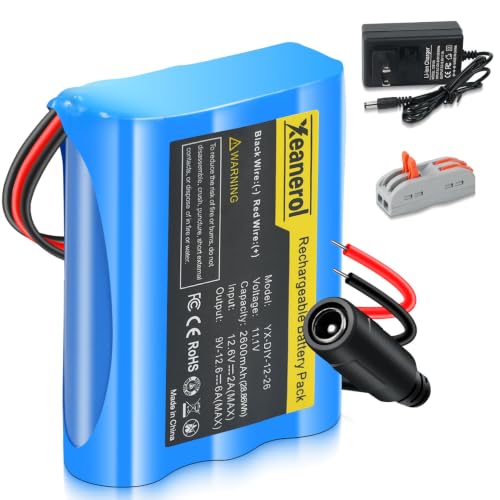
The Xeanerol pack’s maximum output current is 6A, higher than the 3A maximum on the other compact lithium-ion pack here. It includes a 12V charger and cable connector, and its built-in protection board is described by the maker as guarding against several electrical faults. The pack is identified as 11.1V–12V, so verify that the device accepts its voltage behavior rather than assuming every product labelled 12V is interchangeable.
Bottom line: Choose it when a compatible device needs more than 3A but no more than 6A.
KBT 12V 1200mAh Li-ion Pack

The KBT is the lowest-capacity lithium-ion option here, with a 1,200mAh rating and a 70 × 55 × 20mm pack size. A charger and cable connector are included, and the maker says the protection board guards against overcharging, over-discharging, overvoltage and short circuits. Its smaller capacity suits compact, lower-demand projects where limited stored energy is acceptable; it is not the choice for a device that needs longer runtime. The 12V label alone does not confirm connector fit or allowable voltage range, so match those requirements before wiring it in.
Bottom line: Pick it for a small project where 1,200mAh is sufficient.
How to Choose a Small 12 Volt Rechargeable Battery
Match voltage, current and connector before comparing capacity. A lithium-ion pack marketed as 12V may use three cells in series: 11.1V is the nominal voltage, while a fully charged three-cell pack reaches 12.6V. That makes device voltage tolerance important, especially for electronics expecting a tightly regulated 12V supply. Capacity in milliamp-hours is only comparable when voltage and chemistry are similar; watt-hours better express stored energy across different voltages. For a device drawing 1A, a 2.6Ah pack represents roughly 2.6 hours in an ideal calculation, but actual runtime is lower and varies with load and battery design. As a decision rule, reject any pack whose maximum current is below the device’s rated draw or startup demand.
Connector and Polarity Fit for 12V Battery Packs
A connector that physically fits can still have the wrong polarity. DC barrel plugs commonly differ in outer diameter, inner diameter and polarity, so check the device label or manual and verify the plug dimensions before connecting power. The Talentcell pack specifies DC5521 with inner-positive and outer-negative wiring; other packs here do not give that same connector detail. Bare leads and pigtails require extra care: keep positive and negative conductors separated, use insulated connections, and avoid shorting the battery. A short decision rule is to choose a pack only when its connector dimensions, polarity and voltage range all match the equipment; never rely on the “12V” label alone.
Lithium-Ion Packs Versus Sealed Lead-Acid Batteries
Lithium-ion and sealed lead-acid batteries differ in format as well as chemistry. SLA capacity is commonly rated at a 20-hour discharge rate, so a 7Ah rating does not guarantee 7 hours at every load. Lithium-ion packs with three series cells need a charger designed for 12.6V full charge; use the matching charger supplied for the pack rather than a generic 12V adapter. Never charge a battery that is hot, swollen or physically damaged.
Estimate Runtime and Avoid Battery Mismatches
Estimate runtime by dividing capacity in amp-hours by the device’s current draw, then treat the result as an upper-bound planning figure. A 2.6Ah pack powering a steady 0.5A load gives a simple estimate of 5.2 hours, but conversion losses, voltage cutoff and load changes reduce actual runtime. Startup current matters for motors, radios and other devices with brief peaks; the pack must support that demand, not only the average draw. A common mistake is reading a higher mAh number as proof of compatibility: a 6,000mAh battery with a variable 9–12.6V output may not suit electronics that require regulated 12V. Check both the operating voltage window and current requirements.
Frequently Asked Questions
What voltage should a 12V lithium-ion battery show when full?
A three-cell lithium-ion pack commonly reaches 12.6V when fully charged, despite an 11.1V nominal rating. Confirm that the connected device accepts the pack’s full-charge voltage.
How do I estimate runtime from battery capacity?
Divide capacity in amp-hours by the device’s current draw in amps for a rough upper-bound estimate. A 2.6Ah pack at a steady 0.5A load calculates to about 5.2 hours before real-world losses.
Can a 12V battery power a 12V device?
Only if the device accepts the battery’s actual voltage range and current capability. Some lithium-ion packs marketed as 12V can vary between 12.6V and 9V, rather than holding a constant 12V.
How can I check a DC barrel plug before connecting it?
Check the plug’s outer and inner diameters and verify positive and negative polarity against the device requirements. A DC5521 plug, for example, can be wired inner-positive and outer-negative, but other devices may differ.
Can I charge any 12V rechargeable battery with a 12V charger?
No; charger voltage and charging profile must match the battery chemistry and cell configuration.