
12V to 48V Step Up Converters Compared by Output

For most 12V systems, Daygreen 10A 480W Boost Module is a flexible choice because its 11–35V input range accepts 12V and 24V battery systems and its output is rated at 10A. Choose a different model if your load needs more output current, or if you need 12V-only input rather than a wider input range.
A step-up converter raises DC voltage; at the same power, a lower input voltage requires more current from the battery.
We earn a commission if you buy through links on this page. As an Amazon Associate I earn from qualifying purchases. Products are compared on manufacturer specifications, not hands-on testing.
- Best overall: Daygreen 10A 480W Boost Module – Its 11–35V input range covers 12V and 24V systems, with a 48V, 10A output.
- Best for high output: XWST 25A 1200W Converter – It is rated for 48V at 25A, or 1,200W.
- Best for 12V-only systems: Gebildet 6A 288W Converter – Its 9–16V input range is specified for 12V sources and its output is 6A.
| Product | Best for | Input range | Output current | Rated power | Shop |
|---|---|---|---|---|---|
| Daygreen 10A 480W Boost Module | Flexible input range | 11–35V | 10A | 480W | Check Price on Amazon |
| XWST 25A 1200W Converter | Higher output loads | 12V | 25A | 1,200W | Check Price on Amazon |
| MZHOU 15A 720W Converter | Midrange output | 12V/24V | 15A | 720W | Check Price on Amazon |
| Gebildet 6A 288W Converter | 12V system use | 9–16V | 6A | 288W | Check Price on Amazon |
| Daygreen 10A 480W Plus | Multi-voltage input | 12V/24V/36V | 10A | 480W | Check Price on Amazon |
12V to 48V Step Up Converters
Compare the input ranges and output ratings against the voltage and current needs of your 48V equipment.
Daygreen 10A 480W Boost Module

Daygreen 10A 480W Boost Module accepts the broadest input range among these models: 11–35V DC, covering 12V and 24V battery systems. Its output is rated at 48V and 10A, and the aluminum housing is epoxy-potted with an IP68 rating. The maker says efficiency reaches 97%; built-in overcurrent, overvoltage, and overtemperature protections and a fuse are also specified. This suits a setup that may use either 12V or 24V input. Its 10A output is below the 15A and 25A options, so it is not the match for loads that need more than 10A.
Bottom line: Choose this when input may be 12V or 24V and the load draws no more than 10A at 48V.
XWST 25A 1200W Converter

XWST 25A 1200W Converter has the highest output rating in this group: 25A at 48V, equivalent to 1,200W. It is specified for 12V input and has an IP67 rating, plus overload, overcurrent, overtemperature, and overvoltage protection. The maker gives maximum efficiency as at least 95% and ripple as 800mV. Choose it when the load requires more than 15A but no more than 25A. The 12V-only input makes it a poor fit for a 24V battery source; also size the source, wiring, and fuse for the substantial input current.
Bottom line: Pick this for a 12V source and a 48V load requiring more than 15A, up to 25A.
MZHOU 15A 720W Converter
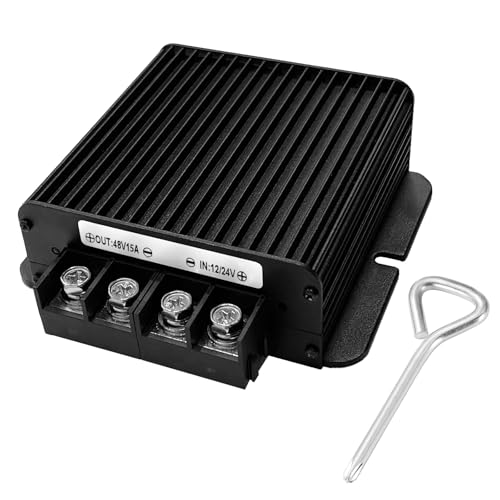
MZHOU 15A 720W Converter bridges the output gap between the 10A and 25A models, with a 48V, 15A, 720W rating and 12V/24V input. Its metal/ABS shell is described as dustproof and shockproof, but the maker explicitly cautions that it is not waterproof. This is a fit for a 48V load above 10A and up to 15A when the installation stays dry. The maker mentions overload protection, but the specifications do not identify other protection types; buyers who require a particular protection feature should verify it before ordering.
Bottom line: Choose this for a 12V or 24V source and a 48V load drawing up to 15A in a dry location.
Gebildet 6A 288W Converter

Gebildet 6A 288W Converter is the lowest-output option here, rated at 48V, 6A, or 288W, with a 9–16V input range. The aluminum enclosure has an IP68 rating, and the maker says conversion efficiency reaches 96%. The product is expressly marked as unsuitable for Starlink series equipment, so choose it for another 12V-based system that stays within its output rating. Its 6A ceiling is below the other models, making it unsuitable when the 48V load needs more than 6A.
Bottom line: Pick this for a non-Starlink 12V system whose 48V load draws no more than 6A.
Daygreen 10A 480W Plus

Daygreen 10A 480W Plus is the only converter in this group whose name specifies 12V, 24V, and 36V input, while its output is rated at 48V, 10A, and 480W. That makes it worth considering when the source voltage may be 36V rather than just 12V or 24V. Its 10A output also limits it to loads at or below that current; verify its input operating range before ordering.
Bottom line: Choose this when the source may be 36V and the 48V load stays within 10A.
How to Choose a 12V to 48V Converter
Start with the load’s 48V current, then choose a converter rated at or above that current. Output power is voltage multiplied by current, so 48V at 6A is 288W and 48V at 10A is 480W. A step-up converter does not create power: at 90% efficiency, a 480W output requires about 533W from the source. At 12V, that is about 44A of input current, while a 24V source would need about 22A. Those figures illustrate why the battery, wiring, connectors, and fuse must all handle input-side current, not just the smaller 48V output current. Leave operating margin rather than sizing the converter exactly to a load’s peak.
Input Voltage and Battery Fit
Match the converter’s full input range to the source’s voltage while charging and under load; a label that says 12V alone does not guarantee it accepts every real-world battery voltage. For example, a 12V lead-acid battery can be above 12V while charging, and source voltage can sag under heavy current. A converter with a specified 9–16V range accommodates that span; a model specified only as 12V needs more scrutiny. A 12V source feeding a 48V output also draws roughly four times the output current before conversion losses. Check battery capability and wire ampacity, and place an appropriately rated fuse close to the battery positive terminal.
Waterproofing, Heat, and Installation
IP ratings are not interchangeable: IP67 indicates dust-tight construction and protection against temporary immersion under defined test conditions, while IP68 indicates dust-tight construction and immersion protection under conditions set by the manufacturer. Neither rating means a converter can be submerged indefinitely or installed without regard to cable entry points. A high-power boost converter also sheds heat, especially at high input current, so mounting it where heat can escape matters even when the enclosure is sealed. Keep connections clean and protected from corrosion, use wire sized for the input current and cable run, and avoid routing power wires alongside sensitive signal wiring when practical. Never work on energized battery wiring; short circuits can cause burns or fire.
Common Converter Sizing Mistakes
The most common sizing error is choosing by the 48V output alone and overlooking the much higher current drawn at 12V. For a 48V, 15A load, output power is 720W; at 90% efficiency, the 12V side would need about 67A. Another mistake is treating a waterproof rating as permission to ignore mounting and ventilation: sealed cases can still overheat if heat cannot dissipate. Also check whether the equipment has an inrush surge when it starts, since a load’s startup demand can exceed its steady current. Choose a converter and source that can tolerate that surge, or confirm the load’s startup requirements before installation.
Frequently Asked Questions
How many amps does a 48V load draw from a 12V battery?
Input current depends on output power and conversion efficiency, not just the 48V load current. A 48V, 10A load uses 480W; at 90% efficiency, the 12V source must deliver about 44A.
Can a 12V step-up converter run from a 24V battery?
Only if the converter’s input range includes the 24V system voltage. A model specified for 9–16V is not suitable, while an 11–35V range includes 24V.
What wire size should I use for a 12V to 48V converter?
Size the input wires for the battery-side current, cable length, and allowable voltage drop. A 480W output at 90% efficiency draws about 44A from 12V, so the wire and fuse must be selected for that current and the installation conditions.
Does IP68 mean a converter can stay underwater?
No; IP68 does not mean indefinite or unrestricted submersion. The permitted immersion conditions are set by the manufacturer, and cable entries and installation still affect water protection.
Why does my 48V device fail to start on a converter?
Startup inrush can briefly exceed the device’s steady-state current, causing a converter to trip or its output to sag. Check the load’s startup demand and choose a converter with capacity for that surge, not only the continuous rating.