
14 Watt LED Equivalent: 100W Bulbs Compared

For a 14 watt LED equivalent that replaces a 100W incandescent, start with the intended light color: A19 14W Daylight 12-Pack pairs 1600 lumens with 5000K daylight, while Linkind A19 14W Soft White 4-Pack gives the same brightness in 2700K soft white.
Choose daylight for crisp task lighting and soft white for a warmer look; before ordering, confirm your fixture takes an A19 bulb with an E26 base and does not require dimming.
We earn a commission if you buy through links on this page. As an Amazon Associate I earn from qualifying purchases. Products are compared on manufacturer specifications, not hands-on testing.
- Best overall: A19 14W Daylight 12-Pack – Combines 1600 lumens, 5000K daylight, and an E26 base in a 14W, 100W-equivalent bulb.
- Best for warm light: Linkind A19 14W Soft White 4-Pack – Produces 1600 lumens at 2700K for a soft white alternative to daylight.
- Best for lower brightness: Sylvania A19 14W Daylight 4-Pack – Offers dimming and 800 lumens, but it is a 60W-equivalent bulb rather than a 100W replacement.
| Product | Best for | Brightness | Color temperature | Shop |
|---|---|---|---|---|
| A19 14W Daylight 12-Pack | Bright daylight | 1600 lumens | 5000K | Check Price on Amazon |
| Linkind A19 14W Soft White 4-Pack | Warm white | 1600 lumens | 2700K | Check Price on Amazon |
| Sylvania A19 14W Daylight 4-Pack | Daylight alternative | 1500 lumens | Daylight; K unspecified | Check Price on Amazon |
| IINVGOOD A19 14W Daylight 12-Pack | High-CRI daylight | 1600 lumens | 5000K | Check Price on Amazon |
14 watt LED equivalent bulbs
Compare brightness, color temperature, and dimming needs before matching a bulb to your fixture.
A19 14W Daylight 12-Pack

For a bright daylight 100W replacement, this A19 bulb provides 1600 lumens at 5000K and uses 14W. It has an E26 medium screw base, a non-dimmable design, and a 12-bulb pack. The maker says its lifespan exceeds 25,000 hours and its CRI is above 90. This suits rooms where crisp, high-output light is the priority. The limitation is that it cannot dim, so it is a poor match for fixtures controlled by a dimmer; choose a dimmable bulb instead when adjustable brightness is needed.
Bottom line: Choose this for bright 5000K light in a non-dimmable E26 fixture.
Linkind A19 14W Soft White 4-Pack

This option keeps the 14W, 1600-lumen output but shifts the color to 2700K soft white, unlike the daylight choices. The A19 bulb has an E26 standard base and comes in a four-pack; the maker gives a lifespan of up to 15,000 hours. It fits bedrooms, living rooms, or other spaces where a warmer appearance matters more than a cooler task-light effect. It is non-dimmable, so it will not serve a dimming setup. Choose a compatible dimmable model if the fixture needs adjustable output.
Bottom line: Pick this for 1600 lumens of soft white light without dimming.
Sylvania A19 14W Daylight 4-Pack
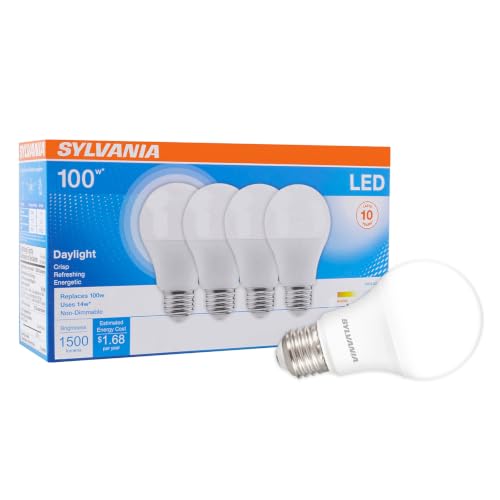
Unlike the 1600-lumen options, this Sylvania A19 uses 14W for 1500 lumens, making it a slightly lower-output daylight alternative. It has a frosted finish and comes in a four-pack. The maker says the bulbs last up to 11,000 hours and turn on instantly. This suits a buyer who wants daylight color from a familiar A19, E26-style bulb form, while accepting less brightness than the leading choices. The color specification does not include a Kelvin number, so confirm the preferred color temperature before choosing if matching existing bulbs is important.
Bottom line: Choose this for a 1500-lumen daylight replacement and instant-on operation.
IINVGOOD A19 14W Daylight 12-Pack

This 12-pack pairs 1600 lumens with 5000K daylight and a CRI of 90+, emphasizing color rendering alongside brightness. Each A19 bulb uses 14W, has an E26 medium base, and is non-dimmable. The maker claims a lifespan exceeding 25,000 hours. It suits home or office spaces where accurate-looking colors and bright daylight are priorities. The key restriction is the non-dimmable design; use a dimmable bulb for a dimmer-controlled fixture. It shares core output with other 14W daylight options, so color rendering is the differentiator rather than a brightness gain.
Bottom line: Pick this when high color rendering is a priority in a non-dimmable fixture.
How to choose a 14 watt LED equivalent
Choose by lumens first, because wattage measures energy use rather than brightness. A 100W incandescent replacement is commonly around 1600 lumens; the 14W options here provide 1500 or 1600 lumens, while the 800-lumen bulb is a lower-output 60W equivalent. Then select color temperature: 2700K looks warm and yellowish, while 5000K appears cooler and more daylight-like. If the fixture uses a dimmer, the bulb must be dimmable and compatible with that control. A non-dimmable bulb is not a suitable substitute. A19 describes the common bulb shape, and E26 is the standard medium screw base used by many household fixtures.
Match bulb color to the room
For a warmer, relaxed appearance, look for 2700K soft white; for a cooler, daylight-like effect, choose 5000K. These Kelvin values describe color appearance, not brightness, so compare lumens separately. Daylight can make task areas feel crisper, while warm white is often chosen in bedrooms and living rooms. When matching bulbs in one open space, keep color temperature consistent to avoid visibly different patches of light. A product marked only “daylight” cannot be compared precisely by Kelvin unless its number is provided, so verify the color temperature if exact matching matters.
Check base, shape, and dimmer compatibility
Most household A19 bulbs use an E26 medium screw base, but the fixture label or old bulb is the practical fit check. A19 describes the bulb envelope; it does not guarantee that every enclosed, recessed, or specialty fixture is appropriate. Check the fixture’s allowed bulb type and wattage-equivalent guidance, especially in enclosed housings where heat management matters. For dimmer-controlled lights, use a bulb explicitly marked dimmable and ensure the dimmer supports LED loads. Three-way sockets need bulbs made for three-way operation; a standard bulb does not provide stepped output simply because the fixture has multiple settings.
LED brightness and incandescent equivalents
Use this quick comparison to avoid confusing watts with light output. Equivalent wattage is a convenient replacement label, while lumens provide the more direct brightness comparison.
| Incandescent replacement | Typical LED brightness | Practical use |
|---|---|---|
| 60W equivalent | About 800 lumens | Lower-output general lighting |
| 100W equivalent | About 1600 lumens | Brighter general or task lighting |
Actual room brightness also depends on shade, fixture direction, ceiling height, wall color, and how many bulbs are installed. A shaded lamp can deliver less light to a work surface than an exposed bulb with the same lumen rating. For reading or detailed tasks, compare total fixture output and placement rather than choosing by equivalent wattage alone.
Frequently Asked Questions
How bright is a 14 watt LED bulb?
A 14W LED in this group produces 1500 or 1600 lumens. That is in the range commonly used to replace a 100W incandescent bulb.
Does 14 watts mean the bulb is as bright as 100 watts?
No. Watts measure electrical power, while lumens measure light output. These 14W bulbs are labeled as 100W equivalents because they produce roughly 1500 to 1600 lumens.
What color temperature should I choose for a bedroom?
A 2700K soft white bulb gives a warmer appearance often preferred for relaxing spaces. Choose 5000K when you want a cooler, daylight-like look instead.
Can I use a non-dimmable LED with a dimmer switch?
No; use a bulb marked dimmable with a compatible LED dimmer. A bulb that is not designed to dim may flicker or behave unpredictably on a dimmer.
Will an A19 bulb fit an E26 socket?
Usually, because A19 describes the bulb shape and E26 is the common medium screw base. Confirm both the fixture’s socket and its clearance, since bulb shape alone does not ensure a fit.