
360 Bird View Car Systems: 4 Models Compared

BY-J 360 Surround System suits drivers who want a 1080p four-camera system with AI detection and support for up to 128GB USB storage. Choose another system if a different storage limit or installation approach better fits your vehicle; these systems combine camera views to show the area around a car.
We earn a commission if you buy through links on this page. As an Amazon Associate I earn from qualifying purchases. Products are compared on manufacturer specifications, not hands-on testing.
- Best overall: BY-J 360 Surround System – It combines 1080p four-channel recording, AI detection and a 128GB USB maximum.
- Best for 22-foot vehicles: Weivision 1080P 360 Surround System – The maker says it is designed for vehicles up to 22 feet and records four 1080p channels.
- Best for night vision: Weivision Universal 360 Bird View System – It specifies night vision and waterproof IP69 cameras.
- Best for flexible storage: 360° Panoramic Bird View System with AI Warning – It supports compatible USB drives from 16GB to 512GB.
| Product | Best for | Camera resolution | Recording storage | Vehicle fit | Shop |
|---|---|---|---|---|---|
| BY-J 360 Surround System | AI detection | 1080p, 4 channels | Up to 128GB USB | Car, SUV, van | Check Price on Amazon |
| Weivision 1080P 360 Surround System | Up to 22-foot vehicles | 1080p, 4 channels | Up to 32GB | Vehicles up to 22 ft | Check Price on Amazon |
| Weivision Universal 360 Bird View System | Night vision | — | — | Most vehicles, not buses | Check Price on Amazon |
| 360° Panoramic Bird View System with AI Warning | Large USB drives | — | 16–512GB USB | Cars, SUVs, trucks | Check Price on Amazon |
360 bird view car systems
Compare camera, recording and fit specifications before choosing a surround-view setup.
BY-J 360 Surround System

AI detection is the distinguishing feature of this system: the maker says it can recognize vehicles and pedestrians and activate the panoramic view. It uses a HiSilicon Hi3520V600 processor, provides a 360-degree bird’s-eye view with AI distance measurement, and records four HD channels with loop recording. The maker also says the TVI cameras provide 1920 × 1080P video. This option suits drivers who want detection features alongside recording. Its USB storage maximum is 128GB, so drivers who need more capacity should compare systems with larger stated limits.
Bottom line: Choose it if AI detection and 1080p recording are priorities.
Weivision 1080P 360 Surround System
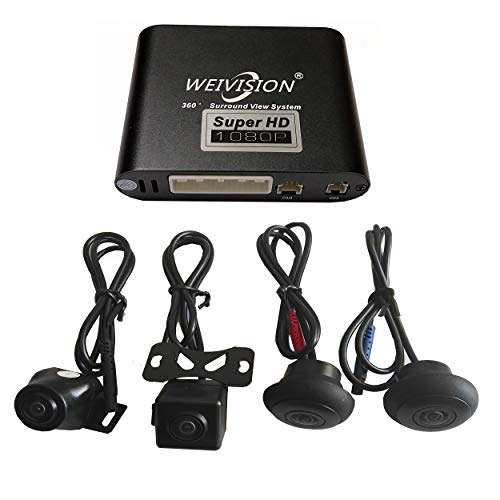
The 22-foot vehicle fit and four-channel 1080p recording set this Weivision system apart. It includes four 190-degree fish-eye cameras with a horizontal viewing angle above 170 degrees, cycle recording, and 1080p video output. The maker says it is designed for pickup trucks and other vehicles within 22 feet, and describes installation and calibration as easy. The maximum recording capacity is 32GB, which may be restrictive for drivers who want more storage or extended recording. Confirm that your vehicle falls within the length range before selecting it.
Bottom line: Choose it for a vehicle within 22 feet and four-channel 1080p recording.
Weivision Universal 360 Bird View System

Night vision and an IP69 waterproof rating distinguish this Weivision system. It uses four cameras with viewing angles above 170 degrees and supports automatic image mosaicking, shock-sensor parking monitoring, and MP4 recording that can be viewed on a PC or mobile device. The maker says it fits almost all vehicles, except long vehicles such as buses. Professional installation is required, and the side mirrors need a 20 mm hole for the side cameras. That drilling requirement makes this a poor match for anyone seeking a no-modification installation.
Bottom line: Choose it if night vision matters and professional mirror drilling is acceptable.
360° Panoramic Bird View System with AI Warning

USB storage flexibility is the main distinction here: the maker says the system accepts 16GB to 512GB USB drives in FAT32 format. It records four-in-one HD video using H.265 compression and supports AHD, TVI, CVI, HDMI, VGA, and CVBS video outputs. Four language options are Chinese, Korean, English, and Russian. This system may suit drivers who need a larger storage range or multiple output choices.
Bottom line: Choose it if broad USB capacity and multiple output formats matter most.
How to choose a 360 bird view car system
Choose by vehicle fit, camera coverage, recording needs and installation requirements, in that order. A surround-view system typically combines front, rear and side camera feeds into a top-down image; camera placement and calibration determine whether the stitched view lines up correctly. A 190-degree camera field of view is not the same as a 190-degree usable image, because fisheye distortion and vehicle bodywork affect what appears on screen. Compare stated camera resolution and storage capacity, and make sure the system’s video output can connect to your display. If your vehicle exceeds a length limit, do not assume the view will cover it accurately. Treat the display as a parking aid, not a replacement for mirrors or direct checks.
Installation and calibration needs
Installation can involve more than attaching cameras: wiring, choosing camera positions and calibrating the stitched image all affect the result. A system that requires a 20 mm hole in each side mirror calls for a different commitment than one described as easy to install. Before installation, check that cameras will not be blocked by trim, accessories or a rear-mounted spare tire. Calibration usually requires a level, open area and a repeatable reference around the vehicle so the system can align the camera feeds; follow the system-specific procedure. Misaligned cameras can make distances and object positions appear wrong. If drilling, wiring or calibration is beyond your experience, use a qualified installer.
Camera view, recording and storage
Camera resolution and viewing angle describe different things: resolution affects image detail, while angle describes how much scene a lens captures. Wide-angle lenses can show more area but also distort distance near the edges, so use the stitched view cautiously when judging gaps. Recording capacity also differs from live-view capability; a larger drive gives more room, while loop recording may overwrite older footage when storage fills. Check the required drive format and output connection before purchasing storage or a display. Keep cameras clean and check their positions after mirror adjustments, body work or a minor impact. A four-camera system still has blind areas if a lens is obstructed or its feed is misaligned.
Using a 360-degree view safely
Use the panoramic display as one input while parking, not as proof that the path is clear. Camera perspective can hide low objects, narrow posts or children close to the vehicle, especially near lens edges or when a camera is blocked. Stop if the view is unclear, check mirrors and look around directly before moving. Keep the screen positioned so it does not distract from the road, and avoid adjusting settings while driving. For reversing or tight turns, move slowly enough to stop immediately if the image and direct view do not agree.
Frequently Asked Questions
Do 360-degree car cameras need calibration?
Yes, calibration aligns the camera feeds so the stitched overhead view corresponds to the vehicle. A level, open space and consistent reference points help; follow the system’s calibration procedure after installation or camera repositioning.
Can a 360 camera system replace parking sensors?
No, a camera view is not a substitute for parking sensors or direct checks. Wide-angle lenses can distort distance, and low or close objects may be hard to see; move slowly and check around the vehicle.
What does a 190-degree camera angle mean?
A 190-degree figure describes a very wide lens view, not a guaranteed clear 190-degree image. Fisheye distortion and parts of the vehicle can obscure or warp areas near the edge.
How much storage does a car camera system need?
Storage needs depend on channel count, resolution, compression and how long you want to retain recordings. Four-channel systems generate more footage than a single camera, and loop recording may overwrite older clips when the drive fills.
Can I install a 360 camera system myself?
Some kits may be manageable for experienced installers, but camera placement, wiring and calibration affect the view. A system that requires a 20 mm side-mirror hole calls for drilling, so professional installation is prudent if you are not equipped to do that accurately.