
360 Degree Bird View Camera for Car Compared by Fit

For most passenger cars, Weivision Universal 360 Bird View System is the best fit because its maker describes it as a universal system, excluding long vehicles such as buses. Drivers who need a specified vehicle-length limit or AI features should compare Weivision Super HD 1080P 360 System or BY-J 1080P 360 Surround System instead.
A 360-degree bird view system combines cameras around the vehicle into a stitched overhead view; it can help with parking, but it does not replace mirrors or direct observation.
We earn a commission if you buy through links on this page. As an Amazon Associate I earn from qualifying purchases. Products are compared on manufacturer specifications, not hands-on testing.
- Best overall: Weivision Universal 360 Bird View System – The maker describes it as universal for nearly all cars, except long vehicles such as buses.
- Best for pickups: Weivision Super HD 1080P 360 System – The maker specifies vehicles up to 22 feet and four-channel 1080p recording.
- Best for AI alerts: BY-J 1080P 360 Surround System – Its features include pedestrian and vehicle detection with smart alerts.
| Product | Best for | Vehicle fit | Camera angle | Recording limit | Shop |
|---|---|---|---|---|---|
| Weivision Universal 360 Bird View System | Most passenger cars | Nearly all cars; excludes long vehicles | Above 170° | — | Check Price on Amazon |
| Weivision Super HD 1080P 360 System | Pickups up to 22 ft | Vehicles up to 22 ft | 190°; horizontal above 170° | 32 GB max | Check Price on Amazon |
| BY-J 1080P 360 Surround System | AI detection features | Car, SUV, van | — | 128 GB USB max | Check Price on Amazon |
360 Degree Bird View Camera Systems for Cars
Compare vehicle fit and camera capabilities first, then account for installation and calibration before choosing a system.
Weivision Universal 360 Bird View System

Broad vehicle compatibility is the main distinction of Weivision Universal 360 Bird View System: the maker says it suits almost all cars, while excluding long vehicles such as buses. The kit uses four wide-angle cameras, waterproof IP69 housings and night vision, and it stitches the views into a bird’s-eye display. Parking monitoring with a shock sensor and MP4 recording are also included. This is a practical match when the vehicle is a typical car and a surround view is the priority. Installation is a meaningful limitation: the maker calls for professional installation, and the side mirrors need a 20 mm hole for the side cameras.
Bottom line: Choose this if broad passenger-car compatibility matters more than a specified recording resolution.
Weivision Super HD 1080P 360 System
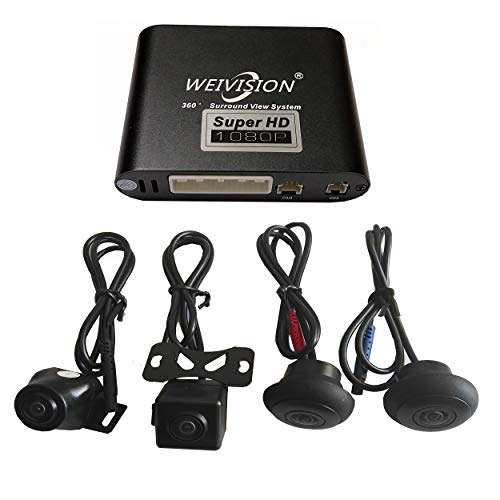
A defined vehicle-length cap sets Weivision Super HD 1080P 360 System apart: its maker says it is designed for vehicles up to 22 feet, including pickups. Four 1080p cameras have a 190-degree stated angle, with horizontal coverage above 170 degrees; the system records on four channels, supports cycle recording and accepts up to 32 GB. The limit gives pickup owners a concrete fit condition to check against overall vehicle length. The trade-off is storage capacity: 32 GB maximum is less than the 128 GB USB limit in BY-J 1080P 360 Surround System, which matters to drivers who want to retain more footage.
Bottom line: Choose this for a vehicle at or under 22 feet when four-channel 1080p recording is a priority.
BY-J 1080P 360 Surround System

AI detection distinguishes BY-J 1080P 360 Surround System from the other passenger-car options: the maker says it recognizes vehicles and pedestrians, triggers panoramic view automatically, and sends smart alerts. The system also combines four-channel HD recording, loop recording and a 360-degree bird’s-eye view with AI distance measurement. Its USB recording limit is 128 GB, the largest capacity specified among these exact-fit systems. Confirm compatibility with the vehicle before ordering.
Bottom line: Choose this when AI recognition, alerts and a 128 GB USB limit matter most.
How a 360-degree bird view camera works
A surround-view system uses cameras mounted at the front, rear and sides, then combines their images into an overhead-style view. The camera feeds overlap, and calibration aligns them so the joined image appears continuous; a poor alignment can make objects seem displaced near a seam. These systems assist low-speed maneuvers such as parking, but the displayed perspective is processed rather than a direct camera view. Keep using mirrors and look around the vehicle, especially for small children, pets and objects close to the body. A stitched view can also distort distances at the edges, so use it to locate obstacles rather than judge exact clearance.
Fit and installation for a car camera system
Vehicle length and camera placement are the first fit checks: Weivision Super HD 1080P 360 System has a maximum of 22 feet, while Weivision Universal 360 Bird View System excludes long vehicles such as buses. A four-camera setup needs front, rear and side mounting positions, plus wiring routed to the display or recorder. Side-mirror mounting can require drilling; Weivision Universal 360 Bird View System specifically calls for a 20 mm hole, so owners unwilling to modify mirror housings should account for that before choosing. Calibration matters after installation because the four camera views must be aligned to create a useful composite. Park on level ground during calibration, keep each lens unobstructed, and do not assume a universal system fits every body shape without adjustment.
Compare camera angles and recording capacity
Angle and storage are useful differentiators, but they do not establish how well a stitched image will fit a particular vehicle. The table separates the coverage and recording limits; an em dash means the input does not supply a comparable figure.
| Need | Choose | Reason |
|---|---|---|
| Known four-camera angle | Weivision Super HD 1080P 360 System | 190° camera angle; horizontal view above 170° |
| Largest USB capacity | BY-J 1080P 360 Surround System | Maximum 128 GB USB |
| IP-rated camera housings | Weivision Universal 360 Bird View System | IP69 rating |
Recording capacity affects how much footage can be retained before cycle recording overwrites older files. A larger capacity does not guarantee a particular recording duration, since resolution, frame rate and file settings also affect storage use. Review camera placement and display compatibility alongside these figures rather than choosing from angle alone.
Using a bird view system safely
Use a 360-degree view as a parking aid, not as permission to move without checking the surroundings. Camera seams, perspective distortion and blocked lenses can hide or misplace objects, especially close to bumpers or beside the vehicle. Stop and inspect the area whenever the display conflicts with what you see in the mirrors or through the windows. Keep lenses clean and check their alignment after a camera or mirror is bumped, replaced or adjusted. If a system offers automatic alerts or parking monitoring, treat those features as supplemental; they do not guarantee that every pedestrian or obstacle will be detected.
Frequently Asked Questions
Do 360-degree car cameras replace backup cameras?
No, a surround-view system adds a stitched overhead perspective rather than eliminating the need to look behind the car. Continue checking mirrors and surroundings, since seams and lens perspective can distort nearby objects.
How many cameras does a 360-degree car system use?
A typical car surround-view setup uses four cameras: front, rear and one on each side. Camera placement and calibration determine how continuously those feeds join around the vehicle.
Does a 360 camera need calibration after installation?
Yes, calibration aligns the four camera images into a coherent view. Recheck alignment after a camera or mirror is moved, replaced or struck.
Can a 360-degree camera show objects close to a car?
It can display nearby objects, but the joined image may distort their position or distance near camera seams. Stop and verify clearance directly before moving through a tight space.
How much recording storage does a car system need?
The systems here specify limits from 32 GB to 128 GB, and cycle recording can overwrite older video. Recording time also depends on video settings, so select capacity based on how much footage you need to retain.