
Best Coin Scale on the Market: 5 Scales Compared

For most coin collectors, MEIYA 600g Pocket Coin Scale is the best coin scale because its 0.01g increments and seven measurement units support precise weighing across several precious-metal conventions. Choose DigiWeigh 1000BX Coin Scale if you need a flat portable scale with a 1,000g capacity and Troy ounces; choose an integrated microscope model if you want magnification alongside weighing.
We earn a commission if you buy through links on this page. As an Amazon Associate I earn from qualifying purchases. Products are compared on manufacturer specifications, not hands-on testing.
- Best overall: MEIYA 600g Pocket Coin Scale – Its 0.01g increments, 600g capacity, tare function and seven units suit coin and jewelry weighing.
- Best for bullion units: DigiWeigh 1000BX Coin Scale – It measures in Troy ounces, grains, pennyweights and carats, with a 1,000g capacity.
- Best for coin inspection: Elikliv Microscope with Weighing Scale – The built-in scale pairs with a 4.3-inch digital microscope screen.
- Best for batch counting: 30kg Coin Counting Scale – Its counting and alert modes pair with a 30kg capacity for parts and coins.
| Product | Best for | Capacity | Readability | Units | Shop |
|---|---|---|---|---|---|
| MEIYA 600g Pocket Coin Scale | Fine increments | 600g | 0.01g | g, ct, dwt, ozt, gn, tl, oz | Check Price on Amazon |
| DigiWeigh 1000BX Coin Scale | Bullion units | 1,000g | 0.1g | g, oz, ozt, gn, dwt, ct | Check Price on Amazon |
| Elikliv Microscope with Weighing Scale | Coin inspection | 300g | 0.1g | g, oz, ct | Check Price on Amazon |
| TOMLOV DM4W Microscope Scale | Microscope weighing | — | 0.1g | g, oz, ct | Check Price on Amazon |
| 30kg Coin Counting Scale | Batch counting | 30,000g (30kg) | 0.1g | g, kg, lb | Check Price on Amazon |
Coin Scales Compared
Compare the capacity, smallest displayed increment and measurement units to match a scale to the coins or valuables you weigh.
MEIYA 600g Pocket Coin Scale

MEIYA 600g Pocket Coin Scale stands apart for its 0.01g readability and compact pocket-scale format. It has a 600g capacity, tare function and seven units: grams, carats, pennyweights, Troy ounces, grains, taels and ounces. That combination suits collectors who weigh small coins or jewelry and want finer displayed increments than the 0.1g models here. A smaller increment is not the same as guaranteed accuracy, however; the specifications do not give an accuracy figure. For high-value bullion checks, compare repeated readings and use an appropriate reference weight rather than treating the display resolution as proof of authenticity.
Bottom line: Choose this if finer displayed increments and multiple precious-metal units matter most.
DigiWeigh 1000BX Coin Scale
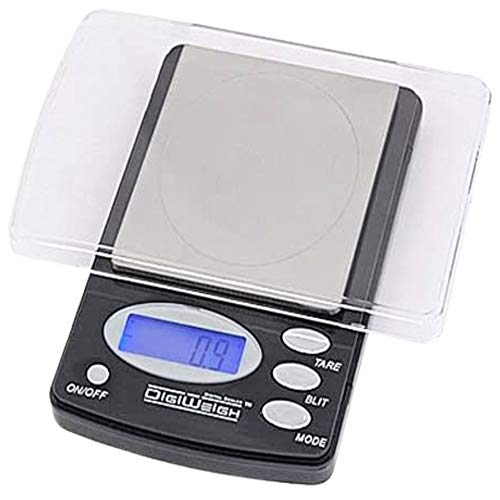
DigiWeigh 1000BX Coin Scale is a dedicated, flat coin scale with the broadest capacity among the pocket-style models: 1,000g. It measures in grams, ounces, Troy ounces, grains, pennyweights and carats, making it useful when bullion references use a unit other than grams. Its readability is 0.1g, and the specifications say it arrives pre-calibrated with batteries and instructions. The trade-off is that it does not offer the 0.01g increments of MEIYA 600g Pocket Coin Scale. Pick it for capacity and metal-specific units; collectors who need finer displayed increments should compare that alternative instead.
Bottom line: Choose this if you weigh bullion and want Troy ounces, grains or pennyweights.
Elikliv Microscope with Weighing Scale
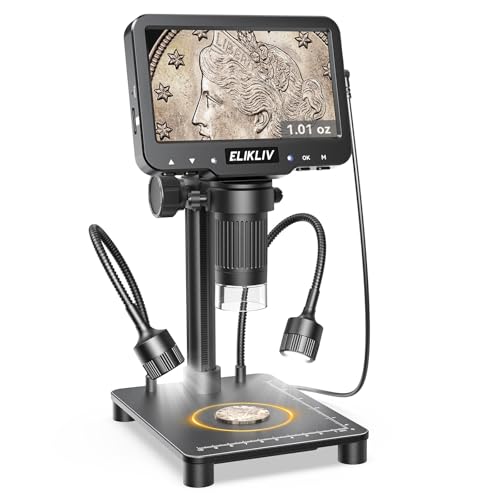
Elikliv Microscope with Weighing Scale combines a 300g scale with a digital microscope, so its distinguishing feature is inspection and weighing in one setup. It has a 4.3-inch screen, eight plus two lights, camera and video functions, and USB PC viewing; the scale supports grams, ounces and carats with 0.1g readability. That suits collectors who want magnification while examining small details. The scale has less capacity than the standalone 1,000g and 30kg options, and its units omit Troy ounces. Its advertised 0.1-second reading speed is a maker claim, not a substitute for checking that readings settle consistently.
Bottom line: Choose this if a microscope and scale in one device fit your inspection routine.
TOMLOV DM4W Microscope Scale

TOMLOV DM4W Microscope Scale pairs a digital microscope with a scale and differs from Elikliv Microscope with Weighing Scale in its stand height and accuracy figure. It has a 4.3-inch IPS screen, an 8-inch stand, compatibility with Windows and Mac, and gram, ounce and carat units. The maker gives 0.1g resolution and ±0.5g accuracy, so a displayed tenth of a gram should not be mistaken for a tenth-gram accuracy guarantee. Confirm the needed lift range before ordering.
Bottom line: Choose this if you want an integrated microscope and the accuracy matters to your workflow.
30kg Coin Counting Scale

30kg Coin Counting Scale is designed for counting and inventory rather than pocket portability: it supports up to 30kg and has quantity-alert and weight-alert modes. Its display switches among grams, kilograms and pounds, and the backlit LCD helps with visibility in varied lighting. This high capacity suits batches of coins or parts, but the 0.1g increment should not be read as a promise of accuracy across the full 30kg range. Its units also omit Troy ounces, carats and pennyweights, so precious-metal weighing in those conventions is less convenient than with DigiWeigh 1000BX Coin Scale or MEIYA 600g Pocket Coin Scale.
Bottom line: Choose this for high-capacity coin or parts counting with alert modes.
How to Choose a Coin Scale
Choose a coin scale by matching its readability, capacity and units to the job. Readability is the smallest displayed increment, not the same as accuracy: a 0.01g display does not prove a reading is accurate to 0.01g. For ordinary coin checks, a 0.1g increment can help distinguish larger weight differences; for small precious-metal pieces, finer increments can make comparisons easier. Check that the maximum capacity comfortably exceeds the coin plus any tray you use. A tare function subtracts the tray’s displayed weight, but it does not improve the scale’s underlying accuracy. If you need metal-market units, confirm that the scale supports Troy ounces (ozt), not just everyday ounces (oz).
Coin Weight and Scale Readings
Coin weight varies by denomination, composition and wear, so use the specific coin’s published specification as a reference rather than a generic “coin weight.” For a familiar U.S. comparison, a current-weight nickel is 5.00g, a quarter is 5.67g, and a dime is 2.268g; older cents can differ from current zinc cents. A scale can flag a weight difference, but weight alone cannot authenticate a coin because counterfeits can be made to match a target mass. Weigh on a level, stable surface and keep the coin centered. If repeated readings drift, check for drafts, contact with the table, debris on the platform or a low battery before drawing a conclusion.
Scale Types for Collectors
Standalone pocket scales prioritize portability and often include tare and precious-metal units, while counting scales prioritize batches, higher capacity and quantity functions. Microscope scale combinations add magnification but trade some scale capacity or unit choice for an inspection setup. Use this quick guide to match the format to the task.
| Need | Scale type | What to prioritize |
|---|---|---|
| Small coin or jewelry readings | Pocket scale | Fine increment, tare, suitable capacity |
| Bullion comparisons | Coin or jewelry scale | Troy ounces and other needed units |
| Examining coin details | Microscope scale combo | Screen, lighting and suitable capacity |
| Counting batches | Counting scale | Capacity and counting functions |
For a single coin, a 30kg capacity is usually unnecessary; choose a high-capacity counting model only if batch weighing or inventory counting is part of the job.
Using and Caring for a Coin Scale
Keep a coin scale clean, level and free of vibration for steadier readings. Brush dust from the weighing platform with a soft, dry brush; liquid cleaners can enter the housing or damage a display. Avoid dropping coins onto the platform, since impact can affect a sensitive weighing mechanism. Calibration weights should be close to the weight range you use and match the scale’s supported calibration procedure; do not assume a coin is an adequate calibration weight. For precious-metal work, let the scale stabilize, weigh the same item more than once, and note the unit each time. Store pocket scales closed or protected from pressure, and remove batteries during long storage if the maker’s instructions recommend it.
Frequently Asked Questions
Does a 0.01g coin scale guarantee accurate readings?
No; 0.01g describes the displayed increment, not necessarily the accuracy. Compare the scale’s accuracy, if available, and check repeatability with a suitable reference weight near the range you use.
Are Troy ounces and regular ounces the same?
No; a Troy ounce is about 31.10g, while an avoirdupois ounce is about 28.35g. Check the unit symbol before comparing a coin or bullion reading with a reference.
Can coin weight alone prove that a coin is genuine?
No; weight is one screening measurement, not proof of authenticity. Compare the coin’s dimensions, appearance and other identifying features against a trusted reference as well.
Why does my coin scale show changing readings?
Drafts, vibration, an uneven surface or a coin touching the platform edge can make readings unstable. Place the scale on a firm, level surface, center the coin and wait for the display to settle.
Should I use a tray when weighing small coins?
A tray can help keep small coins centered, but tare its weight before adding the coin. Make sure the tray and coin together remain below the scale’s capacity.