
Rust Remover for Guns: 4 Options Compared by Use

For firearm-specific rust and lead deposits, choose Birchwood Casey Rust and Lead Remover Cloth, a treated 11-by-14-inch cloth; Extreme Force Premium Gun CLP, 3 oz is a CLP option for cleaning, lubrication, and protection with rust removal among its claimed functions. Choose a general metal soak only for compatible, removed parts, not an assembled firearm.
For routine lubrication and protective coverage, consider a CLP instead; for rust on removable bare metal parts, a soak is a different kind of treatment.
We earn a commission if you buy through links on this page. As an Amazon Associate I earn from qualifying purchases. Products are compared on manufacturer specifications, not hands-on testing.
- Best overall: Birchwood Casey Rust and Lead Remover Cloth – The cloth is explicitly made for gun maintenance and removes rust deposits without hard scrubbing.
- Best for CLP treatment: Extreme Force Premium Gun CLP, 3 oz – Its synthetic-blend CLP combines cleaning, lubrication, and protection in a 3-ounce size.
- Best for targeted application: Mossy Oak CLP Gun Cleaning Oil, 3 oz Combo – The set pairs a 2-ounce mist bottle with a 1-ounce needle oiler for broad and pinpoint application.
| Product | Best for | Format | Size | Application | Shop |
|---|---|---|---|---|---|
| Birchwood Casey Rust and Lead Remover Cloth | Gun deposit removal | Treated cloth | 11 × 14 in | Wipe-on | Check Price on Amazon |
| Extreme Force Premium Gun CLP, 3 oz | CLP rust removal | Synthetic-blend CLP | 3 oz | Liquid | Check Price on Amazon |
| Mossy Oak CLP Gun Cleaning Oil, 3 oz Combo | Flexible CLP application | CLP oil | 2 oz + 1 oz | Mist and needle | Check Price on Amazon |
| CRC Evapo-Rust, 32 oz | Separate metal parts | Water-based soak | 32 fl oz | Submerge and rinse | Check Price on Amazon |
Rust remover for guns compared
Choose by whether you need a firearm-specific wipe, an all-in-one CLP, or a soak for separate metal parts.
Birchwood Casey Rust and Lead Remover Cloth

Unlike the CLP liquids here, this treated cloth is specifically described for gun maintenance and removal of rust and lead deposits. The 11-by-14-inch tan cloth also addresses plastic buildup in gun bores and contains protective chemicals and waxes intended to inhibit later rust or tarnish. It suits maintenance where wiping deposits is the goal rather than soaking a part or adding lubricant. Its limitation is its cloth format: it is not an all-in-one cleaner and lubricant, so choose another product when lubrication is also needed.
Bottom line: Choose this for wiping firearm deposits when you do not need a combined lubricant.
Extreme Force Premium Gun CLP, 3 oz
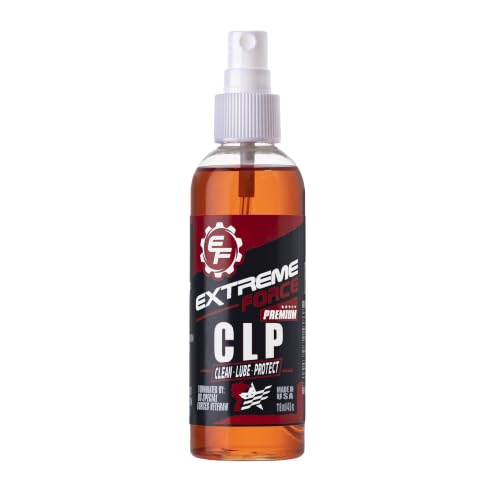
Unlike the treated cloth, this 3-ounce synthetic-blend CLP combines cleaner, lubricant, and protectant functions. The maker says it removes carbon buildup and rust, stays where applied, and repels conditions including rain, snow, saltwater, heat, and cold. That combination suits someone seeking routine firearm care alongside rust removal rather than a dedicated wipe. Its limitation is that the use is an all-in-one treatment, not a rust-removal dip; for heavy corrosion on a removable metal part, a wipe-on CLP may not be the right format.
Bottom line: Choose this when you want a firearm CLP that also claims rust removal.
Mossy Oak CLP Gun Cleaning Oil, 3 oz Combo

This CLP differs from the single-format options by pairing a 2-ounce fine-mist bottle with a 1-ounce needle oiler. The maker says it cleans fouling, carbon, oil, and lead, lubricates, and leaves a thin protective coat that resists rust; it does not claim rust removal. The two applicators suit broad wipe-downs and more targeted placement in tight or recessed areas. Choose it for routine cleaning, lubrication, and corrosion resistance, not as the direct rust remover when existing rust deposits are the main problem.
Bottom line: Choose this for routine CLP care when mist and pinpoint application are both useful.
CRC Evapo-Rust, 32 oz

Unlike the firearm-specific products, this is a ready-to-use water-based rust-removal dip for metal and tools. The maker says parts can be submerged, then rinsed, and that the solution is reusable; it is also described as non-flammable. It may suit compatible, fully removed metal parts when a soak is more appropriate than wiping. The product is not identified as a firearm cleaner, and its rinse step makes it a poor choice for an assembled firearm or parts that cannot be thoroughly dried and protected afterward.
Bottom line: Choose this only for compatible, removable metal parts that can be rinsed and dried.
How to choose a rust remover for a firearm
Match the application to the deposit: a treated cloth is for wiping, a CLP combines cleaning and lubrication, and a dip is for removed parts that can be rinsed. Most firearm maintenance separates bore cleaning from exterior lubrication; use a bore-appropriate cleaner for fouling and apply lubricant sparingly to the contact points specified for the firearm. Heavy pitting is not the same as surface rust, and removing metal can affect fit or finish. If rust has pitted a load-bearing or firing component, stop using the firearm and have a qualified gunsmith assess it. For a wipe-down or CLP routine, keep liquid out of ammunition and avoid assuming that a rust-resisting coating removes established corrosion.
When a soak is suitable for gun parts
A water-based rust dip is only a reasonable choice for a part that can be removed, fully submerged, rinsed, dried, and protected afterward. Do not immerse an assembled firearm: water can remain in recesses, under grips, or in assemblies, where it can promote corrosion or affect function. Check compatibility with the part’s metal and finish before soaking; blued finishes, coatings, springs, and joined assemblies may need different care. A practical decision rule is simple: if a part cannot be separated and completely dried, choose a wipe-on firearm product rather than a dip. After any cleaning, keep the firearm unloaded and verify the chamber and magazine well visually and physically before maintenance.
Cloth, CLP, and rust-removal dip compared
The format determines where a product fits in maintenance: wipe deposits, apply a combined cleaner and lubricant, or soak a compatible loose part. The table maps the method to the task; the rust-removal claim and compatibility still depend on the specific product and firearm.
| Format | Best suited task | Important boundary |
|---|---|---|
| Treated cloth | Wiping rust or lead deposits | Does not replace lubrication |
| Firearm CLP | Combined cleaning, lubrication, protection | Rust resistance is not rust removal |
| Water-based dip | Soaking compatible loose metal parts | Requires rinse, complete drying, protection |
Safe firearm rust-removal steps
Begin with an unloaded firearm and keep ammunition away from the work area. Confirm the chamber is empty, follow the model’s field-stripping procedure, and avoid disassembly beyond your competence. Apply a wipe or CLP to a cloth or the intended surface rather than flooding the action; excess oil can collect debris or migrate into areas where it does not belong. After cleaning, remove residue and leave only the lubrication appropriate to the firearm’s contact points. Before loading, verify that the bore is unobstructed and that parts are correctly reassembled. Do not fire a firearm with visible bore obstruction, uncertain reassembly, or significant corrosion on critical components; seek qualified service instead.
Frequently Asked Questions
Can I use a rust remover dip on a complete firearm?
No; use a dip only on compatible parts that are removed and can be fully rinsed, dried, and protected. A firearm’s recesses and assemblies can trap water, so a wipe-on firearm product is the safer format for an assembled gun.
Does a CLP remove existing rust from a gun?
Some CLPs claim rust removal, while others only claim rust resistance. For the products here, the treated gun cloth and Extreme Force CLP claim rust removal; Mossy Oak describes protection against rust, not removal.
How should I handle rust inside a gun barrel?
Keep the firearm unloaded and use a bore-cleaning method compatible with its barrel and finish. After cleaning, confirm the bore is clear before use; if corrosion is pitted or obstruction remains, do not fire it and have a gunsmith inspect it.
Can a treated gun cloth replace gun oil?
Not necessarily; a cloth intended to remove deposits and inhibit rust is not automatically a lubricant. Use a separate firearm-appropriate lubricant at the points required for the firearm’s operation.
What should I do about pitted rust on a firearm?
Do not try to polish away deep pitting on a critical part, because removing metal can affect fit or strength. Stop using the firearm and have a qualified gunsmith inspect it before firing.