
Tesla Model Y Cooler: 3 Options Compared by Fit

For most Tesla Model Y owners, LIVICE 48QT Frunk Cooler is the pick when a 48-quart ice chest and a front-trunk drain outlet matter more than powered temperature control. Choose BODEGACOOLER 37QT Built-In Fridge or 35QT Tesla Model Y Trunk Fridge instead if you need a compressor fridge that can refrigerate or freeze without relying on ice.
We earn a commission if you buy through links on this page. As an Amazon Associate I earn from qualifying purchases. Products are compared on manufacturer specifications, not hands-on testing.
- Best overall: LIVICE 48QT Frunk Cooler – A 48-quart ice chest has a Model Y-matched drain outlet and quick-access hatch.
- Best for built-in cooling: BODEGACOOLER 37QT Built-In Fridge – The 37-quart compressor fridge offers an adjustable range down to -4°F.
- Best for lower temperatures: 35QT Tesla Model Y Trunk Fridge – The 35-quart compressor fridge reaches -7.6°F and includes app control.
| Product | Best for | Capacity | Cooling method | Temperature range | Shop |
|---|---|---|---|---|---|
| LIVICE 48QT Frunk Cooler | Ice-only cooling | 48 qt | Ice | — | Check Price on Amazon |
| BODEGACOOLER 37QT Built-In Fridge | Built-in fridge | 37 qt | Compressor | -4°F to 68°F | Check Price on Amazon |
| 35QT Tesla Model Y Trunk Fridge | Lower-temperature range | 35 qt | Compressor | -7.6°F to 50°F | Check Price on Amazon |
Tesla Model Y Coolers
Compare these Model Y-matched options by capacity, cooling method and where they fit in the vehicle.
LIVICE 48QT Frunk Cooler

Unlike the powered fridges, this 48-quart cooler uses ice and is shaped for the Model Y front trunk. Its hatch lid gives access to drinks and snacks without opening the full lid, and its drain outlet aligns with the vehicle’s outlet. LIVICE says the cooler can retain ice for up to 84 hours at 95°F when ice and contents are loaded at a 2:1 ratio. It suits trips where a large passive cooler and direct draining are useful. The limitation is that it has no compressor, so temperature control depends on ice.
Bottom line: Choose this if you want a large, ice-based frunk cooler with a quick-access lid.
BODEGACOOLER 37QT Built-In Fridge

With a 37-quart capacity, this is the largest powered option here, while its compressor provides temperature adjustment rather than ice-based cooling. The maker gives a range of -4°F to 68°F and says the fridge supports AC and 12/24V DC power. It is intended for built-in Model Y placement, with secure mounting described as part of its design. This is a fit for owners prioritizing powered refrigeration and more capacity than the 35-quart alternative. Its 36.8-pound weight and 34.1-inch listed width make placement and cargo space important considerations.
Bottom line: Choose this if powered cooling and the larger stated capacity are priorities.
35QT Tesla Model Y Trunk Fridge
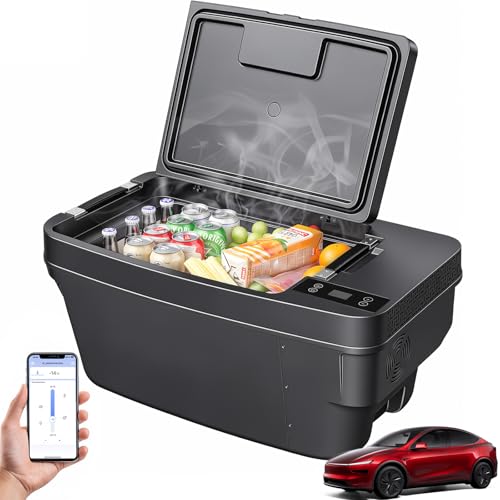
This 35-quart compressor fridge is the option with the lowest minimum temperature, reaching -7.6°F compared with the 37-quart fridge’s -4°F minimum. It is designed for the lower trunk storage area and positioned near the 12V outlet; the maker identifies app control and 12/24V DC operation. Its 27-pound weight is lower than the 37-quart model’s, but it also has 2 fewer quarts of capacity. Choose it when that lower temperature range and trunk placement align with your plans; confirm the vehicle year and trim fit before ordering.
Bottom line: Choose this if its lower minimum temperature and lower-trunk placement suit your needs.
How to Choose a Tesla Model Y Cooler
Choose first between an ice chest and a compressor fridge: an ice chest needs ice, while a compressor fridge uses vehicle power to maintain a selected temperature. Cooler capacity is measured in quarts; one quart is 0.25 gallon, so 35 quarts equals 8.75 gallons and 48 quarts equals 12 gallons. A larger capacity can hold more, but it also occupies more cargo space. For an overnight trip where you need frozen storage, select a powered model whose minimum temperature is below 32°F; for drinks chilled with ice, a passive chest may be enough. Before choosing a built-in unit, compare its exterior dimensions with the intended compartment and account for ventilation and access to its power connection.
| Need | Choose |
|---|---|
| Ice-based cooling and direct draining | 48-quart ice chest |
| Powered cooling to -4°F | 37-quart compressor fridge |
| Powered cooling to -7.6°F | 35-quart compressor fridge |
Frunk and Trunk Fit
Measure the usable compartment before buying a vehicle-specific cooler: compare length, width and height against the space, not just the advertised capacity. Leave room to open the lid or access a hatch; a cooler that fits with its lid shut may be awkward to load in a tight compartment. A drain outlet only helps if it lines up with the vehicle’s drain, and placement near a power outlet matters for powered models. For an installed fridge, check the vehicle’s model year and compartment layout against the fit; vehicle updates can change interior dimensions. The practical rule is simple: if any cooler dimension exceeds the measured opening or usable floor area, choose a different size or location.
Ice Chest Versus Compressor Fridge
An ice chest cools passively and does not need vehicle power, while a compressor fridge can be set to a temperature range and may freeze contents. Ice-based coolers accumulate meltwater, so a drain can simplify cleanup, but draining does not replace keeping food sealed and separated from contaminated water. Powered fridges require a compatible power source; check voltage and connectors before a trip. A compressor’s low-temperature limit matters more than its maximum for frozen goods: freezing requires a setting at or below 32°F, with some margin useful if contents start warm. For a day trip with drinks, ice may be convenient; for longer use or frozen food, a powered fridge gives more direct temperature control.
Safe Loading and Power Use
Keep perishable food at 40°F or below, and frozen food at 0°F or below; these are standard food-safety limits. A fridge’s setpoint is not proof that every item has reached that temperature, so use a separate appliance thermometer when food safety matters. Pre-chill food and drinks before loading to reduce the cooling demand, and avoid repeatedly opening the lid. Do not block the vehicle’s ventilation paths or overload a power connection; use the compatible supply intended for the cooler. For ice chests, pack food in sealed containers and drain meltwater as needed. For trips in hot weather, plan more frequent temperature checks, since heat and frequent access make maintaining safe temperatures harder.
Frequently Asked Questions
Can a Tesla Model Y cooler freeze food?
A compressor fridge with a minimum setting below 32°F can be set for freezing; these options reach -4°F and -7.6°F. An ice chest cannot provide a controlled freezing temperature, so use a freezer thermometer to verify food temperature.
How many quarts is enough for a Model Y cooler?
The options here range from 35 to 48 quarts, or 8.75 to 12 gallons. Choose capacity based on the amount of food and drinks, then confirm the cooler’s exterior dimensions fit the intended compartment.
Does an ice cooler need a Tesla power connection?
No, an ice chest cools with ice and needs no electrical connection. A compressor fridge does need a compatible power supply, so check its voltage and connector against the outlet you plan to use.
What temperature should a car fridge maintain for food?
Keep refrigerated perishable food at 40°F or below and frozen food at 0°F or below. Verify the actual interior temperature with an appliance thermometer, especially after loading warm food or opening the lid often.
How should I check cooler fit in my Model Y?
Measure the usable compartment’s length, width and height, including the opening the cooler must pass through. Leave additional room to open its lid and, for a powered unit, reach its power connection and ventilation.