
Best Tools for Epoxy Flooring: 3 Kits Compared

For most epoxy flooring projects, BERXOL 18-Inch Self-Leveling Kit is the best fit because its rake adjusts at two points and its roller frame spans 12 to 18 inches. Choose Coral Crystal Epoxy Floor Tool Kit instead if you need a long extension pole for coating, or Self Leveling Epoxy Floor Kit if a kit with gloves and multiple rollers better matches your work.
We earn a commission if you buy through links on this page. As an Amazon Associate I earn from qualifying purchases. Products are compared on manufacturer specifications, not hands-on testing.
- Best overall: BERXOL 18-Inch Self-Leveling Kit – Its rake has two adjustment points, and the roller frame adjusts from 12 to 18 inches.
- Best for long reach: Coral Crystal Epoxy Floor Tool Kit – Its extension pole adjusts from 16 to 63 inches.
- Best for multiple rollers: Self Leveling Epoxy Floor Kit – It includes 9-inch and 4-inch spike rollers plus a paint roller.
| Product | Best for | Spike roller widths | Shop |
|---|---|---|---|
| BERXOL 18-Inch Self-Leveling Kit | Adjustable coverage | 18 in, 9 in | Check Price on Amazon |
| Coral Crystal Epoxy Floor Tool Kit | Long reach | — | Check Price on Amazon |
| Self Leveling Epoxy Floor Kit | Roller variety | 9 in, 4 in | Check Price on Amazon |
Tools for epoxy flooring
Compare each kit’s roller setup, thickness-control features and reach before choosing tools for your coating project.
BERXOL 18-Inch Self-Leveling Kit

The adjustable rake and roller frame set this kit apart: the rake has two height-adjustment points, while the frame changes from 12 to 18 inches. It includes 18-inch and 9-inch spike rollers, spiked shoes, and gloves for epoxy or concrete-coating work. The replaceable 18-inch roller head can be changed when worn. This kit suits buyers who want to tune rake height and working width rather than rely on a fixed-width setup. The trade-off is that the pole length is not given, so confirm the reach you need before ordering.
Bottom line: Pick this if adjustable rake height and roller width matter more than a specified pole reach.
Coral Crystal Epoxy Floor Tool Kit

A 16-to-63-inch extension pole distinguishes this kit, giving users a broad reach range for coating work. The kit combines a paint roller for primer, a spiked roller for bubble removal, a stainless steel trowel, gloves, and spiked shoes. Its maker says the spiked roller helps avoid pinholes by removing air bubbles. This setup suits a buyer who wants roller work and wet-floor access tools in one kit, including for garage or basement projects.
Bottom line: Choose this when adjustable extension reach is the main requirement.
Self Leveling Epoxy Floor Kit
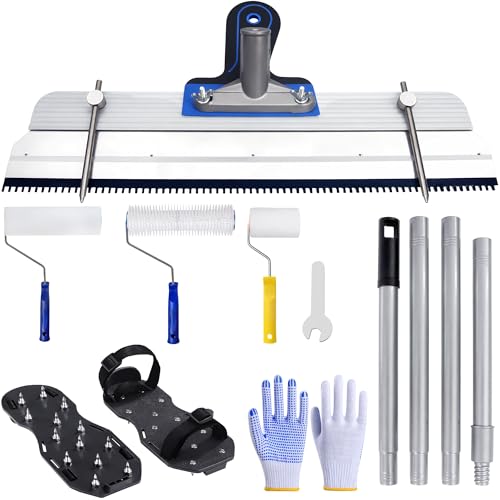
The combination of a 9-inch and 4-inch spike roller plus a paint roller gives this kit more roller options than a single-width setup. It also includes a self leveling rake, spiked shoes, an extension pole, and gloves for cement or epoxy floor projects. Its maker says the rollers and rake help spread and smooth material while removing bubbles. The assortment suits buyers who want different roller widths for broad and tighter areas.
Bottom line: Pick this for a kit centered on multiple roller widths and basic accessories.
How to choose epoxy flooring tools
Choose tools by coating task: a spike roller is for working air bubbles out of wet material, while a rake or gauge rake spreads material at a controlled depth. Roller width affects coverage; wider rollers cover more floor per pass, while narrower rollers are easier to maneuver around edges and obstacles. For example, a 20-inch roller covers a broader path than a 9-inch roller, but the wider tool needs more open space. If thickness adjustment matters, prioritize a rake with a defined tooth spacing or adjustable height. Match accessories to your process: spiked shoes are used to walk across wet coating, while paint rollers handle primer or coating application.
For a measured project, pick the widest roller that can pass through doorways and around fixed obstacles without repeated repositioning.
Spike rollers, rakes and shoes compared
Spike rollers, rakes and spiked shoes serve different jobs; no single tool replaces the others. A spike roller works through wet material to release bubbles, while a rake distributes a layer and controls its depth. Spiked shoes let an applicator walk across a wet floor while limiting contact from ordinary footwear. Spike length should suit the coating depth: spikes that are too short may not reach through the layer, and overly long spikes can disturb the substrate. Check roller and rake compatibility with the product you are applying, since self leveling cement and epoxy coatings do not necessarily use identical application methods.
This task-to-tool guide helps separate application, leveling and wet-floor access needs.
| Task | Tool to prioritize | Selection cue |
|---|---|---|
| Bubble release | Spike roller | Match width to open area and maneuvering space |
| Spread or depth control | Rake or gauge rake | Look for defined teeth or height adjustment |
| Walking on wet coating | Spiked shoes | Use only as appropriate for the coating workflow |
| Primer application | Paint roller | Use the roller type specified for the coating system |
Plan roller width and pole reach
Roller width and pole length determine how easily a kit works in a particular room. A wider roller can speed coverage across an unobstructed floor, but narrow rooms, posts and floor drains favor a shorter roller that turns more easily. Extension poles reduce the need to bend and can help reach farther across wet material; choose a pole whose working length lets you maintain control rather than simply choosing the longest range. One kit here specifies a 16-to-63-inch pole, while another gives a 25.59-to-57.09-inch range. Measure the working distance and clearances before selecting a reach.
With less than 9 inches of clear path between an obstacle and a wall, choose a roller narrower than that gap to maneuver without striking either edge.
Prepare for safe epoxy floor application
Spiked shoes are for controlled movement over wet coating, not ordinary walking; use them only when the coating system and work sequence call for crossing the wet surface. Epoxy components can irritate skin and eyes, so wear chemical-resistant gloves and eye protection specified by the product safety data sheet, and provide ventilation during mixing and application. Keep the room clear of children and pets until the coating has cured according to its manufacturer. A spike roller should be worked while the material remains within its usable application period; once the coating starts to set, rolling can mark rather than smooth it. Stage tools and exits before mixing to avoid crossing the floor unnecessarily.
Check the coating’s working time and cure time before starting, since these determine how much area can be applied and rolled safely.
Frequently Asked Questions
What does a spike roller do on epoxy floors?
A spike roller works air bubbles out of wet coating to help reduce surface pinholes. Use it while the coating is still within its working time, since rolling partly set material can leave marks.
How wide should an epoxy floor roller be?
Choose the widest roller that fits the open floor and can still maneuver around edges and obstacles. A 20-inch roller covers more ground per pass than a 9-inch roller but is harder to turn in tight spaces.
Are spiked shoes necessary for epoxy flooring?
Spiked shoes can help applicators walk across wet coating without ordinary shoe soles contacting it. Use them only when the coating system and application sequence allow it, and plan movement before mixing.
Can self leveling cement tools be used for epoxy?
Some kits are marketed for both epoxy and self leveling cement, but the application methods are not automatically interchangeable. Check the coating maker’s instructions for roller, rake and spike compatibility before applying material.
When should I use a rake instead of a roller?
Use a rake to distribute material and control its spread depth; use a spike roller to release bubbles from the applied layer. A rake with defined teeth or height adjustment gives more control over spreading than a roller alone.