
Portable Pickleball Court Flooring: 3 Options Compared

For casual home play, Portable Pickleball Court Mat Set is the clearest match because it combines a marked mat and net, while Indoor Pickleball Mat Set, 1.6 × 3.6 m adds balls for family games. These portable mats are far smaller than a regulation pickleball court, which measures 20 by 44 feet; choose a different floor system if you need full-court coverage.
20-Piece Interlocking Sport Tile Set is a related option: interlocking sport tiles rather than a marked pickleball mat, intended for hard, flat surfaces.
We earn a commission if you buy through links on this page. As an Amazon Associate I earn from qualifying purchases. Products are compared on manufacturer specifications, not hands-on testing.
- Best overall: Portable Pickleball Court Mat Set – Its marked mat and matching portable net make it a direct fit for casual pickleball play.
- Best for family play: Indoor Pickleball Mat Set, 1.6 × 3.6 m – The set includes a portable net, two silent balls, and two perforated balls.
- Best for modular flooring: 20-Piece Interlocking Sport Tile Set – Twenty interlocking tiles cover about 24.86 square feet when installed as directed.
| Product | Best for | Footprint | Surface or material | Included play gear | Shop |
|---|---|---|---|---|---|
| Portable Pickleball Court Mat Set | Marked mat play | 98.43 × 49.21 in | Textured backing | Mat and net | Check Price on Amazon |
| Indoor Pickleball Mat Set, 1.6 × 3.6 m | Family game sessions | 63.0 × 141.7 in | Diatom mud play mat | Net, 4 balls | Check Price on Amazon |
| 20-Piece Interlocking Sport Tile Set | Hard-surface floor | About 24.86 sq ft | Polypropylene | 20 tiles | Check Price on Amazon |
Portable pickleball court flooring options
Compare the marked play mats with a modular tile floor, and match the footprint to the space you have.
Portable Pickleball Court Mat Set

Unlike a full-size court surface, this set is a compact marked play area measuring 98.43 by 49.21 inches, with a portable net. The maker says the mat has a noise-reducing surface and a nonslip backing, features intended for indoor play and quick setup. It suits beginners or casual games in a limited space, provided the available floor is larger than the mat itself. The footprint is much smaller than a regulation court, so it is not a full-court flooring solution for standard play.
Bottom line: Choose this for a small, marked play area with a matching net.
Indoor Pickleball Mat Set, 1.6 × 3.6 m
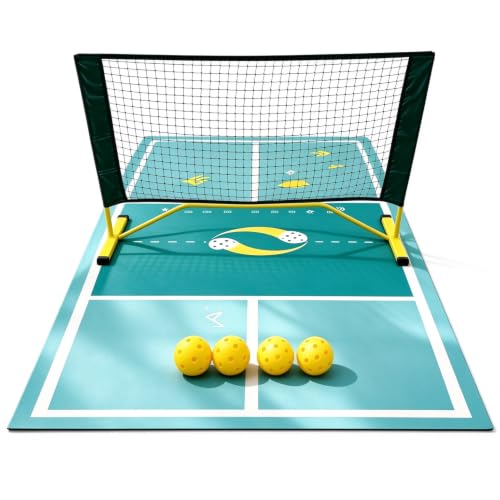
Where Portable Pickleball Court Mat Set supplies a smaller marked mat and net, this set also includes two silent balls and two perforated balls, making it suited to family recreation. Its mat measures 63.0 by 141.7 inches and has printed boundary lines; a hook-and-loop fastening system holds the portable net together. The maker describes the mat as suitable for living rooms and playrooms. Its compact footprint favors casual home games rather than regulation-size rallies, and buyers should plan around the mat dimensions rather than assuming it covers a full court.
Bottom line: Pick this when a home game kit with four balls matters more than full-court size.
20-Piece Interlocking Sport Tile Set

Unlike the printed mats, these are modular polypropylene tiles rather than a pickleball-specific court surface. Twenty tiles measuring 13.38 inches square cover about 24.86 square feet. The maker says the tiles can deliver at least 98% ball bounce when installed on a solid, flat surface such as concrete or asphalt; on soft or uneven ground, they function primarily as a drainage mat. This option may suit someone building a small hard-surface practice area, but it does not provide pickleball court markings or a net, and the maker identifies it as basketball court tile.
Bottom line: Choose these for a small, modular floor over solid, level ground, not a marked pickleball court.
How to choose portable pickleball court flooring
Start with the intended play area: a regulation pickleball court is 20 by 44 feet, while portable home mats cover only a fraction of that space. Measure the usable floor, including room for players to move beyond the printed boundaries, before choosing a mat. For casual drills or family play in a room, a compact marked mat can be useful; for full-court play, a small mat or a 20-tile set is not enough coverage. On hard floors, clear dust and moisture first, since grit can reduce traction and water can make even textured surfaces slippery. Avoid placing a mat across a doorway or over loose rugs where an edge could shift or catch a foot.
Portable court flooring size and layout
Official pickleball court markings enclose a 20-by-44-foot rectangle for both singles and doubles, with a 7-foot non-volley zone on either side of the net. Those dimensions provide a useful scale check: a mat under 12 feet long is a practice or recreational play surface, not a regulation court. Leave extra clearance around any playing area so players can stop and turn without stepping onto furniture or walls. If a product gives only its mat footprint, compare that measurement with the actual open floor, not the room’s overall dimensions. A marked miniature court may help with positioning, but its boundary spacing does not replicate full-court movement.
Marked mats versus interlocking sport tiles
Printed mats give players visible boundaries in one portable piece, while interlocking tiles build a floor from smaller modules. A smooth, solid base matters for tile stability and predictable ball response; the tile maker specifically limits its claimed high bounce to solid, flat surfaces. On a soft or uneven base, those tiles may serve as drainage flooring instead of a reliable court surface. Use this quick comparison to match the format to the task.
| Need | Better fit | Key tradeoff |
|---|---|---|
| Printed play boundaries | Marked mat | Compact footprint versus full court |
| Modular floor sections | Interlocking tiles | Requires a firm, level base |
| Regulation-size play | Full court surface | Needs a 20-by-44-foot marked area |
Floor safety and setup mistakes
Set portable flooring on a clean, dry, level surface and check that its edges lie flat before play. A curled mat corner or separated tile can become a trip hazard during quick lateral movement, so stop and reposition any section that shifts. Keep the net supports outside the main movement lanes where possible, and leave clear space around the play area. Indoor pickleball still involves fast stops and changing direction; use shoes with court-appropriate traction rather than socks on a smooth floor. Do not treat a nonslip or shock-absorbing claim as a substitute for checking the surface underfoot, especially if the floor is dusty, damp, or uneven.
Frequently Asked Questions
How big is a regulation pickleball court?
A regulation pickleball court measures 20 feet wide by 44 feet long for both singles and doubles. The non-volley zone extends 7 feet from the net on each side.
Can a small portable mat cover a full court?
No; a full court is 20 by 44 feet, far larger than a compact home mat. Use small mats for casual play or drills, not full-court positioning.
What surface should interlocking court tiles sit on?
Use a solid, flat base such as concrete or asphalt for predictable court use. The tile maker says its high-bounce claim applies on those types of surfaces, while soft or uneven ground limits the tiles mainly to drainage use.
How much room should I leave around a home mat?
Leave clear floor beyond the printed edges so players can slow down and turn without reaching a wall or furniture. The amount depends on the room, but a mat footprint alone does not include movement clearance.
How do I keep portable court flooring from becoming a trip hazard?
Lay the floor flat on a clean, dry surface and check corners and tile joints before playing. Reposition any edge or section that curls, separates, or shifts underfoot.