
Best Fog Lights for Motorcycle: 4 Options Compared

For most riders, Future Eyes F150 2.1-Inch Fog Lights is the strongest fit because its adjustable bracket and cutoff beam help aim light while limiting glare. Riders who want more selectable modes or a larger lamp should consider Auxbeam MT8 Series 3-Inch Fog Lights instead.
Motorcycle auxiliary fog lights add forward lighting, but beam aim and mounting clearance matter as much as color; verify the mounting fit and wiring before choosing.
We earn a commission if you buy through links on this page. As an Amazon Associate I earn from qualifying purchases. Products are compared on manufacturer specifications, not hands-on testing.
- Best overall: Future Eyes F150 2.1-Inch Fog Lights – The 360-degree adjustable bracket and cutoff beam provide aiming flexibility.
- Best for lighting modes: Auxbeam MT8 Series 3-Inch Fog Lights – It offers eight modes, including white, amber, and strobe combinations.
- Best for compact pods: Zmoon 1.3-Inch Dual-Color Pods – The 1.3-inch pods provide a white-or-amber choice in a small format.
| Product | Best for | Light size | Modes | Water resistance | Shop |
|---|---|---|---|---|---|
| Future Eyes F150 2.1-Inch Fog Lights | Adjustable beam aim | 2.1 in | 6+ modes | IP67 | Check Price on Amazon |
| Auxbeam MT8 Series 3-Inch Fog Lights | Multiple light modes | 3 in | 8 modes | IP67 | Check Price on Amazon |
| Zmoon 1.3-Inch Dual-Color Pods | Small dual-color pods | 1.3 in | 2 modes | IP65 | Check Price on Amazon |
| Kewig Dual-Color Auxiliary LED Kit | Strobe warning modes | — | White/amber, strobe | — | Check Price on Amazon |
Motorcycle Fog Lights Compared
Compare the lighting choices and physical fit before deciding which auxiliary lamps suit your motorcycle.
Future Eyes F150 2.1-Inch Fog Lights

Future Eyes F150 2.1-Inch Fog Lights stands apart with a 360-degree adjustable bracket and automotive-style cutoff technology, useful when precise beam placement matters on a motorcycle. Its 2.1-inch lights include white and amber high/low beams, strobe, and DRL functions, with IP67 water resistance. The maker says the optical lenses focus and distribute light to extend riding range while the cutoff helps reduce glare. The limitation is that its many functions and adjustable mount may be more than a rider needs for a simple auxiliary-light setup; check that the bracket and wiring suit your bike.
Bottom line: Choose this if you want adjustable aiming and several beam functions.
Auxbeam MT8 Series 3-Inch Fog Lights

Auxbeam MT8 Series 3-Inch Fog Lights is the largest explicitly sized lamp here at 3 inches, and its eight lighting modes give riders several color and warning-light combinations. The options include white, amber, combined colors, and strobe patterns; the lights also have a startup DRL. The maker calls them IP67 waterproof and says the ACC wire must be connected. This setup suits riders who want mode choices, but the 3-inch format needs room on the bike and the required ACC connection makes wiring compatibility an important decision point.
Bottom line: Pick this if eight modes and a 3-inch lamp suit your mounting space.
Zmoon 1.3-Inch Dual-Color Pods
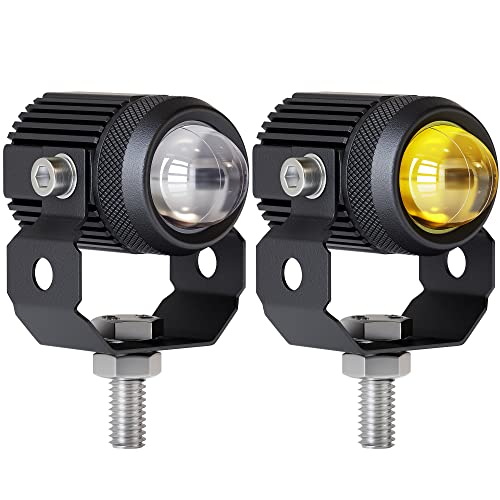
Zmoon 1.3-Inch Dual-Color Pods uses 1.3-inch pods, making its lamp size smaller than the other explicitly dimensioned options. White and amber are its two modes, and the housing is aluminum with IP65 water resistance. The maker claims 60 watts and 6,000 lumens per light and describes a bifocal lens intended to focus the beam. These pods fit buyers seeking a straightforward color choice in a small lamp, while the two-mode limit is less suitable for riders who want DRL or strobe functions.
Bottom line: Choose these for a small pod with basic white and amber modes.
Kewig Dual-Color Auxiliary LED Kit

Kewig Dual-Color Auxiliary LED Kit combines white and amber lighting with left-right alternating strobe warning modes, distinguishing it from options centered on standard beam selections. The kit includes a 6.7-foot waterproof harness and a switch for changing light modes. Its lens is borosilicate glass, and the maker claims 60 watts and 6,000 lumens. No lamp size or water-resistance rating is provided among the specifications, so this choice is harder to compare for tight mounting spaces or wet-weather requirements than options with explicit dimensions and IP ratings.
Bottom line: Consider this if the left-right strobe modes and harness fit your setup.
How to choose motorcycle fog lights
Choose motorcycle fog lights by beam control, mounting room, and wiring before counting modes. White light is a common choice for clear nighttime visibility, while amber can reduce the appearance of scattered glare in fog or rain; neither color makes poor aiming safe. A cutoff beam helps keep light below oncoming drivers’ sightlines, and an adjustable mount makes it easier to direct the beam after installation. Check available space around the fork, crash bars, and fairing, then compare lamp diameter and bracket range. If your motorcycle has limited accessory power, verify current draw and circuit capacity before adding lamps; a relay and fused lead are typical ways to protect an accessory circuit.
Beam color and mode tradeoffs
White and amber serve different conditions, while strobe and DRL functions add separate uses. Amber is often preferred in fog because shorter-wavelength blue-rich light scatters more, but beam height and intensity still matter more than color alone. A low, controlled beam is preferable to a high, unfocused spot near traffic. Strobe patterns are warning functions, not a substitute for steady forward lighting, and road laws can restrict flashing colors or patterns; confirm local rules before using them on public roads. Use the mode chart to match functions to riding needs rather than treating a higher mode count as automatically better.
| Need | Useful feature |
|---|---|
| Clear-night visibility | White beam |
| Fog or rain use | Amber option and controlled beam |
| Directional adjustment | Adjustable mount or cutoff beam |
| Warning function | Strobe mode, where permitted |
Mounting and wiring fit
Motorcycle auxiliary lights need rigid mounting and secure, weather-protected wiring. Vibration can loosen fasteners, so use locking hardware where appropriate and recheck the brackets after the first rides and routine service. Route wires away from exhaust heat, steering stops, suspension travel, and sharp edges; leave enough slack for full handlebar movement without creating a snag point. A fused supply and relay are common for higher-load accessories, with a switched trigger wire preventing lights from remaining on after shutdown. One product here specifically requires an ACC wire connection, so confirm your bike has a compatible switched circuit before selecting it.
Water ratings and safe aiming
IP ratings describe protection against dust and water, but they do not mean a light is safe to submerge or pressure-wash at close range. IP65 indicates protection against water jets, while IP67 includes a defined temporary-immersion test; seals and connectors can still be vulnerable after installation damage. Aim auxiliary lamps low enough to avoid dazzling oncoming traffic, then check beam alignment on level ground against a wall. A practical starting point is to keep the brightest part of the beam below headlight height at a short test distance, then verify visibility and cutoff from the rider’s position. Recheck aim after changing brackets or load.
Frequently Asked Questions
Are amber motorcycle fog lights better in heavy fog?
Amber can reduce blue-rich light scatter compared with white, but beam control and modest brightness are also important. Aim the beam low and avoid using a broad, glaring pattern around oncoming traffic.
How should motorcycle auxiliary lights be aimed?
Aim them low so the brightest part of the beam stays below oncoming drivers’ eyes. Check alignment on level ground against a wall and recheck after moving the mount.
Can motorcycle fog lights stay on with the ignition?
Use a switched accessory or ACC circuit so the lights turn off with the ignition. A fused supply and relay are typical for accessory lighting, and one option specifically requires an ACC wire connection.
What does IP67 mean for motorcycle lights?
IP67 indicates dust-tight construction and protection under a defined temporary-immersion test, not unlimited underwater use. Avoid close-range pressure washing and inspect connectors and seals after installation.
Do motorcycle strobe lights work on public roads?
Strobe modes are intended as warning functions and may be restricted by local road rules, especially flashing colors or patterns. Check your jurisdiction’s requirements before using them in traffic.