
Best Respirator for Spray Paint: 3 Mask Kits Compared

For spray painting, choose AirGearPro G-500 A1P2 Respirator because its A1P2 system combines organic-vapor cartridges for vapors with a P2 filter for particles.
A respirator covers the nose and mouth, but spray work may require a specific respirator and cartridge selected from the coating’s safety data sheet; goggles alone do not protect against vapor exposure.
We earn a commission if you buy through links on this page. As an Amazon Associate I earn from qualifying purchases. Products are compared on manufacturer specifications, not hands-on testing.
- Best overall: AirGearPro G-500 A1P2 Respirator – Its A1P2 combination is explicitly intended for organic vapors and airborne particles.
- Best for replacement filters: BEESAFETY RD-518 A1/P2 Kit – The kit includes 2 A1 cartridges and 8 P2 dust filters.
| Product | Best for | Vapor filter | Particle filter | Included extras | Shop |
|---|---|---|---|---|---|
| AirGearPro G-500 A1P2 Respirator | A1P2 filtration | A1 | P2; at least 98% | Goggles | Check Price on Amazon |
| BEESAFETY RD-518 A1/P2 Kit | Extra P2 filters | A1; 2 cartridges | P2; 8 filters | Goggles | Check Price on Amazon |
| Silicone Half-Face Mask with A1 Filters | Silicone facepiece | A1 | — | Goggles; 6 filter cottons | Check Price on Amazon |
Respirators for spray paint
Compare each kit’s vapor and particle filtration alongside the gear included for the job.
AirGearPro G-500 A1P2 Respirator

The A1P2 filter pairing is the key distinction: the maker says the cartridge filters organic vapors with boiling points above 65°C, while the P2 filter captures at least 98% of airborne particles. That makes this the clearest match here for a spray-paint task involving both vapor and mist, provided the coating’s hazard information calls for those filter classes. The reusable mask accepts replacement filters. The goggles add eye coverage, but the specifications do not establish a US approval or a fit-test method, so verify those before relying on it for occupational exposure.
Bottom line: Choose it when the coating calls for A1 vapor and P2 particle filtration.
BEESAFETY RD-518 A1/P2 Kit
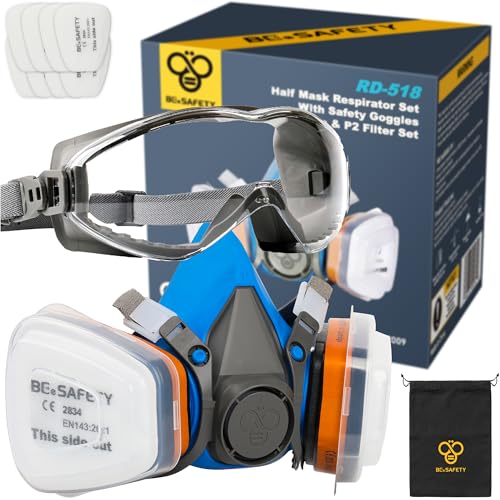
The strongest differentiator is its filter supply: this reusable set includes 2 A1 organic-vapor cartridges and 8 P2 dust filters, plus safety goggles. The maker describes it as intended to reduce exposure to organic vapors and airborne particles, a combination relevant to many spray tasks. Its replaceable setup can suit users who want spare particle filters on hand. Filter life depends on contaminant concentration, humidity, and use, so do not rely on a fixed replacement interval; use the cartridge maker’s change schedule and leave the area if odor breakthrough occurs.
Bottom line: Pick it when having eight spare P2 filters is a priority.
Silicone Half-Face Mask with A1 Filters

The silicone face seal sets this kit apart, and it includes two A1 cartridges, six filter cottons, and splash-protective goggles. The maker describes it for spray paint and other work involving solvents, but the filter information identifies A1 cartridges rather than a complete particle-filter classification. That matters because spray painting can create both vapor and aerosol; confirm the proper particle filter and compatibility with the specific coating before use. The product is marked for occupational use only, so it is not a substitute for checking workplace requirements or establishing a proper face seal.
Bottom line: Choose it only when its A1 cartridge and compatible particle filter suit the coating.
How to choose a spray paint respirator
Choose the cartridge and particle filter from the coating’s safety data sheet, not from a generic “paint” label. Spray work can expose you to vapor from solvents and aerosol droplets or particles, so a filter for one hazard does not automatically cover the other. For organic vapors, an NIOSH-approved cartridge marked for organic vapor is a common selection, paired with the particulate filter specified by the product and hazard assessment. A1 and P2 are European filter classes, not a substitute for checking US workplace requirements. If the paint calls for supplied-air respiratory protection, a half-face air-purifying mask is not an equivalent option.
Fit and seal checks for half-face masks
A tight face seal is essential: facial hair crossing the sealing surface can prevent a respirator from sealing, and a loose strap adjustment can let contaminated air bypass the filters. In US workplaces, required respirator use falls under OSHA’s respiratory protection standard, which includes medical evaluation, fit testing, and a written program. A user seal check each time the mask is donned is different from a formal fit test. Do not assume a mask fits because its straps feel snug; choose a size and model that seals across your nose, cheeks, and chin, and avoid wearing it over facial hair at the seal.
Vapor cartridges and particle filters do different jobs
Organic-vapor cartridges use sorbent media to capture certain vapors; particulate filters capture droplets and dust. Neither function should be inferred from the other, so spraying a solvent-based coating may require both types in a compatible assembly. Replaceable filters also have different service limits: particulate filters may become harder to breathe through as they load, while vapor cartridges can reach the end of their service life without a large increase in breathing resistance. Odor breakthrough is a warning to leave the area, not a dependable routine change schedule. Select and change filters according to the contaminant, exposure conditions, and manufacturer schedule.
| Work condition | Selection check | Decision |
|---|---|---|
| Paint creates vapor and aerosol | Confirm both vapor and particle ratings | Use a compatible combination system |
| Only dust exposure is assessed | Confirm the required particle class | Use a particle filter matched to the hazard |
| Hazard requires supplied air | Check the safety data sheet and workplace assessment | Do not substitute a half-face cartridge mask |
Common spray-paint respirator mistakes
A common mistake is choosing by the number of included filters rather than by their class and compatibility. Filter cotton or a dust filter does not automatically capture organic vapors, and a vapor cartridge alone does not make a complete particulate system. Another error is assuming that a respirator protects the eyes; half-face masks leave the eyes exposed, so use suitable eye protection for the paint and spray method. Use ventilation and isolation controls as well as respiratory protection, and do not spray in a confined space without a suitable hazard assessment and required controls.
Frequently Asked Questions
Can a P2 filter protect against paint fumes?
No; P2 is a particle-filter class, while organic-vapor cartridges address certain vapors. Spray coatings may require both, so match the filter combination to the coating’s safety data sheet.
How often should spray paint cartridges be replaced?
There is no universal number of hours for organic-vapor cartridge replacement. Use a cartridge change schedule based on the contaminant and exposure conditions, and leave the area immediately if you detect breakthrough odor.
Can I spray paint with facial hair under a respirator?
Facial hair that crosses the sealing surface can prevent a tight seal. In required workplace use, a tight-fitting respirator needs fit testing, and the wearer must use it without hair between the face and seal.
Do half-face respirators protect eyes from paint spray?
No; a half-face respirator covers the nose and mouth, not the eyes. Use suitable eye protection for the coating and spray process.
Are A1 and P2 filter ratings US approvals?
A1 and P2 are European filter classifications, not US NIOSH approval markings. For US workplace use, verify the respirator and cartridges carry the approvals required for the hazard and follow the applicable respiratory-protection program.