
6 Inch Virtual Reality Glasses: Phone Fit Compared

For a phone that measures up to 6 inches diagonally, Topmaxions DIY VR Headset is the clearest match because its compatibility spans 3.5 to 6.0 inches. Choose Mobile VR Headset with Controller instead if your phone is larger than 6 inches, since it supports 5.0–7.0-inch phones; buyers wanting a DIY cardboard-style set should consider Wuden 20-Piece VR Hardboard Kit.
We earn a commission if you buy through links on this page. As an Amazon Associate I earn from qualifying purchases. Products are compared on manufacturer specifications, not hands-on testing.
- Best overall: Topmaxions DIY VR Headset – Its phone range is 3.5–6.0 inches, directly covering the target size.
- Best for larger phones: Mobile VR Headset with Controller – It supports phones from 5.0 to 7.0 inches.
- Best for DIY assembly: Wuden 20-Piece VR Hardboard Kit – The 20-piece hardboard set is designed for making cardboard-style VR glasses.
| Product | Best for | Phone fit | Headset type | Control | Shop |
|---|---|---|---|---|---|
| Topmaxions DIY VR Headset | Phones up to 6 in | 3.5–6.0 in | DIY cardboard-style | Triangular wings | Check Price on Amazon |
| Wuden 20-Piece VR Hardboard Kit | DIY kit builders | 6 in | Hardboard pieces | Phone magnets | Check Price on Amazon |
| Mobile VR Headset with Controller | Larger phones | 5.0–7.0 in | Wearable headset | Phone-connected controller | Check Price on Amazon |
| VR SHINECON Smartphone VR Headset | VR game viewing | — | Wearable headset | — | Check Price on Amazon |
| Universal VR Goggles | Wide-view viewing | — | Wearable headset | — | Check Price on Amazon |
6 Inch Virtual Reality Glasses Compared
Compare phone-size compatibility first, then choose between a DIY cardboard-style set and a headset with built-in viewing adjustments.
Topmaxions DIY VR Headset
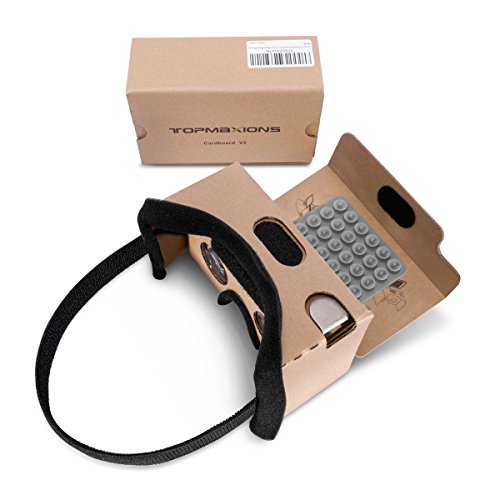
Topmaxions DIY VR Headset gives the most direct fit for phones up to 6 inches, with a range of 3.5 to 6.0 inches. This DIY headset adds a sponge nose pad, forehead pad, lengthened headband and suction cups to hold the phone. Triangular wings contact the screen for interaction. It suits buyers who want a simple phone-based viewer with face padding. Its 6-inch maximum is a diagonal measurement, so check the phone’s actual width and height against the headset opening before choosing it, especially for a phone with a large camera bump.
Bottom line: Pick this if your phone is no larger than 6 inches diagonally and you want a padded DIY viewer.
Wuden 20-Piece VR Hardboard Kit

Wuden 20-Piece VR Hardboard Kit is a 20-piece hardboard kit rather than a finished headset, making it the distinct choice for buyers who want to assemble a cardboard-style viewer. The set is yellow and comes with a Cardboard app; its maker says assembly takes about 3 minutes and that magnets can control a phone. Support for LR format is also claimed. The tradeoff is that buyers must build the glasses themselves, so this is less suitable for anyone seeking a ready-to-wear headset or adjustable optical fit.
Bottom line: Choose this if you want a DIY hardboard viewer and are comfortable assembling it.
Mobile VR Headset with Controller

Mobile VR Headset with Controller extends beyond the 6-inch target, accepting phones from 5.0 to 7.0 inches. Its adjustable FD and OD settings are intended to align focal distance and unilateral myopic alignment, and a phone-connected controller handles music playback and volume. That makes it a better fit for someone whose phone exceeds 6 inches or who wants viewing adjustments and basic media controls. The fit range does not confirm whether a particular phone’s case or body dimensions will fit, so verify those before ordering.
Bottom line: Pick this if your phone is between 6 and 7 inches or you want a controller.
VR SHINECON Smartphone VR Headset

VR SHINECON Smartphone VR Headset is a smartphone VR headset focused on 360-degree video, 3D rotation and VR-supported games, rather than a defined 6-inch phone fit. Its adjustable head strap is the distinguishing comfort feature among the options without a phone-size range. This suits buyers who prioritize head movement and an adjustable strap for supported VR content. Because no phone-size compatibility is given, it is not a safe pick based on screen diagonal alone; confirm that your specific phone fits the headset before choosing it.
Bottom line: Consider this for supported VR games if you can confirm the phone fit first.
Universal VR Goggles

Universal VR Goggles is a universal-style headset emphasizing 360-degree panoramic viewing and adjustable pupil distance, not a 6-inch phone range. Its free-size label and claimed support for myopia users distinguish it from the cardboard options, while the adjustable pupil distance may matter to buyers aligning the lenses to their eyes. This option suits someone who values those optical adjustments for movies or games. The phone’s compatible dimensions remain unconfirmed, so verify the physical fit rather than assuming that “universal” means every 6-inch phone will fit.
Bottom line: Choose this if pupil-distance adjustment matters and you can verify phone compatibility.
How to choose a 6 inch phone VR headset
Start with phone compatibility, then consider headset style and controls. A phone’s advertised screen size is its diagonal, not its width or height; two phones with the same diagonal can have different aspect ratios and body dimensions. Also account for a case, buttons and camera bump, which can affect whether the phone sits flat in its holder. Phone-based VR viewers split a compatible display into two side-by-side images, one for each eye, so an app or video must offer a suitable VR or stereoscopic mode. A headset cannot turn ordinary single-view content into true stereoscopic material. If your phone is near a maximum, measure its outer dimensions and confirm holder clearance before buying.
Phone size and headset fit
A 6-inch phone diagonal is a useful starting point, not a complete fit guarantee. The screen measurement runs corner to corner, while a headset grips the phone by its physical width and height. Screen aspect ratio, bezels and case thickness can change fit even when two phones share the same diagonal. Remove a bulky case if the holder requires a close fit, and make sure the headset does not press the phone’s side buttons. The practical decision rule is simple: if your device exceeds a model’s upper diagonal limit, choose a model with a larger range; if it is at the limit, verify the holder dimensions first. Lens-to-screen alignment also matters: a misplaced phone can make the split image appear blurred or uneven.
Cardboard viewers and adjustable VR headsets
Cardboard-style viewers use a phone as the display and rely on compatible VR content; a DIY kit also requires assembly. Wearable headsets add a frame and may include features such as lens-position adjustments, head straps or a controller, but phone-size compatibility still has to match. The table helps separate the main choices without treating every headset as interchangeable.
| Need | Choice | What to verify |
|---|---|---|
| Up to 6-inch phone, padded DIY viewer | Topmaxions DIY VR Headset | Phone body dimensions and camera clearance |
| DIY hardboard set | Wuden 20-Piece VR Hardboard Kit | Comfort with assembly |
| Phone over 6 inches, up to 7 inches | Mobile VR Headset with Controller | Case and holder fit |
| VR games or optical adjustments | VR SHINECON Smartphone VR Headset or Universal VR Goggles | Specific phone compatibility |
Using phone-based VR safely
Keep sessions short at first and stop if you feel eye strain, dizziness, nausea or disorientation. Phone VR places a magnified image close to the eyes and uses head movement, which can be uncomfortable for some people; taking breaks is sensible, especially during early use. Never wear a phone headset while walking near traffic, stairs or other hazards, because the viewer blocks much of your surroundings. Children should use VR only with adult supervision and age-appropriate content. For a clearer image, center the phone and adjust the headset’s lens or pupil settings where available; increasing screen brightness alone will not fix poor alignment or incompatible content.
Frequently Asked Questions
Does a 6-inch phone always fit a 6-inch VR headset?
No; the diagonal alone does not guarantee a fit. Phone body width, height, case thickness and camera placement can interfere with the holder, so check the physical dimensions when the phone is near the headset’s maximum.
What does a phone need to show VR content?
The phone needs compatible VR or stereoscopic content, typically displayed as two side-by-side views for the eyes. A headset holder by itself does not make regular single-view video stereoscopic.
Can I wear a phone case inside a VR viewer?
Only if the holder has enough clearance for the case and still secures the phone flat. Bulky cases can obstruct fit or shift the screen away from the lenses, so remove one if it prevents proper seating.
How should I reduce discomfort during phone VR?
Start with a short session, center the phone, and stop if you notice dizziness, nausea or eye strain. Keep the headset off while walking or near hazards because it blocks your view of the surrounding space.
What is the difference between DIY and wearable VR glasses?
A DIY viewer is assembled from components and uses a phone as its screen, while wearable headsets provide a ready-to-wear frame and may add adjustments or controls. In either case, phone fit and compatible VR content are necessary.