
Best Binoculars for Watching Football: 4 Picks

The Hontry 10×25 is the best fit for most football fans here because its 10x magnification offers a closer view without the stronger shake risk of 18x or 20x binoculars. Fans who prioritize a wider view or steadier tracking should consider lower magnification; this group starts at 10x.
Binocular numbers show magnification and objective-lens diameter in millimeters: 10×25 magnifies 10 times through 25 mm front lenses.
We earn a commission if you buy through links on this page. As an Amazon Associate I earn from qualifying purchases. Products are compared on manufacturer specifications, not hands-on testing.
- Best overall: Hontry 10×25 Compact Binoculars – 10x magnification is a more manageable handheld choice than the 12x to 20x alternatives.
- Best for a wide field: Occer 12×25 Compact Binoculars – Its field of view is 273 feet at 1,000 yards.
- Best for distant details: 20×50 High-Powered Binoculars – 20x magnification brings distant action closer, with a 168-yard field at 1,000 yards.
| Product | Best for | Magnification | Objective lens | Weight | Shop |
|---|---|---|---|---|---|
| Hontry 10×25 Compact Binoculars | Handheld balance | 10x | 25 mm | 0.6 lb | Check Price on Amazon |
| Occer 12×25 Compact Binoculars | Wide stated view | 12x | 25 mm | 0.86 lb | Check Price on Amazon |
| 20×50 High-Powered Binoculars | Maximum magnification | 20x | 50 mm | 1.96 lb | Check Price on Amazon |
| 18×56 UHD Binoculars | Large objective lens | 18x | 56 mm | 0.5 lb | Check Price on Amazon |
Binoculars for Watching Football
Compare magnification, lens diameter and weight to match your seat and how steadily you can hold a pair.
Hontry 10×25 Compact Binoculars
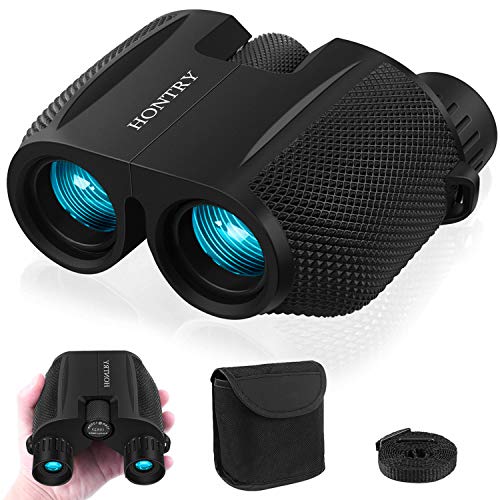
The 10×25 format gives this pair a less aggressive magnification than the 12x, 18x and 20x options, which can make it easier to keep moving play in view by hand. It weighs 0.6 lb and uses BaK-4 prisms; its interpupillary-distance range is 60 to 75 mm. The compact size suits fans who want to carry binoculars between games as well as use them in the stands. The limitation is 10x power: from very distant seats, it brings the field in less than the higher-powered alternatives.
Bottom line: Choose this pair for a compact, comparatively manageable handheld view.
Occer 12×25 Compact Binoculars

The 273-foot field of view at 1,000 yards is the standout advantage here, giving a broader stated view than the 20x pair. Its 12x magnification provides more reach than the 10x model, while the 25 mm objective lenses keep the format compact. Occer says the eyecups adjust for eyeglass wearers and the optics use FMC broadband coating and BAK4 prisms. At 12x, hand movement is more noticeable than at 10x, so fans tracking fast plays may prefer a lower-power view.
Bottom line: Pick this pair when a wider stated field of view matters most.
20×50 High-Powered Binoculars

The 20x magnification is the highest among these options, so this pair is aimed at fans prioritizing distant detail over easy play tracking. Its 50 mm objective lenses are larger than the 25 mm lenses in the compact models, and the maker gives a field of view of 168 yards at 1,000 yards. At 1.96 lb, it is also the heaviest option here. Strong magnification makes hand shake more apparent and narrows the scene, so this choice is less suited to following continuous action without support.
Bottom line: Choose it for distant detail if you can steady the higher magnification.
18×56 UHD Binoculars

The 56 mm objective lens is the largest in this group, paired with 18x magnification for long-distance viewing. The maker also describes dielectric-coated BAK4 prisms and an included phone adapter. That combination may appeal to fans who want high magnification and a large front lens for distant seating. However, 18x magnification is difficult to hold steady while following live action, and the weight of 0.5 lb is unusually light for this size, so confirm the weight before relying on it for carry planning.
Bottom line: Consider it when long-range magnification and a large lens take priority.
Choosing Binocular Magnification for Football
For handheld football viewing, 6x to 8x is a common practical range because it balances reach with a steadier image and wider scene. These choices start at 10x, so the 10x pair is the least demanding to hold steady. Magnification multiplies both the apparent size of movement and the effect of hand tremor; 18x and 20x can make tracking a moving ball harder. If keeping the play in view matters more than seeing distant detail, favor the lowest power you can find. If your seat is far from the field and you can brace your arms on a rail, higher power may help reveal more detail, but it cannot make every play easy to follow.
Matching Field of View to Your Seat
A wider field of view makes it easier to locate players and follow action without constantly repositioning binoculars. Field-of-view figures are commonly given as feet across at 1,000 yards, so compare figures using that same distance and unit. The Occer pair gives a 273 feet at 1,000 yards; the 20x pair gives 168 yards at 1,000 yards, equivalent to 504 feet across. Those figures may reflect different measurement conventions or wording, so confirm how the manufacturer defines the second figure before comparing directly. A practical rule: for midfield action or frequent scanning, prioritize the wider verified field; for a fixed distant target, magnification may matter more.
| Viewing priority | Choose | Trade-off |
|---|---|---|
| Steadier handheld tracking | Lowest magnification available | Less apparent enlargement |
| Wide scene scanning | Wider verified field of view | Less emphasis on maximum power |
| Distant fine detail | Higher magnification | More shake and narrower scene |
Objective Lens Size and Carry Weight
The second number in binocular sizing is the objective-lens diameter in millimeters: 10×25 has 25 mm front lenses, while 20×50 has 50 mm lenses. Larger objectives can gather more light, but usually add bulk and weight; actual brightness also depends on optical design, coatings and lighting. For a long game or a crowded stadium, weight and grip comfort matter because binoculars are held repeatedly rather than used for one quick look. These products range from 0.5 lb to about 1.96 lb according to their weights, though one stated figure is unusually low for its lens size. Verify that weight if it affects your carry choice, and check venue bag rules before bringing any binocular case.
Frequently Asked Questions
What magnification works best for football games?
About 6x to 8x is a common handheld range for balancing enlargement and steadiness. Among these picks, 10x is the lowest power, while 18x and 20x are more prone to visible hand shake.
Are 20x binoculars good for watching football?
20x binoculars can make distant details appear larger, but the narrow view and amplified hand movement can make fast plays harder to follow. Bracing your arms on a rail helps, though it does not widen the field of view.
What do 10×25 numbers mean on binoculars?
The 10x means objects appear about ten times closer, and 25 means each objective lens is 25 mm across. Objective diameter alone does not determine brightness; coatings, optical design and available light also matter.
Can I use binoculars while wearing glasses?
Yes, but usable eye relief and adjustable eyecups affect whether you can see the full field without removing glasses. Fold-down eyecups are often useful, and the Occer pair says its eyecups adjust for eyeglass wearers.
How do I keep binoculars steady during a game?
Hold the barrels with both hands and brace your elbows against your body or a stable rail. Shake becomes more apparent as magnification rises, which is one reason 10x is easier to manage than 18x or 20x.