
Permanent Furniture Sliders for Carpet: 3 Options Compared

For a more secure mount on carpet, Shepherd SlideGlide 2-3/4-Inch Round offers adhesive, screw-on, or combined installation, while GorillaGlides CB503 2-Inch Screw-On is a screw-on option for furniture legs 2 to 3-1/2 inches in diameter. Choose adhesive pads instead when you need a smaller footprint or a flexible strip shape.
We earn a commission if you buy through links on this page. As an Amazon Associate I earn from qualifying purchases. Products are compared on manufacturer specifications, not hands-on testing.
- Best overall: Shepherd SlideGlide 2-3/4-Inch Round – Offers self-adhesive, screw-on, or combined installation in a 2-3/4-inch round base.
- Best for larger legs: GorillaGlides CB503 2-Inch Screw-On – Screw-on glides fit furniture legs 2 to 3-1/2 inches in diameter.
- Best for small furniture: 1-1/4-Inch Adhesive Sliders, 24-Pack – Includes 24 self-adhesive pads, each 1-1/4 inches across.
| Product | Best for | Mount | Shape and size | Pack count | Shop |
|---|---|---|---|---|---|
| Shepherd SlideGlide 2-3/4-Inch Round | Flexible mounting | Adhesive or screw-on | Round, 2-3/4 in | 4 | Check Price on Amazon |
| GorillaGlides CB503 2-Inch Screw-On | Wide furniture legs | Screw-on | Round, 2 in | 4 | Check Price on Amazon |
| 1-1/4-Inch Adhesive Sliders, 24-Pack | Small furniture legs | Self-adhesive | Round, 1-1/4 in | 24 | Check Price on Amazon |
Permanent Furniture Sliders for Carpet
Compare attachment methods and dimensions to match the slider to the furniture leg and how firmly it needs to stay put.
Shepherd SlideGlide 2-3/4-Inch Round

Shepherd SlideGlide 2-3/4-Inch Round stands out for its choice of attachment: adhesive, screws, or both. Each of the four round sliders has a 2-3/4-inch rigid resin base with a low-friction surface, intended to move furniture over carpet without lifting. The beige pads suit furniture with enough flat leg area for the broad round base, and the screw option can make sense where adhesive alone may not hold through frequent movement. Check that each leg can accept a screw before choosing the screw-on method; adhesive-only installation avoids drilling.
Bottom line: Choose this if you want the option to combine adhesive and screws for a more firmly attached glide.
GorillaGlides CB503 2-Inch Screw-On
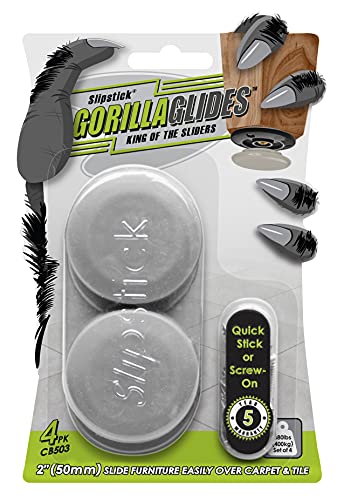
GorillaGlides CB503 2-Inch Screw-On is the only option here that specifies a furniture-leg diameter range: its screw-on glides are intended for legs from 2 to 3-1/2 inches across. The set contains four round, 2-inch glides with a low-friction bottom for carpet and hard surfaces. That makes leg measurement the deciding step; a leg under 2 inches falls outside the fit, and these glides are not a match for it. The screw attachment is useful when a permanent mechanical mount matters more than a peel-and-stick application.
Bottom line: Pick these for furniture legs measuring 2 to 3-1/2 inches when you want a screw-on mount.
1-1/4-Inch Adhesive Sliders, 24-Pack
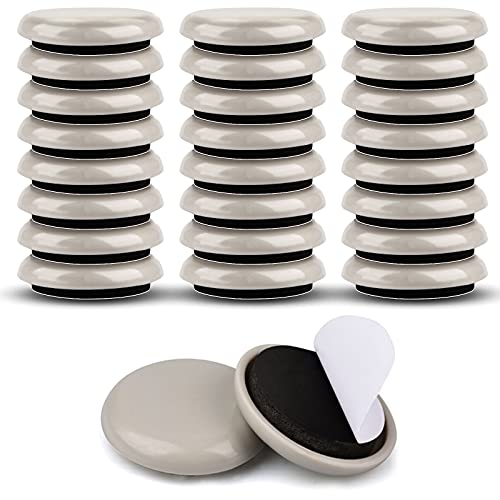
1-1/4-Inch Adhesive Sliders, 24-Pack offers the highest count in this group: 24 self-adhesive sliders, each 1-1/4 inches across. The compact pads suit smaller furniture feet and multiple contact points, and their EVA foam adhesive layer is 2 mm thick. The small round footprint is less suited to broad furniture legs than the larger bases, so measure the flat area under each foot before applying. Adhesive mounting keeps installation simple, but it does not offer the screw-fastened option found on some of the larger glides.
Bottom line: Choose this set when compact adhesive pads and a larger quantity matter more than screw mounting.
How to choose permanent furniture sliders for carpet
Start with attachment, then measure the furniture foot. Screw-on glides need a foot that can accept a fastener; self-adhesive pads need a clean, flat area and enough surface contact to hold. A combination mount can add retention, but only where the foot can be drilled safely. Measure the underside in both directions and leave room for the glide to sit centered rather than overhanging an edge. For round feet, match the pad diameter to the available flat base; for rails or narrow feet, a rectangular strip may cover more length. Carpet pile also matters: a glide reduces friction, but it cannot correct a loose leg or an unstable furniture frame.
| Foot and attachment need | Slider type to consider |
|---|---|
| Leg accepts a fastener and is 2–3-1/2 inches across | Screw-on round glide |
| Flat base around 2-3/4 inches wide | Large adhesive or screw-on round pad |
| Small flat feet or several contact points | 1-1/4-inch adhesive rounds |
| Long, narrow underside | Rectangular adhesive strip |
Adhesive versus screw-on furniture glides
Screw-on sliders provide a mechanical attachment, while adhesive sliders avoid drilling and are easier to place on a suitable flat surface. Adhesives bond best when the mounting area is clean, dry, and free of loose finish; dust or a curved underside can reduce contact. Screws are not suitable for every furniture leg, especially thin or hollow parts, so verify that a fastener can be installed without breaking through or splitting the material. Do not rely on adhesive alone if a pad shifts during a gentle check before moving furniture. With heavy furniture, secure the glide at each intended contact point and keep hands clear when tilting a piece to install it.
Measure furniture feet before installing sliders
A useful fit rule is to select a glide no wider than the flat support area under the leg, unless its design explicitly wraps or overhangs the foot. The 2-inch screw-on style here is specified for legs from 2 to 3-1/2 inches across, while the 1-1/4-inch pads target a much smaller footprint. Rectangular sliders need enough width and length to sit flat without crossing an edge. Check each leg rather than measuring just one: chairs and older furniture can have slightly different feet. If a leg is rounded, tapered, or uneven underneath, a flat adhesive pad may have too little contact area; choose a fitting attachment instead of forcing the pad into place.
Use furniture sliders safely on carpet
Furniture glides lower the effort needed to move an item, but they do not make a heavy piece safe to move alone. Remove contents that can shift, keep the path clear, and use another person for bulky or awkward furniture. Lift or tilt only enough to place a slider, and never put fingers under a loaded leg. After installation, test movement gently and stop if a pad rotates, peels, or catches carpet fibers. A glide that shifts can leave a leg unsupported and may make the furniture rock. Recheck attachment after moving or repositioning furniture; adhesive can loosen and screws can back out with repeated movement.
Frequently Asked Questions
Can adhesive furniture sliders stay on carpet permanently?
Adhesive furniture sliders attach to the furniture foot, not to the carpet, and may remain in place during routine movement if their bond holds. Clean and dry the mounting surface before applying, and check for lifting edges before moving a heavy item.
How do I measure a furniture leg for a slider?
Measure the flat underside across its widest points in inches. For example, a 2-inch screw-on glide in this group is specified for legs 2 to 3-1/2 inches across; reject a glide that overhangs the usable flat support area.
Are screw-on sliders better than adhesive pads?
Screw-on sliders add a mechanical fastener, while adhesive pads avoid drilling and require a flat, clean bonding surface. Choose screws only if the furniture leg can safely accept a fastener without splitting or puncturing through.
Can furniture sliders damage carpet?
A glide with a smooth, intact base can reduce dragging across carpet, but trapped grit or a damaged edge can still snag fibers. Inspect the slider before use and stop if it catches or sheds material.
How many sliders does a piece of furniture need?
Place a slider under each load-bearing foot so the furniture stays supported evenly. A typical four-legged chair therefore needs four; add supports only where the furniture has additional load-bearing legs.