
Mops for Concrete Floors: 5 Types Compared by Use

For concrete floors, KeFanta Commercial String Mop is the closest match because its cotton string head is explicitly intended for concrete and its clamp accepts several mop-head styles. Choose a different type if you want a bucket-based spin wringer or a trigger spray setup rather than a commercial-style wet mop.
We earn a commission if you buy through links on this page. As an Amazon Associate I earn from qualifying purchases. Products are compared on manufacturer specifications, not hands-on testing.
- Best overall: KeFanta Commercial String Mop – Its cotton string mop head is specifically described for concrete floors.
- Best for clean-water rinsing: O-Cedar RinseClean Spin Mop – The bucket separates rinse water, and the mop head is machine washable.
- Best for controlled wringing: Microfiber Self-Wringing Twist Mop – The twist wringer removes water while keeping hands dry.
| Product | Best for | Mop style | Head material | Handle length | Shop |
|---|---|---|---|---|---|
| KeFanta Commercial String Mop | Concrete and garages | String wet mop | Cotton | 57.5 in | Check Price on Amazon |
| O-Cedar RinseClean Spin Mop | Clean-water rinsing | Spin mop and bucket | Microfiber | — | Check Price on Amazon |
| O-Cedar EasyWring Microfiber Spin Mop | Hands-free wringing | Spin mop and bucket | Microfiber | — | Check Price on Amazon |
| Microfiber Self-Wringing Twist Mop | Dry-hand wringing | Twist mop | Microfiber | 57 in | Check Price on Amazon |
| 800 mL Refillable Spray Mop | Quick spot cleaning | Trigger spray flat mop | Microfiber pads | — | Check Price on Amazon |
Mops for Concrete Floors
Match the mop style to the floor area, how much water you want to manage, and the way you prefer to wring the head.
KeFanta Commercial String Mop

KeFanta Commercial String Mop is the only option here explicitly matched to concrete floors, making its cotton string head the clearest fit for garage or utility-floor cleanup. The commercial-style mop has a 57.5-inch stainless-steel handle and an upgraded jaw clamp that grips the head and allows replacement. Its mop head is washable and reusable. This is a simple wet-mopping setup rather than a bucket-and-spin system, so it suits buyers who want a traditional string mop and can manage rinsing and wringing separately.
Bottom line: Choose it for concrete cleanup with a traditional cotton string mop.
O-Cedar RinseClean Spin Mop

O-Cedar RinseClean Spin Mop differs from the concrete-specific string mop by pairing a microfiber head with a bucket designed to rinse with clean water from start to finish. A built-in foot pedal spins water out, giving the user control over how damp the mop remains. O-Cedar says the system removes over 99% of bacteria with just water; that claim is the maker’s, not a reason to assume a particular result on every concrete surface. Choose this system for indoor hard-floor cleaning where clean-water rinsing is the priority; it is not explicitly identified for concrete.
Bottom line: Pick it when clean-water rinsing matters more than a concrete-specific match.
O-Cedar EasyWring Microfiber Spin Mop

O-Cedar EasyWring Microfiber Spin Mop pairs a microfiber head with a built-in wringer and splash guard, unlike the separate clamp-and-head format of KeFanta Commercial String Mop. The bucket design supports hands-free wringing and helps keep splashes inside while moving it. Its washable, reusable head is recommended for replacement every 3 months for optimal cleaning results. The mop uses plain water to capture dirt and grime, according to O-Cedar. This is a practical alternative for general hard-floor care, but the product features do not specifically connect it to concrete floors.
Bottom line: Choose it for a bucket system with hands-free wringing and a splash guard.
Microfiber Self-Wringing Twist Mop

Microfiber Self-Wringing Twist Mop uses a twist-style wringer rather than a bucket pedal, removing water from the head while keeping hands dry. Its 57-inch handle has a foam grip, and the head combines microfiber with a scrub pad for dirt and stubborn stains. The maker describes the mop as suitable for wet and dry cleaning and says its microfiber absorbs water without excess dripping. That water control can help when avoiding excess moisture, but concrete-floor compatibility is not explicit in the product features, so consider it a general-purpose alternative.
Bottom line: Pick it for a long handle and hand-twist wringing without touching the wet head.
800 mL Refillable Spray Mop
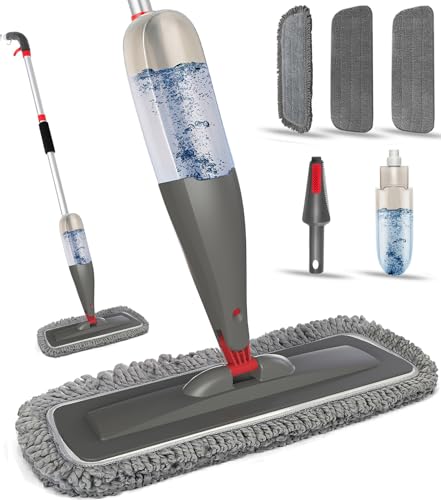
800 mL Refillable Spray Mop replaces a bucket with a trigger-operated sprayer and an 800 mL refillable bottle, a different approach from the wet string and spin mops. It includes three reusable microfiber pads, and its swivel flat head is designed to reach around furniture and along baseboards. The bottle can hold a custom cleaning solution, while the trigger operates without batteries. This format may suit light, targeted cleaning on compatible hard floors; it is not presented specifically for concrete, and its flat-pad design is a different fit from a large string head for broad garage floors.
Bottom line: Choose it for targeted spray cleaning rather than broad concrete-floor mopping.
How to choose a mop for concrete floors
Concrete floors call for a mop that can handle the amount of grit and moisture in the space. For broad garage or utility-floor cleaning, a string mop is a straightforward choice because its loose strands cover uneven texture better than a small flat pad. For sealed indoor concrete, a microfiber spin mop or spray mop can offer more control over water. Sweep or vacuum grit first; abrasive particles dragged under a wet mop can scratch a sealer. If the floor is unsealed or absorbs water quickly, use a well-wrung head and work in small sections instead of leaving standing water.
Use the mop head and wringing style as the decision rule: choose a string head for rougher, larger areas, and a microfiber flat or spin head for smoother sealed floors where controlled dampness matters.
Concrete surface and water control
Sealed concrete is less absorbent than bare concrete, so the finish changes how wet a mop should be. A damp, well-wrung head is a sensible starting point for sealed floors; bare or porous concrete can darken temporarily as it absorbs water and may take longer to dry. Concrete floors also vary in texture: a smooth polished surface is easier for flat pads, while broom-finished or pitted areas can hold dirt beyond a flat pad’s reach.
Test a cleaning solution in an inconspicuous spot if the floor has a coating, and avoid acidic cleaners such as vinegar on cement-based surfaces because acids can etch concrete. Keep people off wet floors until they are dry; water and cleaning residue can make hard surfaces slippery.
String, spin, twist, and spray mop styles
String mops, spin mops, twist mops, and spray mops manage water differently. Cotton string heads offer loose strands that can reach textured areas, while microfiber heads are common on spin, twist, and flat spray systems. Spin buckets use a wringer mechanism, twist mops wring by turning the handle, and spray mops dispense solution from an onboard bottle. A larger reservoir reduces refill trips but adds liquid weight to the handle.
The table compares the practical tradeoff rather than claiming every style suits every concrete finish.
| Style | Water control | Most useful condition |
|---|---|---|
| String | Separate rinse and wring | Large or textured areas |
| Spin bucket | Pedal-controlled wringing | Indoor floors needing rinsing |
| Twist | Hand-twist wringing | When keeping hands dry matters |
| Spray flat mop | Trigger-dosed solution | Light spot cleaning on smooth floors |
Cleaning and caring for mop heads
Rinse a mop head when it looks visibly dirty or stops picking up soil; a loaded head can redistribute grit instead of removing it. Wash reusable microfiber and cotton heads separately from lint-producing laundry when possible, and let them dry fully before storage to reduce odor and mildew. Do not use fabric softener on microfiber because residue can reduce its ability to absorb water and trap dirt.
For heavy garage soil, use a clean rinse bucket or change the water when it turns muddy. A mop head used on oil, automotive fluids, or other hazardous spills should not go back into routine household cleaning; handle those materials according to the product’s safety guidance.
Frequently Asked Questions
Can you use a microfiber mop on concrete floors?
Yes, microfiber mops can clean smooth sealed concrete when used damp rather than soaking wet. Textured or pitted concrete may be easier to reach with a string head.
How wet should a mop be on sealed concrete?
Use a well-wrung, damp mop on sealed concrete so water does not pool on the finish. Work in small sections and let the floor dry before walking across it.
Should concrete be swept before mopping?
Yes, remove loose grit before wet mopping because particles can scratch a sealer when dragged across the surface. A dust mop, broom, or vacuum can remove debris first.
Can vinegar be used to mop a concrete floor?
Avoid vinegar on cement-based concrete because its acidity can etch the surface. If the floor has a sealer, test a compatible cleaner in an inconspicuous area before full use.
How often should a concrete mop head be washed?
Wash reusable mop heads after they become visibly soiled or stop picking up dirt, and dry them fully before storage. A mop used for garage spills should stay separate from routine indoor cleaning.