
Ravinte Cabinet Hardware: 3 Styles Compared by Fit

Ravinte Square Bar Pulls, 5-Inch Centers is the best fit for most replacements when existing holes are 5 inches apart, because its center spacing matches that measurement. Choose Ravinte Round T-Bar Pulls, 3-Inch Centers for 3-inch spacing or Ravinte Brushed Nickel Round Knobs if you want knobs rather than a bar pull.
Cabinet hardware includes pulls and knobs used to open doors and drawers; matching the existing hole spacing can avoid drilling new holes.
We earn a commission if you buy through links on this page. As an Amazon Associate I earn from qualifying purchases. Products are compared on manufacturer specifications, not hands-on testing.
- Best overall: Ravinte Square Bar Pulls, 5-Inch Centers – Its 5-inch hole centers suit cabinets already drilled at that spacing.
- Best for 3-inch spacing: Ravinte Round T-Bar Pulls, 3-Inch Centers – The round T-bar pull has 3-inch hole centers and comes in a 30-pack.
- Best for knob style: Ravinte Brushed Nickel Round Knobs – The round brushed-nickel knobs offer an alternative to bar pulls.
| Product | Best for | Hole spacing | Finish | Shop |
|---|---|---|---|---|
| Ravinte Square Bar Pulls, 5-Inch Centers | 5-inch replacements | 5 in | Matte black | Check Price on Amazon |
| Ravinte Round T-Bar Pulls, 3-Inch Centers | 3-inch replacements | 3 in | Matte black | Check Price on Amazon |
| Ravinte Brushed Nickel Round Knobs | Round knob style | — | Brushed nickel | Check Price on Amazon |
Ravinte Cabinet Hardware Compared
Match the hardware shape and hole spacing to the cabinet doors or drawers you plan to update.
Ravinte Square Bar Pulls, 5-Inch Centers
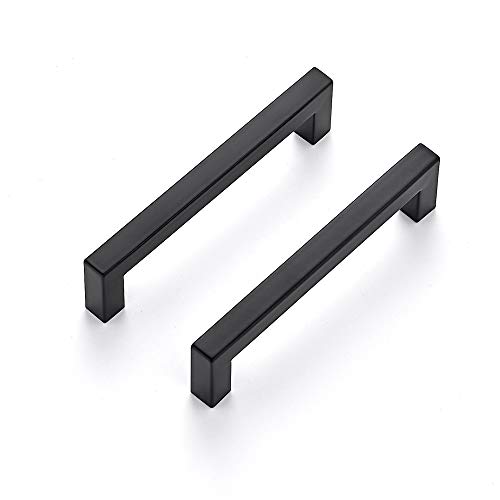
For an existing 5-inch hole pattern, this square bar pull gives a direct spacing match among these Ravinte options. The set has 30 stainless-steel pulls, and the maker gives an overall length of 5-1/2 inches, a 1/2-inch width and a 1-2/5-inch projection. Brand says screws are included and calls the installation easy.
The straight, square profile suits buyers seeking a bar grip in matte black. Its limitation is the fixed 5-inch center spacing: it will not align with 3-inch holes without drilling or using another approach. Measure center to center before choosing it.
Bottom line: Choose this when your current mounting holes are 5 inches apart and you want square bar pulls.
Ravinte Round T-Bar Pulls, 3-Inch Centers
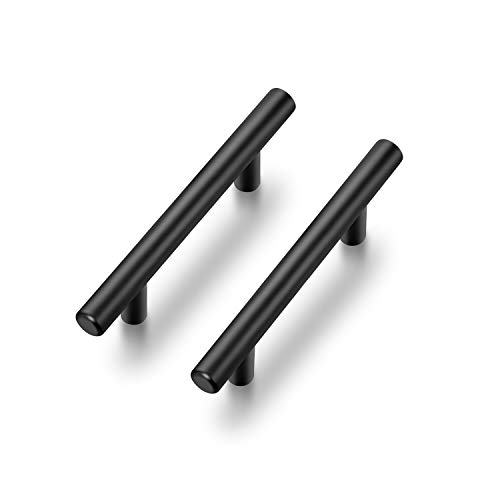
This Ravinte set is the option for a 3-inch center-to-center hole pattern, rather than the 5-inch spacing of Ravinte Square Bar Pulls, 5-Inch Centers. It includes 30 stainless-steel pulls with a round T-bar shape and matte-black finish. The measurements give an overall length of about 5 inches, so the visible pull extends beyond its mounting points.
Choose it for drawers or doors already drilled 3 inches apart and for a rounded profile. The key limitation is that its holes do not match a 5-inch pattern; measuring before replacing hardware helps avoid misaligned screws or extra drilling. Brand offers a 365-day evaluation period.
Bottom line: Pick this for existing 3-inch holes and a round T-bar shape.
Ravinte Brushed Nickel Round Knobs

Unlike the bar pulls, these Ravinte pieces are individual round knobs, making them the shape choice for cabinet doors or drawers where a single mounting point is preferred. Each knob has a 1-1/4-inch diameter, a 3/4-inch base and a 7/8-inch height. The 30-pack includes a 1-inch screw and a 1.57-inch screw per knob.
The brushed-nickel finish gives this set a different look from the matte-black pulls. Knobs use one mounting hole, so they cannot directly replace a two-hole pull unless you address the unused hole. Choose them when a knob profile and finish suit the cabinet better than a bar.
Bottom line: Choose these when you want round knobs and can use a single mounting point.
How to Measure Ravinte Cabinet Hardware
Measure cabinet pulls from the center of one screw hole to the center of the next; that center-to-center distance, not the pull’s full length, determines whether a replacement fits. Common pull spacings include 3 inches and 5 inches, while overall length extends beyond the mounting points. For example, a pull with 5-inch centers can measure 5-1/2 inches end to end.
Before removing old hardware, measure across the centers of the existing holes and record the result. If the measurement is under 4 inches, a 5-inch-center pull will not align without drilling or another change. A paper template can help transfer two-hole spacing accurately, and a level helps keep multiple pulls aligned across a drawer bank.
Match spacing before style
| Existing mounting pattern | Practical choice |
|---|---|
| Two holes 3 inches apart | 3-inch-center pull |
| Two holes 5 inches apart | 5-inch-center pull |
| One hole | Single-screw knob |
Pulls and Knobs for Cabinet Doors and Drawers
Bar pulls attach at two points, while a cabinet knob usually attaches through one screw hole. That difference matters during a refresh: replacing a two-hole pull with a knob leaves one hole unused, and replacing a knob with a pull requires a second mounting point. Pulls can be easier to grasp with several fingers, while knobs take up less horizontal space on a narrow door or drawer front.
Check the cabinet face dimensions and neighboring doors before choosing a projection or shape. Hardware that extends too far can catch on adjacent doors or interfere with a nearby wall; a pull’s projection is the distance it stands out from the cabinet surface. For a row of drawers, consistent placement and a template help keep each two-hole pull level and evenly positioned.
Cabinet Hardware Finishes and Materials
Matte black and brushed nickel create different visual contrasts, so compare the finish with nearby faucets, hinges and appliance trim rather than treating either color as universally compatible. Stainless steel and zinc alloy are common hardware materials; the material and finish affect appearance and the care approach. A damp soft cloth is generally suitable for routine dust and fingerprints, while abrasive pads can scratch metal finishes.
Kitchen pulls are handled frequently and may collect grease near cooking areas, so wipe them with mild soap and water as needed and dry them afterward. Avoid assuming every finish tolerates strong cleaners: test a cleaner on an inconspicuous area or use the hardware maker’s care directions. For mixed metals, repeating one finish in several locations usually looks more deliberate than adding many unrelated tones.
Installing Cabinet Pulls Without Misaligned Holes
Accurate drilling starts with measuring twice and marking the centers before making holes. A common cabinet pull template has guide marks for standard spacings such as 3 inches and 5 inches; verify the actual template measurement rather than relying on its label. Use a drill bit sized for the screw shank, and keep the drill square to the cabinet face to reduce the chance of angled holes.
Place a scrap board behind a door or drawer front when drilling through to help limit tear-out on the back surface. Tighten mounting screws snugly, not excessively, because overtightening can damage the cabinet face or hardware. If the existing holes differ from the replacement spacing, pause before drilling: confirm the new layout clears edges, drawer interiors and nearby hardware, then decide whether filling and redrilling is appropriate.
Frequently Asked Questions
How do I measure cabinet pull hole spacing?
Measure from the center of one screw hole to the center of the other, in inches. Do not use the pull’s end-to-end length; common center measurements include 3 inches and 5 inches.
Can I replace a cabinet pull with a knob?
A knob typically uses one mounting screw, while a pull uses two. A knob will not cover both holes of a two-hole pull, so account for the unused hole before making the switch.
Are cabinet pulls measured by total length?
Replacement compatibility is determined by center-to-center spacing, not total length. A pull with 5-inch centers can have an overall length greater than 5 inches.
What if the new cabinet pull holes do not line up?
Do not force screws into misaligned holes. Recheck the center-to-center measurement; if it differs, choose hardware with a matching spacing or plan how to fill or redrill before installation.