
Best 5G Sub Micro Servo Picks by Fit and Features

For most buyers, P0050 5g Analog Servo is the best 5g sub micro servo because it gives specific torque and speed ratings at two voltages. Choose NEEBRC 5G Servo, 4-Pack if compact dimensions matter more, or GOTECK GS5010MG 5g Digital Servo if you want metal gears; check that the servo’s mounting dimensions and control connection match your model.
A sub-micro servo is a small actuator that turns a control horn to move a surface or linkage.
We earn a commission if you buy through links on this page. As an Amazon Associate I earn from qualifying purchases. Products are compared on manufacturer specifications, not hands-on testing.
- Best overall: P0050 5g Analog Servo – Lists torque and speed at both 4.8V and 6.0V.
- Best for compact fit: NEEBRC 5G Servo, 4-Pack – Gives dimensions of 16.7 × 8.2 × 17 mm.
- Best for metal gears: GOTECK GS5010MG 5g Digital Servo – Uses a full-metal gear train.
| Product | Best for | Gear type | Shop |
|---|---|---|---|
| P0050 5g Analog Servo | Rated output | Plastic | Check Price on Amazon |
| NEEBRC 5G Servo, 4-Pack | Compact dimensions | Plastic (name); metal (features) | Check Price on Amazon |
| GOTECK GS5010MG 5g Digital Servo | Metal gears | Full metal | Check Price on Amazon |
5G Sub Micro Servos
Compare the servos by gear construction, stated output and package dimensions before choosing one for your model.
P0050 5g Analog Servo

P0050 5g Analog Servo stands out for publishing torque and speed ratings at both 4.8V and 6.0V, making it easier to compare output at a known supply voltage. It is a 5g analog servo with a coreless motor and plastic gears, suited to lightweight RC airplane, car and DIY robot projects where the output meets the linkage load. The torque is 0.8 kg-cm at 4.8V and 1.0 kg-cm at 6.0V; speed is 0.10 sec/60° and 0.08 sec/60° at those respective voltages. Its limitation is that the compact size is not accompanied by package dimensions, so confirm the mounting fit before ordering.
Bottom line: Pick this if you want published torque and speed ratings at two voltages.
NEEBRC 5G Servo, 4-Pack
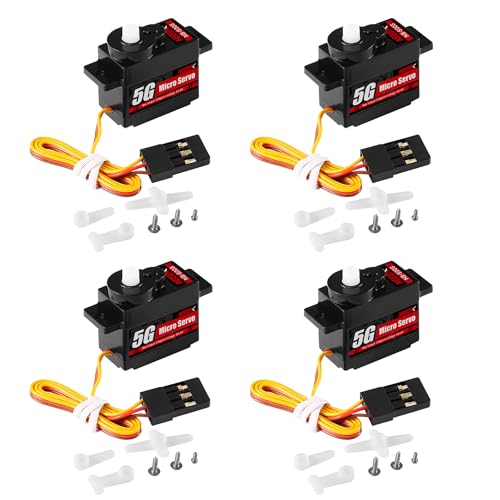
NEEBRC 5G Servo, 4-Pack is the fit-focused choice: its package measures 16.7 × 8.2 × 17 mm, useful when a small airframe or car has limited servo bay space. The set contains four 5g micro servos and is presented for small RC cars, fixed-wing aircraft and robot-arm projects. The gear material is unclear because the product name identifies plastic gears while its maker refers to metal gears, so verify that point if gear material is important to your build. No torque or speed rating is provided in the specifications, which makes this a harder choice for a loaded control surface than a model with published output figures.
Bottom line: Choose it when its dimensions suit a tight servo bay.
GOTECK GS5010MG 5g Digital Servo

GOTECK GS5010MG 5g Digital Servo is the metal-gear choice among these 5g servos, with a full-metal gear train and digital control. Its package measures 21.3 × 11.5 × 20.6 mm, so compare those dimensions with the available mounting space rather than assuming every 5g servo shares the same footprint. The maker says the servo reduces current and cuts power when locked-rotor time and current exceed preset limits. It is aimed at small aircraft, drones, toys and RC vehicles.
Bottom line: Choose it if full-metal gears matter and the larger dimensions fit.
How to Choose a 5G Sub Micro Servo
Start with the load and movement required by the linkage, then compare torque and speed at the voltage your receiver supplies. Torque describes the turning force at the output shaft; a heavier control surface or longer horn increases the load the servo must handle. Speed is commonly written as seconds per 60 degrees, so a lower number means faster travel over that angle. A rating at 6.0V cannot be compared directly with one at 4.8V without accounting for the voltage difference. If the model provides no output requirement, compare like-for-like servos only after confirming operating voltage and control travel in the model documentation.
Also compare mass, gear material and mounting footprint. A 5g label does not guarantee matching case dimensions, output-spline fit or horn geometry. Leave room for the case and wire bend, and ensure the servo horn clears surrounding structure throughout its full travel.
Servo Dimensions and Mounting Fit
Match the case length, width and height to the servo bay; even a few millimeters can prevent a clean fit in a small airframe. Measure the opening and depth, then account for mounting tabs, screw heads, wiring and the horn’s sweep. Do not rely on the 5g size class alone: the three exact-match options here have different stated dimension information, and their mass category does not establish identical mounting geometry.
Before installation, confirm that the output spline accepts the intended horn and that the linkage reaches its endpoints without binding. A useful decision rule is to leave at least 1 mm of clearance around the servo case and moving horn where the design allows; any contact risks restricting travel. Keep the linkage close to 90 degrees to the servo arm at neutral for predictable geometry, then set endpoints to avoid forcing the servo against a hard stop.
Analog and Digital Servo Gear Types
Analog and digital describe control electronics, while plastic and metal describe the gear train; these are separate choices. Digital servos typically refresh motor corrections more frequently than analog designs, but actual response and electrical demand depend on the specific servo and its control signal. Gear material alone does not establish torque, precision or service life, so use published ratings for the task rather than assuming metal gears make a servo suitable for a heavier load.
This comparison includes a 5g analog servo with output ratings and a digital metal-gear option without a torque figure. In any installation, a stalled or binding servo can draw excessive current and overheat; set travel limits so the linkage moves freely at both ends.
Setting Up a 5G Servo Safely
Most hobby RC servos use a three-wire connection for power, ground and control signal, but connector shape and polarity must match the receiver. Do not guess the pin order from wire color alone; check the receiver and servo connection diagrams before applying power. A reversed connection or voltage above the servo’s supported range can damage electronics, while insufficient supply voltage can cause weak or erratic movement.
Secure the servo before powering the model, center it with the transmitter or a servo tester, and attach the horn near its neutral position. With the model restrained, move the control through its full range and watch for binding, buzzing or the horn touching structure. Stop if the motor continues straining at an endpoint. For aircraft, test control direction and free movement before flight; a jammed control linkage can compromise control.
Frequently Asked Questions
What does 5g mean on a sub micro servo?
The 5g label refers to the servo’s approximate mass class, not a guarantee of identical size or output. Compare case dimensions, mounting tabs and published torque before selecting a replacement.
How much torque does a 5g servo need?
Required torque depends on the control surface, linkage geometry and load, so there is no universal figure for every 5g installation. For the P0050, the rating is 0.8 kg-cm at 4.8V and 1.0 kg-cm at 6.0V; compare against the actual requirement at the same voltage.
Can a metal gear servo replace a plastic gear servo?
A metal-gear servo can replace a plastic-gear type only when its voltage, mounting dimensions, spline and travel suit the model. Measure the case and check the horn fit before changing gear types.
Why does a servo get hot when stationary?
A servo can heat up when it is stalled or continually pushing against a load or hard stop. Remove linkage binding, reduce endpoint travel and stop operation if the servo remains strained.
How do I check servo travel before installing it?
Power the servo from a compatible receiver or tester, center the output, then move it through the intended range while checking for interference. Keep at least 1 mm clearance around the case and moving horn where the installation permits.