
Bestway Above Ground Pool Heater: 4 Options Compared

The Bestway Solar-Powered Pool Heating Pad suits above-ground pool owners who want solar warming through their existing filter-pump circulation; the other Bestway product here is not a heater. If you need active heating or cooling, consider an electric heat pump instead, matching its rated capacity to your pool volume.
We earn a commission if you buy through links on this page. As an Amazon Associate I earn from qualifying purchases. Products are compared on manufacturer specifications, not hands-on testing.
- Best overall: Bestway Solar-Powered Pool Heating Pad – Bestway brand match; the pad uses sunlight and connects between a filter pump and the pool.
- Best for 110V heat-pump heating: 16000-BTU Above-Ground Pool Heat Pump – Rated for pools up to 5,000 gallons and provides heating and cooling modes.
- Best for larger 110V pools: Varpoolfaye 16,000-BTU Heat Pump – Rated for pools up to 5,500 gallons and has Wi-Fi control.
- Best for large pools: TURBRO Beluga B50V 50,000-BTU Heat Pump – Rated for pools up to 15,000 gallons and uses a 220–240V connection.
| Product | Best for | Heating method | Pool capacity | Voltage | Shop |
|---|---|---|---|---|---|
| Bestway Solar-Powered Pool Heating Pad | Solar pool warming | Solar pad | — | — | Check Price on Amazon |
| 16000-BTU Above-Ground Pool Heat Pump | Small heat pump pools | Electric heat pump | Up to 5,000 gallons | 110V | Check Price on Amazon |
| Varpoolfaye 16,000-BTU Heat Pump | Wi-Fi heat pump control | Electric heat pump | Up to 5,500 gallons | 110V | Check Price on Amazon |
| TURBRO Beluga B50V 50,000-BTU Heat Pump | Large pool heating | Inverter heat pump | Up to 15,000 gallons | 220–240V | Check Price on Amazon |
Bestway Above Ground Pool Heaters and Alternatives
Compare the solar pad with electric heat pumps by heating method, rated pool capacity and electrical requirements.
Bestway Solar-Powered Pool Heating Pad

Unlike the electric heat pumps here, the Bestway Solar-Powered Pool Heating Pad uses sunlight to warm water moving through the pad. One hose connects to a filter pump and the other returns water to the pool, so the setup depends on compatible circulation equipment. Bestway says the temperature increase depends on weather conditions; sunny exposure is therefore central to its role. The pad measures about 43.3 by 67.3 inches based on its metric dimensions. Choose it for gradual solar warming rather than precise, powered heating; buyers seeking heating independent of sunlight should consider a heat pump.
Bottom line: Choose this for solar warming with a compatible filter-pump circulation setup.
16000-BTU Above-Ground Pool Heat Pump

This heat pump is the only option here with a 5.5 COP, and it is sized for pools up to 5,000 gallons. Its product name gives a 16,000-BTU rating and 110V power; the maker says it can heat and cool. The maker says the heat setting spans 41–104°F and the cooling setting 41–83°F, with thermostat accuracy of ±2°F. This suits owners who want powered temperature control for a smaller pool. It is not a Bestway-branded product, and its gallon limit makes it a poor match for larger pools.
Bottom line: Choose this for a pool up to 5,000 gallons when you want powered heating and cooling.
Varpoolfaye 16,000-BTU Heat Pump
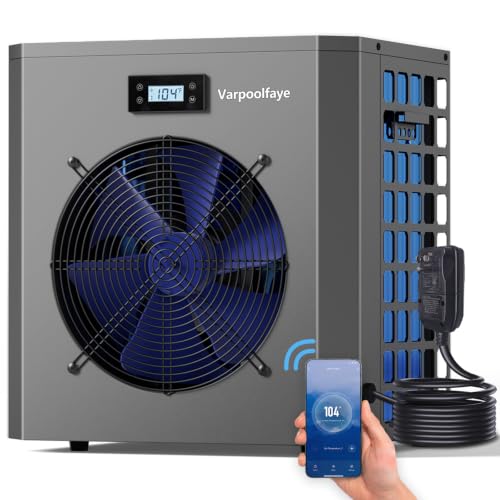
Compared with the other 110V heat pump, this model accommodates a pool rated up to 5,500 gallons and adds Wi-Fi control. Its product name gives a 16,000-BTU output and COP of 4.3; the maker describes heating and cooling modes and a titanium heat exchanger. The maker says heating reaches 104°F and cooling operates from 46–82°F. The size is 16.5 by 14.2 by 17.8 inches. Consider it when remote control matters and your pool falls within its capacity; it is a different brand from Bestway and still requires a powered heat pump setup.
Bottom line: Choose this when Wi-Fi control and a 5,500-gallon capacity fit your needs.
TURBRO Beluga B50V 50,000-BTU Heat Pump

The TURBRO Beluga B50V serves substantially larger pools than the other heat pump choices, with a capacity up to 15,000 gallons and a 220–240V supply. Its product name gives a 50,000-BTU rating; the maker describes an inverter compressor that adjusts heating power and Wi-Fi control. The maker also says capacity can reach 75,000 BTU and COP up to 16.2, so those are maximum claims rather than a single guaranteed operating point. This is a better fit for a large pool with appropriate electrical service, not a small above-ground setup; it is not a Bestway heater.
Bottom line: Choose this for a larger pool when its capacity and 220–240V supply match your setup.
How to choose an above-ground pool heater
Choose the heating method first: solar pads use sunlight and water circulation, while heat pumps use electricity to move heat from surrounding air into pool water. Then compare the heater’s maximum pool capacity with your pool’s volume in gallons; a unit rated for fewer gallons may struggle to keep up. Pool shape matters when estimating volume: for a rectangular pool, multiply length, width and average water depth in feet, then multiply by 7.5 for approximate gallons. For a round pool, use 5.9 times diameter squared times average depth in feet. If your estimate is near the heater’s limit, allow extra capacity rather than choosing a smaller rating.
Solar pads versus electric heat pumps
A solar pad warms circulating water through sun exposure, so its output changes with sunlight, shade and weather. An electric heat pump actively moves heat from air into pool water; its performance is affected by air temperature, pool size, wind and the temperature you want to maintain. The table summarizes the basic trade-offs; it is a starting point, not a promise of a particular temperature increase.
| Type | How it warms water | Key fit condition |
|---|---|---|
| Solar pad | Sunlight warms water circulated through the pad | Sun exposure and filter-pump compatibility |
| Heat pump | Electricity moves heat from air into pool water | Pool capacity and electrical supply |
For a shaded pool or one needing controlled temperature changes, an electric heat pump is generally the more suitable type; for a sunny pool where gradual warming is acceptable, a solar pad may be enough.
Match heater capacity to pool volume
Start with the pool’s actual water volume, not just its outside dimensions or label. Measure the average water depth, since the pool is rarely filled to its full wall height. For a rectangular pool, length × width × average depth in feet × 7.5 gives an approximate gallon figure; for a circular pool, diameter² × depth × 5.9 gives an estimate. Those formulas help compare volume with a heater’s rated gallon limit. A practical decision rule is to avoid any heater whose maximum is below your pool’s estimated volume. Wind, uncovered water and a large gap between current and target temperatures can increase the heating workload.
Electrical and circulation setup
Powered pool heaters need an electrical supply that matches the model: the heat pumps compared here call for either 110V or 220–240V. Pool water and electricity require careful installation; use a qualified electrician to confirm the circuit, grounding and local code requirements before connecting a powered heater. Solar pads do not generate heat without water flow, so verify that the filter pump’s hose connections match the pad and that the pump can circulate water through the added pathway. Do not run a pump dry or operate electrical equipment with wet connections. Leave the space around a heat pump open enough for air to circulate, rather than enclosing it tightly.
Frequently Asked Questions
How do I calculate my pool volume in gallons?
For a rectangular pool, multiply length, width and average water depth in feet, then multiply by 7.5. For a round pool, multiply diameter squared by depth in feet and by 5.9; these give approximate gallons.
Do solar pool heater pads work on cloudy days?
Solar pads rely on sunlight, so clouds and shade reduce the heat available to the water. They also need water circulating through the pad, so connect one between a compatible filter pump and the pool.
Can I use a heat pump with a small above-ground pool?
Yes, if the pool’s estimated volume is within the heater’s capacity and its electrical supply matches the unit. For example, a 5,000-gallon pool is within the capacity given for the 110V, 16,000-BTU option here.
Will a pool heater turn my pool into a hot tub?
A pool heat pump is meant to maintain pool temperatures, not necessarily produce hot-tub temperatures. The TURBRO maker specifically says its heater is not intended to turn a pool into a hot tub.