
Condensation Absorbers for Windows: 5 Options Compared

For broad sill coverage, 3-Roll Felt Window Absorber offers three 16.4-foot rolls, each 2 inches wide; choose a different option if your sill needs thinner tape or you want a single shorter strip.
Window condensation absorbers are absorbent strips placed where water gathers; they can catch droplets but do not remove the moisture source or prevent the glass from reaching its dew point.
We earn a commission if you buy through links on this page. As an Amazon Associate I earn from qualifying purchases. Products are compared on manufacturer specifications, not hands-on testing.
- Best overall: 3-Roll Felt Window Absorber – Three 16.4-foot rolls provide 49.2 feet total of 2-inch-wide felt strips.
- Best for thin tape: FuKuEn Gray Absorption Tape – The 1.18-inch-wide strip is only about 1/6 inch thick.
- Best for shorter spans: 3-Roll White Suede Strip – The 66-inch strip is 2.36 inches wide and has an adhesive backing claim.
| Product | Best for | Roll count | Width | Length | Shop |
|---|---|---|---|---|---|
| 3-Roll Felt Window Absorber | Wide roll coverage | 3 | 2 in | 16.4 ft each | Check Price on Amazon |
| FuKuEn Gray Absorption Tape | Thin sill profiles | 1 | 1.18 in | 157 in | Check Price on Amazon |
| 2-Roll Thick Felt Absorber | Cut-to-fit coverage | 2 | 2 in | 16.4 ft each | Check Price on Amazon |
| FuKuEn White 13-Foot Strip | Shorter thin strip | 1 | 1.18 in | 13 ft | Check Price on Amazon |
| 3-Roll White Suede Strip | Wide adhesive strip | 3 | 2.36 in | 66 in each | Check Price on Amazon |
Condensation Absorbers for Windows
Compare the strips by width, total coverage and the material or reuse features that fit your sill.
3-Roll Felt Window Absorber
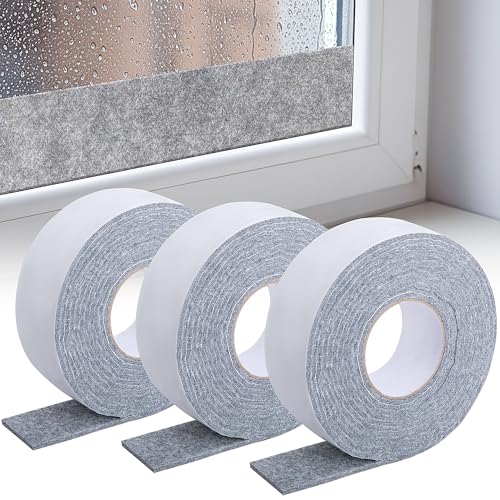
3-Roll Felt Window Absorber separates itself with three long felt rolls, giving buyers more continuous coverage than the shorter options. Each strip is 16.4 feet long, 2 inches wide and 5 millimeters thick, and the material is felt with non-woven fabric. The maker says the strips absorb window moisture and can be reused; they can also be trimmed to fit. This suits several windows or long sills. Its 2-inch width may be too broad for a narrow frame, and the text ends mid-feature, so do not assume an installation method beyond what is confirmed.
Bottom line: Choose it for multiple long sills that can accommodate a 2-inch strip.
FuKuEn Gray Absorption Tape
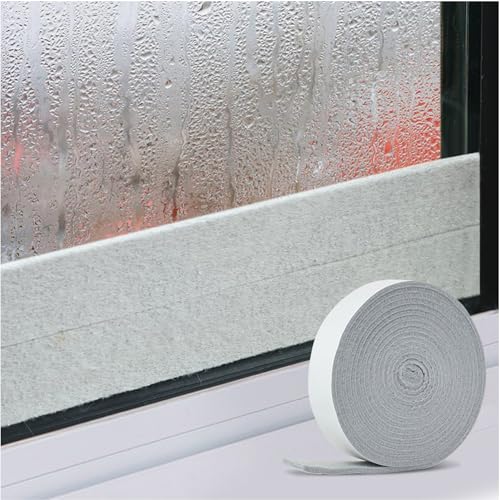
FuKuEn Gray Absorption Tape is the thinner profile in this group: its tape measures 1.18 inches wide and about 1/6 inch thick. The maker says the high-density non-woven material absorbs up to 1.4 ounces per foot, can be squeezed out and air-dried for reuse, and needs sunlight or temperature to dry quickly. The 157-inch length suits a moderate span without having to manage several wide rolls. Buyers who need broad coverage may prefer a 2-inch strip; the narrower width covers less sill width per row.
Bottom line: Pick it for a narrow sill and a thin, reusable tape profile.
2-Roll Thick Felt Absorber

2-Roll Thick Felt Absorber comes as two thick felt rolls, with the maker specifying 32.8 feet total and a 5-millimeter thickness. The 2-inch width and cut-to-fit format make it useful for two long windows or several shorter sill sections. The maker says the dense felt absorbs water and can be reused with proper maintenance. Compared with the three-roll option, it provides fewer rolls and less total length, which matters when covering many windows.
Bottom line: Choose it when two cut-to-fit felt rolls cover your sill plan.
FuKuEn White 13-Foot Strip

FuKuEn White 13-Foot Strip is a 13-foot white strip with the same 1.18-inch width and roughly 1/6-inch thickness as the longer thin tape option. The maker says its non-woven strip absorbs up to 1.4 ounces of condensation per foot, dries for reuse, and may be used around RV windows or AC vents as well as windows. The compact length can suit a single shorter span without leftover roll length. Because the width is narrow, heavy water collection may require more than one row according to the maker, so it may be a poor fit when broad coverage is the priority.
Bottom line: Pick it for a shorter span where a slim white strip fits.
3-Roll White Suede Strip

3-Roll White Suede Strip differs with a wider 2.36-inch strip and an adhesive backing claim, while each roll is 66 inches long. The maker says the non-woven suede absorbs 200 grams of water per 39 inches and can absorb and evaporate moisture repeatedly. Its shorter lengths can be easier to allocate across individual windows than one long roll, and the strip can be trimmed. It is a practical match for wider sills if the adhesive is suitable for the surface. It offers only 16.5 feet total across three rolls, less total length than the long-roll sets.
Bottom line: Choose it for wider sill coverage with shorter cut sections.
How to Choose a Window Condensation Absorber
Choose by the width of the sill, the length of the wet span and how often you can dry the strip. Absorbent tape catches liquid water; it does not lower indoor humidity or warm cold glass, so persistent droplets can return after the strip is saturated. Most homes are generally kept around 30% to 50% relative humidity, and condensation can form when humid indoor air meets glass below its dew point. A room hygrometer can help you distinguish a damp-room issue from a strip-capacity issue. Measure the sill and leave room for the sash to open and close. A strip wider than the usable ledge can obstruct the frame or hang over the edge.
Match Strip Width and Length to the Window
Measure the sill’s flat, usable width and the full run where droplets collect before choosing a roll. A 1.18-inch strip fits a narrower placement than 2-inch or 2.36-inch material, while thickness also matters where the sash or screen sits close to the sill. For two side-by-side windows with a combined 120-inch wet span, allow at least 120 inches of usable strip, plus any extra for trimming or overlap. Cut strips to the measured run rather than stretching them across gaps. Keep the strip clear of drainage paths, weep holes and moving hardware; covering these can trap water or interfere with window operation.
Absorbent Strips Versus Fixing the Moisture Source
Absorbent strips manage runoff, while ventilation and humidity control address conditions that produce window condensation. Bathrooms and kitchens can add moisture quickly, so use exhaust fans that vent outdoors and run them during moisture-producing activities. In cold weather, opening blinds or curtains can let room air circulate across the glass; sealed coverings can leave the window surface colder. A portable dehumidifier can help if indoor relative humidity stays above roughly 50%, though the right setting depends on the home and outdoor conditions. Treat a recurring wet sill as a clue to check humidity, airflow and leaks rather than relying on a strip alone.
| Need | Choice | Reason |
|---|---|---|
| Narrow placement | 1.18-inch strip | Takes less sill width |
| Broad coverage | 2-inch or 2.36-inch strip | Covers more width in one row |
| Several long windows | Long multi-roll set | Provides more total running length |
Drying and Reusing Condensation Strips
Dry a reusable strip fully between wet periods, because trapped moisture can remain against the sill and slow evaporation. Some of these makers say their materials can be reused after squeezing out excess water and air-drying; that does not mean a strip will work equally well when saturated. Inspect the sill when removing a wet strip, and dry standing water rather than covering it. A strip that stays damp or develops an odor needs cleaning or replacement according to its material and care directions. Keep strips away from window tracks and drainage openings, and avoid placing an absorbent material where it can block a route intended to drain water outside.
Frequently Asked Questions
Why do windows collect condensation indoors?
Indoor condensation forms when moist air contacts glass cooler than its dew point. Relative humidity, outdoor temperature, glass insulation and air circulation all affect how often it appears.
How can I reduce condensation without a strip?
Keep indoor relative humidity around 30% to 50% as conditions allow, and use kitchen or bathroom exhaust fans that vent outdoors. Improving airflow across the glass can also reduce cold, stagnant pockets of air.
Can condensation strips stop water damage?
A strip can catch some runoff, but it cannot guarantee protection if the strip saturates or water comes from a leak. Check the sill regularly and dry standing water instead of letting it remain covered.
Can I cut an absorbent strip to fit a window?
Several options here are described as trimmable, but use a clean cut and measure the full wet span first. Leave window tracks, weep holes and drainage paths unobstructed.
How often should a reusable strip be dried?
Dry a reusable strip whenever it becomes wet enough to remain damp, and do not leave saturated material against the sill. A frequently wet strip may signal that indoor humidity or airflow needs attention.