
Sigma 70-300mm f/4-5.6 DG Lens Mounts Compared

For a Nikon digital SLR, choose Sigma 70-300mm f/4-5.6 DG Macro for Nikon; for a Canon SLR, Sigma 70-300mm f/4-5.6 DG APO for Canon is the matching 70-300mm DG option, and the mount is the deciding difference. These are telephoto zoom lenses, meaning they frame distant subjects more tightly than a standard lens.
Choose Sigma 16-300mm f/3.5-6.7 DC OS for Sony E only if you use a Sony E-mount APS-C mirrorless camera and want a wider 16-300mm range; it is a different lens, not a 70-300mm DG model.
We earn a commission if you buy through links on this page. As an Amazon Associate I earn from qualifying purchases. Products are compared on manufacturer specifications, not hands-on testing.
- Best overall: Sigma 70-300mm f/4-5.6 DG Macro for Nikon – The Nikon-mount 70-300mm DG option fits the named lens family and specifies macro-mode close focus.
- Best for Canon SLRs: Sigma 70-300mm f/4-5.6 DG APO for Canon – This 70-300mm DG APO version is identified for Canon SLR cameras.
- Best for Sony E APS-C: Sigma 16-300mm f/3.5-6.7 DC OS for Sony E – Its 16-300mm range and Sony E APS-C fit suit mirrorless users seeking a wider zoom.
| Product | Best for | Camera fit | Focal length | Minimum focus | Shop |
|---|---|---|---|---|---|
| Sigma 70-300mm f/4-5.6 DG Macro for Nikon | Nikon digital SLRs | Nikon digital SLR | 70-300mm | 37.4 in macro mode | Check Price on Amazon |
| Sigma 70-300mm f/4-5.6 DG APO for Canon | Canon SLRs | Canon SLR | 70-300mm | 37.4 in | Check Price on Amazon |
| Sigma 16-300mm f/3.5-6.7 DC OS for Sony E | Sony E mirrorless | Sony E APS-C | 16-300mm | — | Check Price on Amazon |
Sigma 70-300mm f/4-5.6 DG Lens Options
Match the lens mount to your camera first, then compare the macro and optical-design differences.
Sigma 70-300mm f/4-5.6 DG Macro for Nikon

For Nikon digital SLR users, this renewed motorized telephoto zoom matches the 70-300mm f/4-5.6 DG family and includes a macro mode. Its optical construction uses 14 elements in 10 groups, with an angle of view ranging from 34.3 to 8.2 degrees. The macro-mode minimum focusing distance is 37.4 inches (95 cm); the other minimum is 59.1 inches (150 cm). Choose it if your camera uses the compatible Nikon mount and you want the macro-mode option. The f/4-5.6 aperture range is a limitation for dim scenes compared with a lens that opens wider.
Bottom line: Pick this if you use a compatible Nikon digital SLR and want the macro mode.
Sigma 70-300mm f/4-5.6 DG APO for Canon
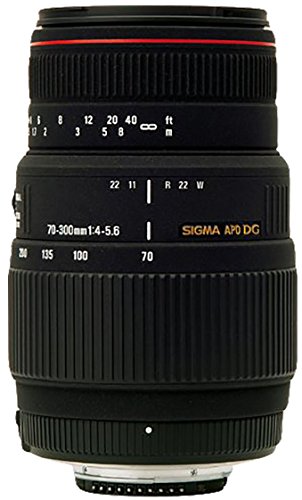
The APO designation and Canon SLR fit distinguish this 70-300mm DG option. It has 14 elements in 10 groups, and its minimum focusing distance is 37.4 inches at all zoom settings. Sigma says its multilayer coating and lens design reduce flare and ghosting, and identifies portraits, sports, and nature photography as uses. The Canon mount makes this the relevant choice among these two 70-300mm DG lenses for a compatible Canon SLR. Its minimum focus distance is still 37.4 inches, so it is not a substitute for a dedicated close-up lens when photographing very small subjects.
Bottom line: Choose this for a compatible Canon SLR when you want the APO variant.
Sigma 16-300mm f/3.5-6.7 DC OS for Sony E

This Sony E-mount APS-C mirrorless lens is the broad-range alternative, not a 70-300mm DG model: it starts at 16mm and reaches 300mm. Sigma says its HLA autofocus motor provides quick, smooth, accurate focusing, and the lens includes optical stabilization. The bundle also includes a hood, caps, pouch, filter kit, cleaning kit, and a four-year limited warranty. Choose it if a single lens spanning wide-angle through telephoto matters more than matching the requested model. It will not fit the Nikon or Canon SLR mounts identified for the other options.
Bottom line: Pick this only if you use Sony E APS-C and prefer its 16-300mm coverage.
How to choose a Sigma 70-300mm DG lens
Choose by camera mount before comparing optical features: the Nikon SLR option and Canon SLR option are not interchangeable. A lens must match the camera’s mount, and autofocus compatibility can also depend on the specific camera body, especially with older SLR systems. Confirm both mount and autofocus support for your exact camera before ordering. The 70-300mm range covers moderate telephoto through long telephoto framing; at 300mm, distant wildlife or field sports fill more of the frame than at 70mm. The variable f/4-5.6 maximum aperture gets smaller as the zoom extends, so available light and shutter speed matter more at the long end. For moving subjects, prioritize a shutter speed fast enough to limit motion blur rather than assuming a long lens alone will keep a shot sharp.
What the macro label means on a 70-300mm zoom
The macro label on a zoom does not by itself mean true 1:1 reproduction: that ratio records a subject at life size on the camera sensor, and close-focus distance alone cannot establish it. The Nikon option gives a macro-mode minimum focus figure of 37.4 inches (95 cm), while the Canon option specifies 37.4 inches at every zoom setting. Working distance is measured from the camera’s sensor plane, not from the front of the lens, so the subject will be closer than that distance to the lens front. For product or insect close-ups, compare maximum magnification as well as focus distance; if you need 1:1, choose a lens that explicitly states 1:1 magnification rather than relying on the macro name.
70-300mm zooms and a wider Sony E alternative
A 70-300mm lens starts at a telephoto focal length, while a 16-300mm zoom also reaches wide-angle framing. That broader range changes the use case, not just the model name. Use this chart to narrow the choice by camera fit and focal-length range.
| Option | Camera fit | Range | Choose when |
|---|---|---|---|
| Sigma 70-300mm f/4-5.6 DG Macro for Nikon | Nikon digital SLR | 70-300mm | You need the macro mode |
| Sigma 70-300mm f/4-5.6 DG APO for Canon | Canon SLR | 70-300mm | You want the APO version |
| Sigma 16-300mm f/3.5-6.7 DC OS for Sony E | Sony E APS-C mirrorless | 16-300mm | You need wider framing in one zoom |
APS-C sensors show a tighter field of view than full-frame sensors at the same focal length; common crop factors are about 1.5x for Nikon APS-C and 1.6x for Canon APS-C. The actual field of view depends on the camera sensor, so do not treat those crop factors as changes to the lens’s physical focal length.
Handling long-zoom photos
At 300mm, small camera movements are more visible, so a tripod or a sufficiently fast shutter can help keep stationary subjects sharp. A common handheld starting point is a shutter speed near 1/300 second at 300mm on a full-frame camera; a crop-sensor camera may call for a faster starting point, and subject motion can require much faster settings. Optical stabilization can reduce blur from camera shake, but it does not freeze a moving subject. The Sony E alternative includes optical stabilization; the 70-300mm entries here do not provide a stabilization specification. For sports or wildlife, use continuous autofocus when your camera supports it, and keep the active focus area on the subject rather than relying only on long reach.
Frequently Asked Questions
Will a Nikon 70-300mm lens fit a Canon SLR?
No; Nikon and Canon SLRs use different lens mounts. Match the mount to the exact camera body, and check body-specific autofocus compatibility before buying.
Does a 70-300mm macro zoom give true 1:1 magnification?
Not necessarily; the macro label and a close-focus distance do not establish 1:1 reproduction. Look for an explicit maximum-magnification ratio if life-size close-ups are essential.
What shutter speed helps at 300mm handheld?
About 1/300 second is a common starting point on a full-frame camera for reducing camera-shake blur with a stationary subject. Crop sensors, hand steadiness, and subject movement can call for faster speeds.
What does the APO label mean on this Sigma lens?
APO identifies the Canon option’s version designation, but the maker does not define its optical performance relative to the non-APO lens. Compare its mount and stated features to your camera and shooting needs.
Can I use a Sony E APS-C lens on a Nikon SLR?
No; the Sony E APS-C mirrorless lens is for a different mount and camera system. Choose a lens specifically compatible with the camera body’s mount.