
Conductive Grease for Electrical Connections: 3 Picks

For conductive grease for electrical connections, FOTU 570 suits the broadest range of uses here because its maker claims operation from -40°F to 392°F and names connectors, terminals, and switches. Choose a different paste if you need a carbon contact paste for low-voltage surfaces or copper paste for high-temperature metal joints.
Conductive grease is a paste intended to support electrical continuity at contact interfaces; dielectric grease instead insulates and protects around connections.
We earn a commission if you buy through links on this page. As an Amazon Associate I earn from qualifying purchases. Products are compared on manufacturer specifications, not hands-on testing.
- Best overall: FOTU 570 Conductive Grease – The maker claims a -40°F to 392°F operating range and names multiple electrical contact applications.
- Best for high-temperature metal joints: Hzutloer Copper Conductive Grease, 100 g – Its maker claims heat resistance up to 2,012°F and identifies copper powder as its conductive medium.
- Best for low-voltage contacts: Lubree Carbon Contact Paste, 100 mL – Carbon-based paste is designed for low-voltage mating and moving contact surfaces.
| Product | Best for | Conductive medium | Temperature capability | Package size | Shop |
|---|---|---|---|---|---|
| FOTU 570 Conductive Grease | General contact use | Not identified | -40°F to 392°F | — | Check Price on Amazon |
| Hzutloer Copper Conductive Grease, 100 g | Hot metal joints | Copper powder | Up to 2,012°F | 100 g | Check Price on Amazon |
| Lubree Carbon Contact Paste, 100 mL | Low-voltage contacts | Carbon | — | 100 mL | Check Price on Amazon |
Conductive Grease for Electrical Connections
Compare the conductive medium and intended contact type before choosing a paste.
FOTU 570 Conductive Grease

FOTU 570 stands out for the range of contact uses named by its maker: connectors, terminals, switches, circuit boards, and contact-friction components. The maker says it is designed to reduce contact resistance and operate from -40°F to 392°F, giving it the widest explicit temperature range among the options with a range supplied. Its applications make it a reasonable fit when one paste is needed across different electrical contact tasks. The limitation is that its conductive medium and package size are not identified here, so buyers who need a specific chemistry or quantity should choose a product that supplies those particulars.
Bottom line: Choose this for varied electrical contacts when its claimed temperature range fits your operating conditions.
Hzutloer Copper Conductive Grease, 100 g
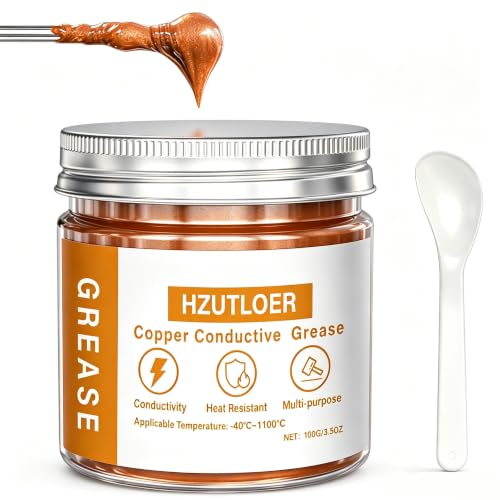
Hzutloer differs from the other conductive pastes by specifying copper powder as its conductive medium and claiming heat resistance up to 2,012°F. The 100 g package is also given by mass, which makes it straightforward to compare with other gram-labeled products. Its maker names battery connectors, electrical systems, and high-temperature metal components among its applications. The major limitation is the very high heat claim: it does not establish that the paste suits every connector, electronic assembly, or contact material. Match the paste to the equipment maker’s requirements, especially for delicate or low-voltage contacts.
Bottom line: Choose this for compatible metal joints where its copper composition and claimed heat range are relevant.
Lubree Carbon Contact Paste, 100 mL

Lubree is the specifically targeted option for low-voltage mating, moving, irregular, corroded, or pitted contact surfaces. Its maker identifies the paste as carbon-based and gives a volume resistivity of 20 Ω·cm, thermal conductivity of 0.5 W/mK, and viscosity above 50,000 cPs at 77°F. The 100 mL bottle is aimed at maintenance kits and repair benches. This specificity can help when the work involves contact interfaces under pressure rather than a general connector-protection task.
Bottom line: Choose this for low-voltage contact surfaces when carbon paste is suitable for the equipment.
How to choose conductive grease for electrical connections
Choose by contact design first, then by conductive medium and operating temperature. A conductive paste is not interchangeable with a dielectric sealant: conductive material belongs only where the connection design permits it, while dielectric grease is insulating. Contact pressure, surface material, and whether parts move all affect what formulation is suitable. For example, Lubree targets low-voltage contact interfaces, while the copper paste names metal joints and high-temperature uses. Avoid treating a maximum temperature claim as proof of compatibility with a particular connector. With delicate electronics or uncertain contact design, use only a paste expressly suited to that application and keep it away from adjacent conductors where bridging could create a short.
Conductive grease versus dielectric grease
Conductive grease is formulated to support continuity at a contact interface; dielectric grease is an electrical insulator commonly used to protect connection surroundings from moisture and contamination. That distinction matters most at mating surfaces: putting insulating grease between contacts can interfere with an intended conductive path, while conductive paste can create an unintended path if it spreads between neighboring conductors. The dielectric products are therefore not substitutes for conductive grease. Use dielectric grease only where the connection design calls for an insulating seal or protective coating, and follow the equipment maker’s placement guidance. Disconnect electrical power before servicing terminals, and avoid applying any paste to energized connections.
Match the paste to the contact and temperature
Match a paste to the contact material, voltage, mechanical motion, and the equipment’s temperature limits rather than selecting by the largest temperature number. Conductive formulations can use different media, such as carbon or copper, and their suitability is not universal across contacts. A temperature claim also describes only one part of compatibility; it does not establish electrical, chemical, or mechanical suitability for every assembly. If the contact is low voltage and moves or has pitting, choose a product intended for those interfaces. If the connection is a battery terminal or switch, confirm the equipment maker permits conductive paste there. For a contact exposed to heat, require the operating limit to cover the actual component temperature.
Apply conductive grease safely
Apply only a thin amount to the intended contact area, because excess paste can migrate into nearby terminals or insulating surfaces. Disconnect power before cleaning or servicing electrical contacts; a metal-filled conductive paste may bridge conductors if it gets where it should not. Clean oxidation and loose contamination using a method suitable for the component, then allow the surface to dry before reassembly. Avoid mixing different greases, since their carrier materials may not be compatible. In vehicle ignition or other high-voltage systems, do not assume a conductive paste is appropriate merely because it is intended for electrical connections; use the exact product type required for that component.
Frequently Asked Questions
Can conductive grease go between electrical contacts?
Only when the contact design and paste are intended for that placement. A conductive formulation can aid continuity at compatible interfaces, but material that bridges adjacent conductors can cause a short.
Is dielectric grease the same as conductive grease?
No. Dielectric grease is insulating, while conductive grease is intended to support electrical continuity at selected contacts. Keep dielectric grease out from between contacts unless the connection design specifically calls for it.
Should conductive grease be used on battery terminals?
Use it only if the battery connection design or equipment maker permits a conductive formulation. Disconnect the battery before servicing, and prevent paste from bridging neighboring terminals or conductors.
How much conductive grease should I apply?
Use a thin film only on the intended contact area; excess can migrate and bridge adjacent conductors. The required amount depends on the contact geometry and the paste’s intended application.
Can copper conductive grease be used on circuit boards?
Do not assume copper paste is suitable for a circuit board just because the maker names electronics among possible uses. Copper is conductive, so use it only where the board design explicitly permits conductive material and where it cannot bridge nearby traces.