
Le Creuset Risotto Pots: 5 Models Compared by Fit

Le Creuset Risotto Pot, 24 cm is the closest match for a Le Creuset risotto pot because it is explicitly identified as a risotto pot and measures 24 cm. Choose a different shape if you want a smaller rice pot, a deeper vessel for soup, or a pan designed for sauces.
Risotto is cooked by adding warm stock gradually to rice and stirring often; a broad cooking surface makes it easier to stir and monitor the grains.
We earn a commission if you buy through links on this page. As an Amazon Associate I earn from qualifying purchases. Products are compared on manufacturer specifications, not hands-on testing.
- Best overall: Le Creuset Risotto Pot, 24 cm – The only product explicitly named a risotto pot, with a 24 cm cast-iron body.
- Best for rice: Le Creuset Rice Pot, 2.1 qt. – A smaller 2.1-quart cast-iron pot comes with a stoneware insert.
- Best for soups: Le Creuset Chef’s Oven, 4.5 qt. – The 4.5-quart cast-iron Chef’s Oven offers more capacity for batch cooking.
| Product | Best for | Capacity | Material | Size | Shop |
|---|---|---|---|---|---|
| Le Creuset Risotto Pot, 24 cm | Risotto and stews | — | Enameled cast iron | 9.4 in. | Check Price on Amazon |
| Le Creuset Chef’s Oven, 4.5 qt. | Larger batches | 4.5 qt. | Enameled cast iron | 10.9 in. long | Check Price on Amazon |
| Le Creuset Petite Stockpot, 3.8 qt. | Boiling liquids | 3.8 qt. | Enamel on carbon steel | 8.9 in. long | Check Price on Amazon |
| Le Creuset Rice Pot, 2.1 qt. | Small rice batches | 2.1 qt. | Enameled cast iron | 9.1 in. long | Check Price on Amazon |
| Le Creuset Saucier, 2.25 qt. | Sauces and stirring | 2.25 qt. | Enameled cast iron | 8.8 in. long | Check Price on Amazon |
Le Creuset Risotto Pots and Alternatives
The risotto pot is the direct match; the other shapes suit different cooking tasks.
Le Creuset Risotto Pot, 24 cm

Unlike the other cookware here, this is explicitly identified as a risotto pot. Its 24 cm enameled cast-iron body is described as distributing and retaining heat from base to side walls, and its large handles are intended for lifting with oven gloves. The maker says it works on all cooker types, including induction, and in the oven; the enamel-coated lid has a heat-resistant stainless-steel knob. It can also be used for stews, soups, roasting, and baking bread. Its capacity is absent from the specifications, so confirm the capacity before ordering if batch size matters.
Bottom line: Pick this if you want the product explicitly made as a risotto pot and 24 cm suits your cooking surface.
Le Creuset Chef’s Oven, 4.5 qt.

The 4.5-quart Chef’s Oven has the largest capacity among these options, making it the choice for larger batches rather than a dedicated risotto shape. Its cast-iron body and tight-fitting lid are designed to retain heat and return moisture to the food. The light-colored smooth enamel interior makes it easier to monitor cooking progress, and the oven is compatible with all cooktops and oven-safe to 500°F. It is also dishwasher-safe and safe for metal utensils. Its deeper oven form is less tailored to stirring risotto than the 24 cm pot.
Bottom line: Choose this for a larger, covered pot that can handle soups and other batch cooking.
Le Creuset Petite Stockpot, 3.8 qt.

The petite stockpot is made for bringing liquids to a boil, not for the broad, shallow profile associated with a risotto pot. Its carbon-steel construction is described as responsive and lightweight, with heat retention to keep liquids warm. Porcelain enamel is non-reactive and nonporous, and a stainless-steel rim protects the top edge from chipping and cracking. It works on all cooktops. The 3.8-quart capacity suits liquids and smaller soup batches, but the specifications do not give an oven-safe rating, so confirm that capability if you need to finish a dish in the oven.
Bottom line: Choose this for boiling and holding liquids rather than frequent risotto stirring.
Le Creuset Rice Pot, 2.1 qt.

The 2.1-quart Rice Pot is the smaller, rice-focused alternative, and its included stoneware insert distinguishes it from the other vessels. Its enameled cast-iron body needs no seasoning and is compatible with all cooktops; the specifications give an oven-safe limit of 500°F, with lower limits for certain knob types. The black satin interior develops a patina over time. This pot suits a compact rice routine, but its smaller capacity and rice-pot design may not suit larger risotto portions. Confirm which knob version you have before using the pot in a hot oven.
Bottom line: Pick this for smaller rice batches when the included insert is useful.
Le Creuset Saucier, 2.25 qt.
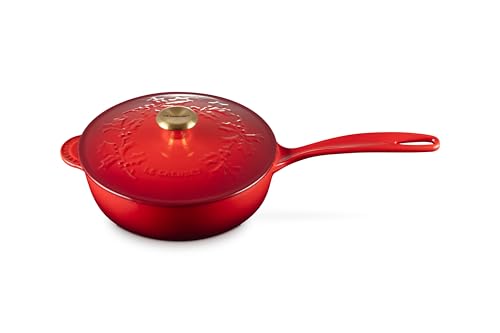
The 2.25-quart saucier is the most sauce-oriented alternative, with a curved cooking vessel suited to stirring rather than the risotto pot’s named use. Its enameled cast iron requires no seasoning, and the light-colored smooth interior helps monitor cooking progress. The tight-fitting lid is designed to circulate steam and return moisture to food. At 2.25 quarts, it is a smaller choice than the Chef’s Oven or petite stockpot, so it makes more sense for sauces or a modest portion than a large risotto batch.
Bottom line: Choose this for sauces and smaller portions that benefit from frequent stirring.
How to choose a Le Creuset risotto pot
Start with the shape and capacity that match your batch, then consider material and cooktop compatibility. Risotto is stirred frequently as warm stock is added in stages, so a vessel with enough room to stir without spilling is more practical than a narrow, nearly full pot. A broad base also gives rice more contact with the cooking surface. Among these options, only the 24 cm risotto pot is named for the dish; the 2.1-quart Rice Pot and 2.25-quart saucier are smaller alternatives, while the Chef’s Oven and stockpot hold more. As a rule, if your usual batch nearly fills a vessel before stirring, move to a larger capacity rather than relying on its nominal volume.
Risotto pot shape and heat management
A wide, relatively shallow pan makes it easier to stir rice evenly and see whether liquid remains around the grains. Enameled cast iron retains heat, so it can continue cooking briefly after the burner is lowered; reduce the heat if the rice is simmering too vigorously. Warm stock before adding it so each addition does not cool the rice mixture sharply. Stir regularly, especially after adding liquid, but do not assume constant vigorous stirring is required. For stovetop safety, lift rather than slide heavy cast iron across a glass cooktop, and use dry oven mitts with hot handles. The 24 cm model’s specifications identify it as suitable for induction and oven use.
Risotto pots compared with rice pots and stockpots
A risotto pot and a rice pot are not interchangeable by name alone: the risotto pot is the direct match for frequent stirring, while the rice pot is the smaller rice-focused option here. A stockpot prioritizes boiling and holding liquid, and a saucier is shaped for sauces. Match vessel size to the food volume and stirring room, not just the serving count.
| Cooking need | Shape to consider | Reason |
|---|---|---|
| Risotto with frequent stirring | Risotto pot | Directly intended for the dish |
| Smaller rice batch | Rice pot | Rice-focused pot with insert |
| Boiling liquid | Stockpot | Designed to bring liquids to a boil |
| Sauce or smaller stirred portion | Saucier | Sauce-oriented cooking shape |
Using and caring for enameled cast iron
Enameled cast iron does not need seasoning, unlike bare cast iron, but it still benefits from moderate heat and careful handling. Let a hot pot cool before washing to avoid a sudden temperature change, and avoid banging its rim against hard surfaces. The Chef’s Oven and Rice Pot specifications say they are dishwasher-safe; that does not establish dishwasher suitability for every other item in this comparison. The Rice Pot’s specified oven limit is 500°F, with lower limits for certain knobs, while the Chef’s Oven is specified to 500°F. Confirm the knob type and heat limit before putting the Rice Pot in the oven; use an oven mitt for all hot cookware.
Frequently Asked Questions
How much liquid does risotto usually need?
A common starting ratio is about 3 cups of stock for 1 cup of short-grain rice, added gradually as the rice absorbs it. The amount can change with rice variety, pan width, and desired texture, so keep extra warm stock available.
Should stock be warm when making risotto?
Yes, warm stock helps maintain a steady simmer when added to the rice. Keep it in a separate saucepan over low heat and add it in small pours rather than cooling the cooking pot with chilled liquid.
How often should risotto be stirred?
Stir regularly, especially after each addition of stock, to keep rice moving across the pan and release starch. A vigorous uninterrupted boil is not needed; lower the heat if the mixture bubbles hard.
Can enameled cast iron go on induction?
Enameled cast iron works on induction when the pot has a magnetic iron base and a flat contact area. The 24 cm risotto pot and the Rice Pot in this comparison are specified as compatible with induction or all cooktops.
Can a Le Creuset pot go from stovetop to oven?
Only use a pot in the oven within its temperature limit, and account for the knob as well as the body. The Chef’s Oven is specified to 500°F; the Rice Pot’s specified maximum is 500°F but certain knob types have lower limits.