
Belt Sander 1 Inch: 3 Models Compared by Fit

WEN 6515T 1 x 30-Inch Belt and Disc Sander suits most general shop users because its 1-by-30-inch belt shares a machine with a 5-inch disc. Choose VEVOR 550W 30 x 1-Inch Belt Grinder or VEVOR 550W 30 x 1-Inch VFD Grinder instead for variable-speed grinding or knife-making work, where speed control and grinder format matter more than a disc-sanding station.
We earn a commission if you buy through links on this page. As an Amazon Associate I earn from qualifying purchases. Products are compared on manufacturer specifications, not hands-on testing.
- Best overall: WEN 6515T 1 x 30-Inch Belt and Disc Sander – Pairs a 1-by-30-inch belt with a 5-inch disc for two sanding formats in one machine.
- Best for controlled metal grinding: VEVOR 550W 30 x 1-Inch Belt Grinder – Its VFD supports stepless speed adjustment and the belt speed is 26 meters per minute.
- Best for two grinding modes: VEVOR 550W 30 x 1-Inch VFD Grinder – Offers circular and flat grinding modes with a maximum belt speed of 21 meters per second.
| Product | Best for | Motor | Belt speed | Belt format | Shop |
|---|---|---|---|---|---|
| WEN 6515T 1 x 30-Inch Belt and Disc Sander | General shop sanding | 2.3A | 3,160 FPM | 1 x 30 in. | Check Price on Amazon |
| VEVOR 550W 30 x 1-Inch Belt Grinder | Variable-speed grinding | 550W | 85 FPM | 30 x 1 in. | Check Price on Amazon |
| VEVOR 550W 30 x 1-Inch VFD Grinder | Flexible grinding modes | 550W | 4,134 FPM max | 30 x 1 in. | Check Price on Amazon |
1-Inch Belt Sanders Compared
The key distinction is whether you need a stationary belt-and-disc station or a variable-speed grinder for narrower work.
WEN 6515T 1 x 30-Inch Belt and Disc Sander
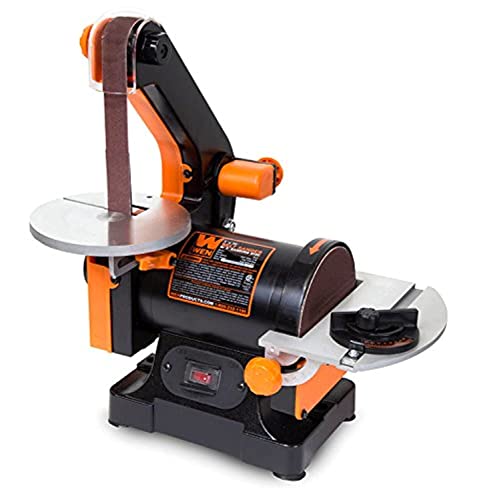
Unlike the two grinder-style options, this benchtop machine adds a 5-inch sanding disc alongside its 1-by-30-inch belt. WEN says its 2.3A motor runs the belt at up to 3,160 FPM and the disc at 3,450 RPM. The package includes an 80-grit disc, a 100-grit belt, a miter gauge, and two dust ports; its base is designed to resist walking and wobbling. It suits users who want both belt and disc sanding in one station. The fixed belt speed is a limitation for work requiring adjustable speed.
Bottom line: Choose this if you want a stationary 1-by-30-inch belt and a disc sander in one machine.
VEVOR 550W 30 x 1-Inch Belt Grinder

This grinder pairs a 30-by-1-inch belt with a VFD for stepless speed adjustment, distinguishing it from the fixed-speed benchtop combination machine. VEVOR says the 550W copper motor runs at 5,500 RPM and gives the belt a line speed of 26 meters per minute, or about 85 FPM. The included kit has three sanding belts and two grinding moulds, and the maker positions it for metalworking and knife making. It fits careful, lower-speed grinding tasks; the belt speed is far below the other two machines, so it is not the fit for users prioritizing fast material removal.
Bottom line: Choose this for VFD adjustment and lower belt speed on controlled grinding tasks.
VEVOR 550W 30 x 1-Inch VFD Grinder

This grinder stands apart with circular and flat grinding modes and support for vertical or horizontal use. VEVOR says its 550W brushless motor has stepless VFD adjustment from 200 to 5,000 RPM and a maximum belt speed of 21 meters per second, about 4,134 FPM. Three sanding belts are included. The mode options suit users switching between shaping and flat finishing in woodworking, knife making, or metalworking. The maximum speed is a ceiling, not a guaranteed working speed for every task, so users needing slow finishing should account for adjustment rather than run it at maximum.
Bottom line: Choose this if circular and flat grinding modes matter alongside variable speed.
How to Choose a 1-Inch Belt Sander
Choose the machine format before comparing motor power: a benchtop belt-and-disc sander handles general shaping and edge work, while a belt grinder favors controlled grinding on smaller parts. Belt speed changes how quickly abrasive removes material; slower speeds help limit heat on metal, while faster speeds suit more aggressive stock removal. A useful starting point is 80-grit for shaping, 120-grit for intermediate smoothing, and 220-grit for finer finishing, with the right progression depending on material and surface condition. For knife edges or thin stock, prioritize controllable speed and steady work support rather than choosing by maximum speed alone.
Check Belt Size and Replacement Compatibility
A belt marked 1 by 30 inches must match both the machine’s 1-inch width and 30-inch loop length; similar widths do not make different lengths interchangeable. Confirm the exact belt dimensions before buying abrasives, and check that the belt tracks centrally before sanding. Use the same grit progression across a project where possible, since jumping from coarse to fine abrasive can leave visible scratches. A belt grinder’s mounting and tracking arrangement also affects whether a belt stays aligned during work, so a belt that fits dimensionally still needs correct tracking adjustment.
Belt Speed, Material and Heat
Higher belt speed generally removes material faster but can build heat more quickly, especially on metal or a small workpiece. Variable-speed control is useful when a job calls for slower finishing or reduced heat, while a fixed-speed station is simpler for repeated general sanding. Keep the work moving and avoid pressing hard enough to stall or overheat the abrasive. Metal grinding can produce sparks; keep combustible material, dust collection debris, and flammable liquids away from the work area, and wear eye protection. Match abrasive type to the material and replace worn or damaged belts before they tear during use.
Common 1-Inch Sander Mistakes
The most common mistake is treating all 1-inch machines as interchangeable: a stationary combo sander and a grinder have different work orientations and capabilities. Another is selecting by maximum speed without considering heat, workpiece size, and the finish required. Confirm the belt size, mount the work securely, and keep fingers clear of the moving belt and pinch points. Never sand loose small parts by hand near a moving belt; use an appropriate fixture or hold the work with a secure method. For metal work, remove combustible dust and materials from the spark path before starting.
Frequently Asked Questions
What belt length fits a 1-inch belt sander?
The belt must match both the machine’s width and loop length; a 1-by-30-inch sander needs a 1-by-30-inch belt. A belt with the right width but a different loop length will not fit.
What grit should I use on a belt sander?
An 80-grit belt is a common starting point for shaping, 120 grit for intermediate smoothing, and 220 grit for finer finishing. Use a finer grit sequence when the material or finish requires less scratch depth.
Can a belt sander grind metal safely?
Yes, with an abrasive and machine suited to metal, eye protection, and control of sparks. Keep combustible dust, liquids, and materials out of the spark path because hot particles can ignite them.
Does variable speed matter on a 1-inch sander?
Variable speed helps when slowing down for precision finishing or to limit heat on metal and small parts. For repeated general sanding at one pace, a fixed-speed benchtop machine may be sufficient.
How do I keep a sanding belt tracking straight?
A belt should run centered on its rollers rather than drifting toward an edge. Check alignment before bringing work to the belt, and correct tracking according to the machine’s adjustment design.