
Best Dune Buggy Wheels and Tires for Different Fits

AlveyTech Razor Dune Buggy Front Wheels suits most Razor Dune Buggy owners because it is a complete 8-inch front wheel assembly with tire, tube, and bearings. Choose GOIMGN 200×50 Tire and Tube Set if you only need a tire-and-tube set, or look at larger wheel assemblies only when their size and mounting setup match your buggy.
Dune buggy wheels and tires must match the original tire dimensions, hub pattern, and steering position; tire diameter alone does not confirm fit.
We earn a commission if you buy through links on this page. As an Amazon Associate I earn from qualifying purchases. Products are compared on manufacturer specifications, not hands-on testing.
- Best overall: AlveyTech Razor Dune Buggy Front Wheels – Complete 8-inch front assemblies include the semi-knobby tires, tubes, and bearings.
- Best for tire-only replacement: GOIMGN 200×50 Tire and Tube Set – A 200×50 tire-and-tube set suits owners retaining compatible wheels.
- Best for larger wheel setups: CWTD 145/70-6 Front Wheel Assembly – The 145/70-6 pair includes tubeless tires, 6-inch rims, hubs, and steering knuckles.
| Product | Best for | Tire size | Included components | Wheel setup | Shop |
|---|---|---|---|---|---|
| AlveyTech Razor Dune Buggy Front Wheels | Razor front replacement | 200×50 (8 in) | 2 wheels, tires, tubes, bearings | Front wheel assemblies | Check Price on Amazon |
| GOIMGN 200×50 Tire and Tube Set | Tire and tube swap | 200×50 (8 x 2 in) | 2 tires, 2 tubes | Existing compatible wheels | Check Price on Amazon |
| CWTD 145/70-6 Front Wheel Assembly | Go-kart front setup | 145/70-6 | 2 tires, rims, hubs, knuckles | 6-in tubeless front | Check Price on Amazon |
| WPHMOTO 23×11-10 Wheel and Tire Set | Wide rear tire fit | 23×11-10 | 2 tires, aluminum rims | 7-in rims, 10-in tires | Check Price on Amazon |
| WPHMOTO 44-Inch Axle Kit with 16×8-7 Tires | Axle and tires | 16×8-7 (200/55-7) | Axle kit, 2 wheels, hubs, brake parts | 44-in axle, 7-in tires | Check Price on Amazon |
Dune Buggy Wheels and Tires Compared
Match the tire dimensions and mounting hardware to your buggy before choosing among these assemblies and replacement tires.
AlveyTech Razor Dune Buggy Front Wheels

For a Razor Dune Buggy front replacement, this set is the only option here that includes the complete wheel assembly with tire, inner tube, and 6000ZZ bearings. Each assembly uses an 8-inch 200×50 semi-knobby tire, making it a more direct choice than tire-only sets or larger go-kart wheels. The assembly dimensions are 9.2 inches long and wide and 6.7 inches high. Its fit is specifically described for the Razor Dune Buggy front; buyers working on a different model or the rear axle should confirm the original wheel dimensions and position first.
Bottom line: Choose this set for a compatible Razor Dune Buggy front wheel replacement.
GOIMGN 200×50 Tire and Tube Set

This 200×50 set replaces the tire and tube while leaving the existing wheel in place, unlike the complete assemblies. It includes two knobby outer tires and inner tubes, and the maker identifies compatibility with Razor RX200, Dune Buggy, Phase Two, Phase Two RDS, and other off-road scooters using the same specification. The outer tire uses a nylon-rubber composite and the tube is butyl rubber. This is not a wheel-and-bearing assembly, so choose it only when the current rims are sound and the 200×50 size and valve arrangement match.
Bottom line: Pick this set when the existing 200×50 wheels can be reused.
CWTD 145/70-6 Front Wheel Assembly

Among the larger front setups, this pair is distinguished by its included steering hardware: two tubeless 145/70-6 tires on 6-inch rims, 3-stud hubs, and left/right steering knuckles. The hub spacing is about 78 mm, with a 54 mm center hole and 17 mm spindle shaft. Those measurements make this a specialized replacement rather than a universal buggy wheel. Its use depends on matching the existing front hub pattern, spindle size, mounting position, and steering layout; it will not substitute for an 8-inch Razor wheel assembly.
Bottom line: Choose this only for a front setup matching its hub and spindle dimensions.
WPHMOTO 23×11-10 Wheel and Tire Set
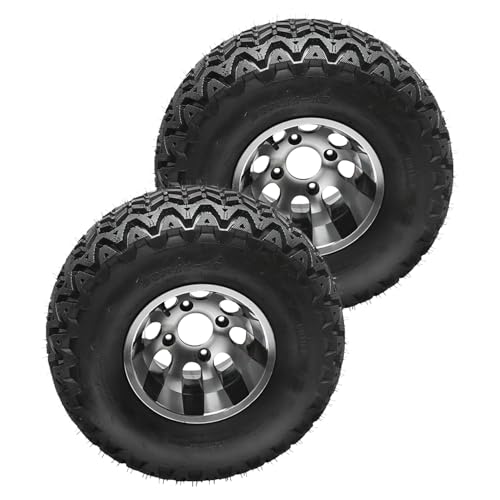
This set is the widest tire option here, with two 23×11-10 knobby tires pre-mounted on 7-inch aluminum rims. The maker gives a 909-pound load capacity at 12 PSI and describes an 8-ply construction for soft-terrain use. The tire size is intended for compatible ATV, UTV, go-kart, and dune buggy setups, but the 10-inch rim and mounting dimensions differ substantially from small Razor wheels. Check the buggy’s available clearance, rim diameter, center hole, and bolt spacing before selecting a large tire assembly.
Bottom line: Consider this for a compatible buggy built around 10-inch rims and wide tires.
WPHMOTO 44-Inch Axle Kit with 16×8-7 Tires

This package differs from wheel-only choices by combining a 44-inch axle kit with two 16×8-7 (200/55-7) tubeless tires, hubs, sprocket, brake disc, and pillow block bearings. The tire has a 4-ply rating, a 160-pound maximum load, and a 10 PSI operating pressure; it is not for highway service. The axle measures 44 inches overall, so this is a drivetrain and wheel conversion rather than a direct front wheel replacement. Verify axle width, frame mounting, brake and chain alignment, and wheel bolt pattern against the buggy before planning a fit.
Bottom line: Pick this for a compatible axle conversion requiring its included brake and chain components.
How to choose dune buggy wheels and tires
Start with the tire size molded on the existing sidewall, then match rim diameter and hub attachment. A 200×50 tire is an 8×2-inch format, while 145/70-6 and 16×8-7 use different rim diameters and cannot be swapped simply because both are off-road tires. A tire-only replacement requires a reusable rim and compatible tube or tubeless setup; a wheel assembly also needs the right hub, bearing, and steering arrangement. For a front replacement, match the steering spindle and mounting position; for an axle kit, match overall axle width and drivetrain connections. If you cannot identify the size, measure the tire and hub before ordering rather than estimating from vehicle appearance.
Wheel size, clearance, and mounting fit
Wheel fit has three independent checks: tire dimensions, rim diameter, and hub geometry. Tire width and overall diameter affect frame and fender clearance, while bolt spacing, center bore, and spindle size determine whether the wheel attaches correctly. A 78 mm bolt spacing does not mean every three-stud hub fits; center hole and stud count matter too. Use at least 1 inch of clearance around a tire through the full steering sweep and suspension travel as a practical starting point, then check for rubbing under load. Axle width must also suit the frame, and brake or chain parts must line up with their mounts. Confirm measurements on the buggy, not just its model name.
Complete wheels versus tire-and-tube sets
A tire-and-tube set is the narrowest repair: it keeps the rim, hub, and bearings, provided those parts remain usable and the tire dimensions match. A complete wheel assembly adds the rim and often bearings or hubs, reducing the number of parts that must be transferred. Axle kits go further by bundling wheel hardware with drivetrain or brake components, but they demand more measurements and installation work. Use this comparison to choose the scope of replacement.
| Replacement type | Best when | Fit checks |
|---|---|---|
| Tire and tube | Rim and hub can be reused | Tire size, tube, valve |
| Wheel assembly | Wheel or bearings need replacement | Rim diameter, hub, spindle |
| Axle kit | Axle and related parts are being changed | Axle width, brake, chain alignment |
Off-road tire pressure and load limits
Use the tire maker’s operating pressure and load limit as hard boundaries, not suggestions to exceed. The 16×8-7 tire specifies 10 PSI operating pressure and a 160-pound maximum load, while the 23×11-10 set gives a 909-pound capacity at 12 PSI; those figures apply to those tires, not all buggy tires. Low pressure can unseat a bead or damage a sidewall, and overloading increases heat and failure risk. Measure pressure with a gauge before each ride and inspect tread, sidewalls, bead seating, and fasteners. Keep tires marked not for highway service off public roads; off-road tires and small buggy wheels are not automatically road legal.
Frequently Asked Questions
How do I read a 200×50 buggy tire size?
A 200×50 marking indicates a nominal 200 mm outside diameter and 50 mm width, commonly expressed as 8×2 inches. Match the marking and rim format on the existing tire because visually similar small tires can use different bead dimensions.
Can I use a 10-inch rim on an 8-inch wheel setup?
No, a tire designed for a 10-inch rim does not mount on an 8-inch rim. Rim diameter must match exactly, and tire width and overall diameter must also clear the frame and steering.
How much clearance should a buggy tire have?
Use at least 1 inch around the tire as a practical starting clearance through steering and suspension movement. Wider tires need additional lateral room, and loaded suspension can reduce the gap.
When should I replace a buggy inner tube?
Replace a tube when it has a puncture, cracked rubber, damaged valve stem, or cannot hold pressure after the tire and rim are checked. A tube must match the tire’s size range and valve opening.
Are tubeless buggy tires safe to run at very low pressure?
No; pressure must stay within the tire maker’s limits because too little pressure can let the bead separate or damage the sidewall. Check pressure with a gauge before each ride and do not exceed the load rating.