
Best Walking Pad for Tall Person: 4 Models Compared

The MERACH UltraWalk W60 is the strongest starting point for most tall walkers because its 51.4-inch overall length is the longest here, though that measurement is not belt length. Tall walkers should choose another pad if a handrail or a confirmed longer walking surface matters more than an overall frame measurement.
A walking pad is a compact treadmill made mainly for walking, often under a desk. Check the actual usable belt length before buying; overall length cannot tell you how much room your stride has.
We earn a commission if you buy through links on this page. As an Amazon Associate I earn from qualifying purchases. Products are compared on manufacturer specifications, not hands-on testing.
- Best overall: MERACH UltraWalk W60 – Its 51.4-inch overall length is the longest measurement among these options, and it has 12 auto incline.
- Best for handrail support: LONTEK Incline Pad with Handrails – The model name specifies a handle bar and elevated dual handrails.
- Best for fixed incline: Cybergoing T10 Walking Pad – It combines a fixed 7% manual incline with a 15-by-36-inch belt.
| Product | Best for | Overall length | Weight capacity | Incline | Shop |
|---|---|---|---|---|---|
| MERACH UltraWalk W60 | Longer frame | 51.4 in | 400 lb | 12 auto levels | Check Price on Amazon |
| LONTEK Incline Pad with Handrails | Handrail support | 44.5 in | 350 lb | Flat, 10%, 15% | Check Price on Amazon |
| Cybergoing T10 Walking Pad | Fixed incline | — | 300 lb | Fixed 7% manual | Check Price on Amazon |
| Compact Under-Desk Walking Pad | Small spaces | 42.9 in | 264 lb | — | Check Price on Amazon |
Walking Pads for Tall People
Compare overall dimensions and listed features, then confirm belt length because frame length does not equal walking-surface length.
MERACH UltraWalk W60

Among these options, the MERACH UltraWalk W60 has the longest overall length at 51.4 inches, which gives tall shoppers a reason to investigate its fit first. It has 12 auto incline, an under-desk design, Bluetooth speaker, RGB light, and app support. The manufacturer says its capacity is 400 pounds, with a separate sustained 330-pound figure. That capacity does not establish that the walking surface suits a long stride. The belt length is the key limitation for tall walkers, so confirm the usable walking area before choosing it.
Bottom line: Choose this if you want the longest overall frame measurement here and will verify the belt dimensions.
LONTEK Incline Pad with Handrails
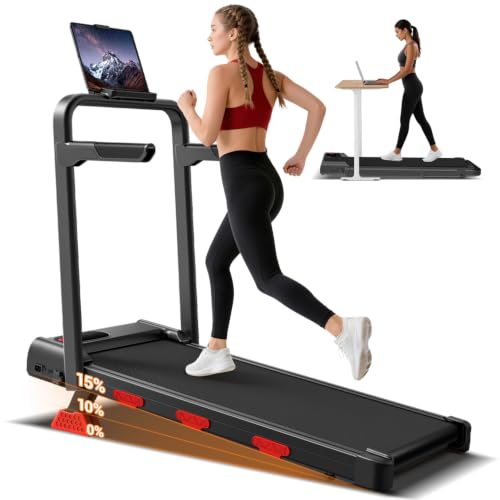
The LONTEK stands apart with a handle bar and elevated dual handrails, a useful distinction if you prefer support while walking. The model name gives a 350-pound capacity and speed ranges of 0.6–6.2 or 7.5 mph, while the maker describes manually configurable flat, 10%, and 15% inclines. Overall length is about 44.5 inches, but the walking belt dimension is not supplied. Tall users should not treat the frame length as stride room; verify belt length and whether the handrail arrangement suits your desk setup.
Bottom line: Pick this when handrails matter more than a confirmed long belt.
Cybergoing T10 Walking Pad
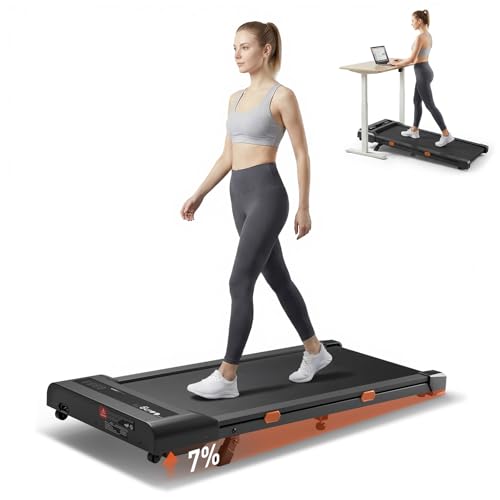
The Cybergoing T10 is the only option here with a specified 15-by-36-inch belt, making its usable surface easier to compare directly. The manufacturer says it has a fixed 7% manual incline, Bosch motor, app and remote control, and 300-pound capacity; maximum speed is 4 mph. A 36-inch belt length may be restrictive for a tall walker with a long stride, so this model is better considered when that measured surface works for your natural pace. Its compact, no-handrail format suits under-desk walking, not users seeking rails.
Bottom line: Choose it only if its 36-inch belt length accommodates your stride.
Compact Under-Desk Walking Pad

The compact under-desk pad prioritizes a small footprint: its dimensions convert to about 42.9 inches long, 19.7 inches wide, and 4.3 inches high. Its maker gives a 1–6 km/h range, equivalent to about 0.6–3.7 mph, and 264-pound capacity. Consider it when storage clearance is the leading constraint and verify the usable deck before committing to regular walking.
Bottom line: Pick this when compact storage takes priority and the belt fit checks out.
How to choose a walking pad for a tall person
Start with usable belt length, not the outside length of the treadmill. A long stride needs more fore-and-aft room, and a 51-inch frame may still have a shorter belt because the motor housing and end caps occupy space. Measure a comfortable walking stride on a level floor, then compare that number with the belt’s usable length; leave room for natural variation rather than walking heel-to-toe at the rear edge. Width also matters: a narrow belt leaves less side-to-side margin. If a seller provides only frame dimensions, request belt dimensions before purchasing. Do not infer a fit from a product name that says “for tall people.”
Walking pad dimensions and stride fit
Measure the area where the pad will sit and the walking surface separately. Frame height affects whether a pad can slide under a bed or desk, while frame length includes non-walking parts and does not establish stride room. Walk at your normal pace and note how much front-to-back space your steps use; compare that span with the belt, allowing a margin so ordinary steps stay centered. A 36-inch belt length is a concrete measurement, but only a user’s stride and comfort determine whether it works. For the pads with no belt measurement here, confirm the deck length and width before choosing by height.
Incline, speed, and support features
Incline changes walking effort without requiring a faster belt speed, but manual and automatic systems operate differently. A fixed or manually configured incline must be set on the machine, while an automatic incline changes under control; check that the levels match how you plan to use the pad. Handrails also change the footprint and desk arrangement, and they can provide a place to steady yourself while stepping on or off. Start at a slow pace, use a stable surface, and do not step onto a moving belt. For desk use, test the walking position and screen height separately so the belt does not force awkward posture.
Walking pad fit comparison
Use frame length only as a preliminary size clue; belt dimensions are the meaningful stride-fit measurement. This table separates known belt data from outside length so the two are not confused.
| Pad | Known size clue | What to confirm |
|---|---|---|
| MERACH UltraWalk W60 | 51.4-inch overall length | Usable belt length and width |
| LONTEK | 44.5-inch overall length | Usable belt length |
| Cybergoing T10 | 15-by-36-inch belt | Personal stride comfort |
| Compact walking pad | About 42.9-inch overall length | Usable belt length and width |
Frequently Asked Questions
Does a longer walking pad frame mean a longer belt?
No; overall frame length includes the motor housing and other non-walking sections. Compare the usable belt dimensions, and verify them when only the outside measurement is available.
How should a tall person check walking stride fit?
Measure the front-to-back span of a comfortable natural step and compare it with the belt’s usable length. Keep enough margin to stay centered instead of relying on frame length alone.
Can I use an incline walking pad under a desk?
Yes, if the desk provides clearance for the pad and your walking posture remains comfortable. Incline raises the front of the machine, so check the deck height and adjust desk height before walking.
Are walking pad handrails necessary for balance?
Handrails are a support feature, not a substitute for careful mounting or a stable walking pace. Step onto the stationary belt, start slowly, and use a clear area around the pad.
What speed is a walking pad measured in?
Walking pads commonly show speed in miles per hour in the United States; convert kilometers per hour by multiplying by about 0.62. For example, 6 km/h is about 3.7 mph.